Select Language:
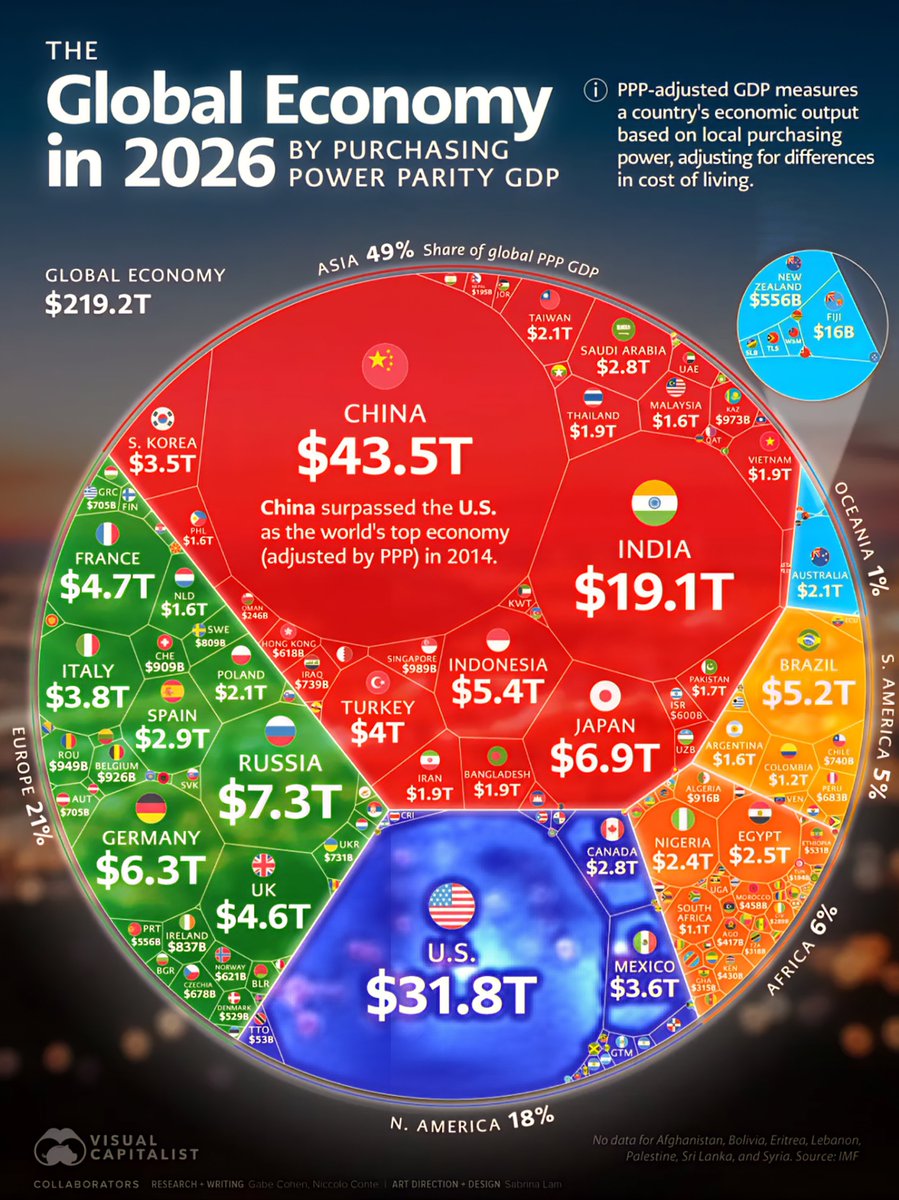
China Continues to Dominate the Global Economy
China retains its position as the world’s largest economy, boasting a staggering GDP of $43.49 trillion in 2026. Its growth over the years has been driven by a rapidly expanding manufacturing sector, technological innovation, and significant infrastructure investments. China’s economic resilience continues to shape global markets, influencing trade flows and investment patterns worldwide. Its influence is evident across emerging markets and developed nations alike, reinforcing its status as an economic powerhouse.
United States: The Largest Economy Among Western Nations
With a GDP of $31.82 trillion, the United States maintains its position as the dominant economy in the Western Hemisphere. The U.S. economy remains highly diversified, with leadership in technology, finance, healthcare, and entertainment sectors. Innovations in artificial intelligence, biotechnology, and clean energy are fueling growth. The nation’s resilient consumer base and robust financial markets continue to underpin its economic strength on the global stage.
India’s Rapid Economic Ascent
India has cemented its place as the third-largest economy with an impressive GDP of $19.14 trillion. The country’s economic trajectory is fueled by a booming tech industry, manufacturing expansion, and a burgeoning middle class. Infrastructure development, digitization, and government reforms are accelerating growth in sectors like e-commerce, telecommunications, and renewable energy. India’s demographic dividend remains a key driver of its economic future.
Russia and Japan: Veteran Economies in a Shifting Global Landscape
Russia, with a GDP of $7.34 trillion, sustains its global economic standing through energy exports, primarily oil and natural gas. The nation continues to adapt to geopolitical challenges and diversify its economy.
Japan, valued at $6.92 trillion, remains a technological and industrial leader. Despite demographic challenges, Japan remains influential in robotics, electronics, and automobile manufacturing, maintaining its position among the world’s top economies.
Germany and Indonesia: European Strength and Southeast Asia’s Rising Powerhouses
Germany holds firm at sixth place with a GDP of $6.32 trillion, leveraging its robust manufacturing sector, especially automobile production, and engineering. The country’s stability and innovation are critical to the Eurozone’s economic health.
Indonesia, ranked seventh with $5.36 trillion, is Southeast Asia’s economic leader. Its resource wealth, extensive population, and ongoing reforms are fueling rapid growth, making it a vital player in regional and global markets.
Brazil and France: Latin America’s Largest Economy and Europe’s Cultural Hub
Brazil, with a GDP of $5.16 trillion, continues to be a major Latin American economy, driven by agriculture, mining, and energy sectors. Political stability and infrastructural investments are pivotal to its future growth.
France, valued at $4.66 trillion, remains Europe’s economic and cultural leader. Its diversified economy, strong tourism sector, and technological innovation sustain its global influence.
The United Kingdom and Turkey: Key Players in Europe and Eurasia
The UK, with a GDP of $4.59 trillion, retains its significant financial services industry centered in London, alongside a resilient manufacturing sector. Post-Brexit adjustments are shaping its economic policies.
Turkey, valued at nearly $4 trillion, stands as an important bridge between Europe and Asia. Its emerging industries, especially in construction, manufacturing, and tourism, contribute to steady growth despite geopolitical complexities.
Italy and Mexico: American Continents’ Economic Pillars
Italy, with a GDP of $3.82 trillion, leverages its strong fashion, automotive, and tourism sectors. Infrastructure and innovation are crucial to overcoming economic challenges.
Mexico, at $3.55 trillion, continues to benefit from its proximity to the U.S. and trade agreements like USMCA. Manufacturing, especially automotive and electronics, drives its economy.
South Korea and Spain: Leading Asian and European Markets
South Korea remains a global leader in electronics, semiconductors, and automobiles, with a GDP of $3.49 trillion. Its technological advancements and innovation ecosystem are central to its economy.
Spain, with $2.94 trillion, benefits from a vibrant tourism industry and export-oriented manufacturing. Economic reforms are aiding recovery and stability.
Saudi Arabia and Canada: Energy Powerhouses and Natural Resources
Saudi Arabia, valued at $2.85 trillion, continues to be a pivotal player in global energy markets, shifting towards diversification with investments in renewable energy.
Canada, with a GDP of $2.81 trillion, maintains its strength in natural resources, including oil, minerals, and forestry, along with a growing technology sector.
Emerging Markets on the Rise
Egypt ($2.53 trillion), Nigeria ($2.39 trillion), and Poland ($2.12 trillion) exemplify emerging economies—focused on infrastructure development, urbanization, and diversified industries. Their expanding consumer markets and regional influence are noteworthy.
Technology and Innovation Leading the Future
Countries like Taiwan ($2.07 trillion), Australia ($2.06 trillion), and Vietnam ($1.94 trillion) are emerging as critical players in global supply chains, especially in electronics, mining, and manufacturing.
A Diverse Global Economic Landscape
European nations like Romania, Belgium, and Switzerland continue to anchor regional stability with GDPs ranging from $900 billion to over $900 billion.
Middle Eastern economies like the UAE and Qatar are also heavily invested in diversification and expanding their financial and tourism sectors, with GDPs surpassing the trillion-dollar mark.
The Significance of PPP in Global Rankings
These rankings are based on Purchasing Power Parity (PPP), emphasizing the relative strength of economies rather than nominal values, providing a more accurate reflection of living standards and economic power.
Note: Data derived from the International Monetary Fund (IMF) and Visual Capitalist’s Voronoi visualizations for 2025.
 ChatGPT
 Perplexity
 Gemini AI
 Grok AI