Select Language:
The Fascinating Geology Behind Canada’s Largest Lakes
1. Major Lakes Cluster Along a Glacial Arc
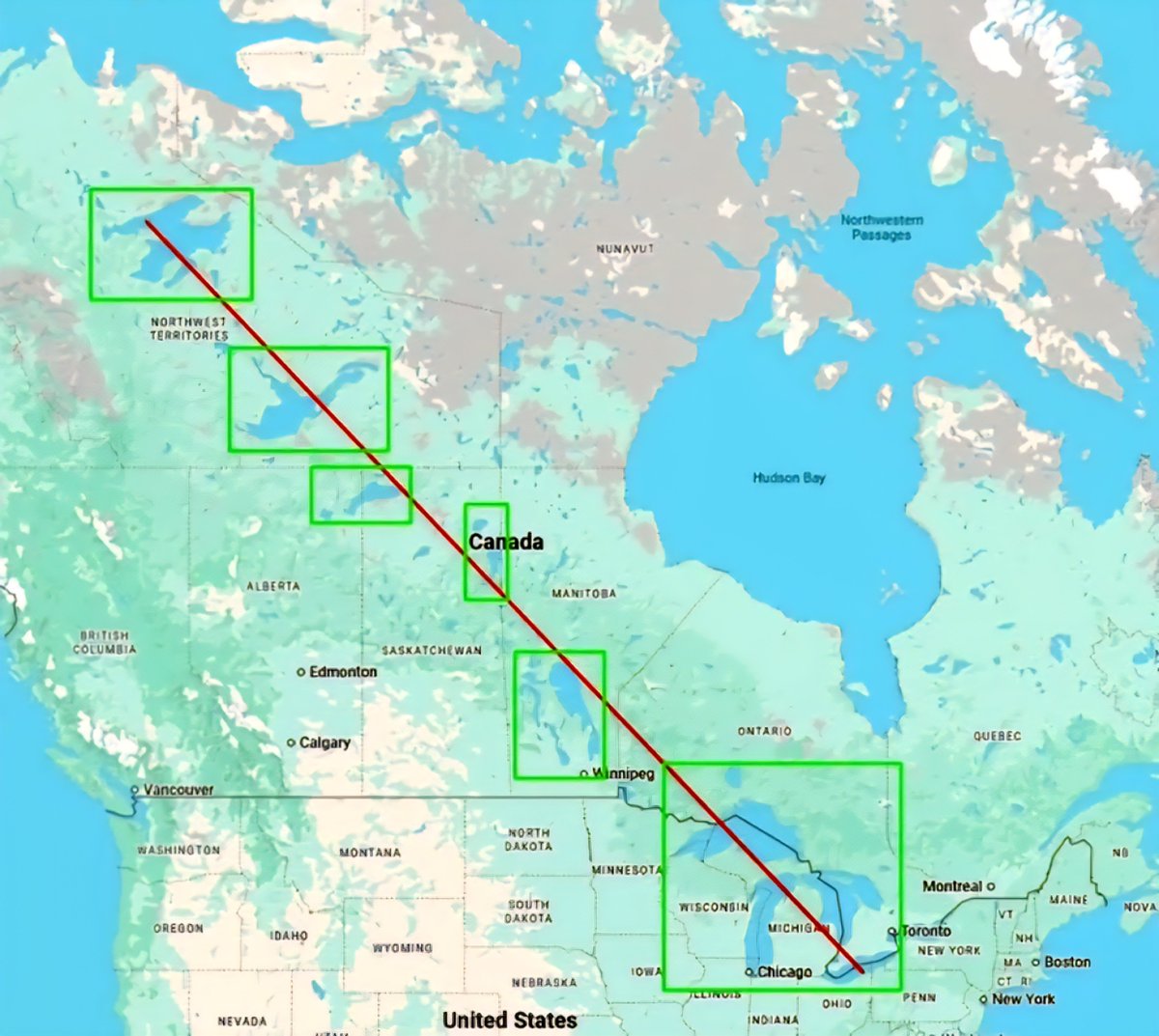
Most of Canada’s largest lakes, including Lake Superior, Lake Huron, Lake Michigan, Lake Erie, and Lake Ontario, are positioned along a distinct north-south line. This alignment is a direct result of glacial activity during the last Ice Age. The glaciers carved out deep basins in the Earth’s crust, leaving behind a string of massive lakes that are interconnected both geographically and geologically.
2. The Role of Glacial Movements and Erosion
During the last Ice Age, sprawling ice sheets covered much of North America. As they advanced and retreated over thousands of years, these glaciers eroded the land beneath them, creating depressions and valleys. When the glaciers receded, these depressions filled with meltwater, forming the Great Lakes. The linear pattern of these lakes can be traced back to the path of the moving glaciers, which followed specific lines of weakness in the Earth’s crust.
3. The Effect of Tectonic Activity
Tectonic forces also played a significant role in shaping the continent’s geology. The North American continent experienced various stresses that caused fractures and faults. These geological features provided pathways for glaciers to move along and also created basins that filled with water after glacial melting. The result: a series of large lakes lined up along fault lines and areas of crustal weakness.
4. The Formation of Basins and Land Depression
Many of these lakes occupy natural basins formed by tectonic rifting or by the heavy weight of overlying glaciers. When glaciers press down on the Earth’s crust, it can cause subsidence, or sinking of the land, which further deepens these basins. As glaciers melt away, these depressions act as perfect catchments for water, ensuring the lakes’ persistent existence.
5. The Connection Between Lakes and River Systems
The Great Lakes are interconnected through a complex network of rivers and channels, facilitating water flow from one to another. This network was also influenced by the glaciers’ path, which deepened valleys and created channels that now form the natural pathways of these water systems. The linear arrangement of these lakes ensures efficient drainage into the Atlantic Ocean via the Saint Lawrence River.
6. The Impact of Lake Formation on Ecology and Human Settlement
The positioning of these lakes along a line has significant ecological implications. The lakes support diverse ecosystems and act as vital transportation routes. Historically, Indigenous peoples and later European explorers and settlers used these waterways for trade, transportation, and settlement. Their linear distribution facilitated movement and trade across the region, shaping the development of modern Canada.
7. Ongoing Geological Processes
Even today, the landscape continues to be shaped by geological forces. Subtle shifts in tectonic activity and glacial rebound—where land slowly rises after being depressed by heavy ice—maintain the integrity and position of these lakes. The line where most of these lakes occur remains a prominent feature of Canada’s geological landscape.
8. Why This Matters for Climate and Environment
Understanding why these lakes are aligned helps scientists predict future changes in the region’s climate and environment. As climate change accelerates melting patterns, the water levels and ecological health of these lakes could be affected. Recognizing the geological history behind their arrangement provides crucial insights into managing and protecting this vital natural resource.
The linear distribution of Canada’s largest lakes is a remarkable illustration of how glaciers, tectonic activity, and land formations intertwine to shape the natural landscape we witness today. This pattern not only explains the lakes’ placement but also highlights the dynamic forces that continue to influence the environment around them.
 ChatGPT
 Perplexity
 Gemini AI
 Grok AI