
Select Language:
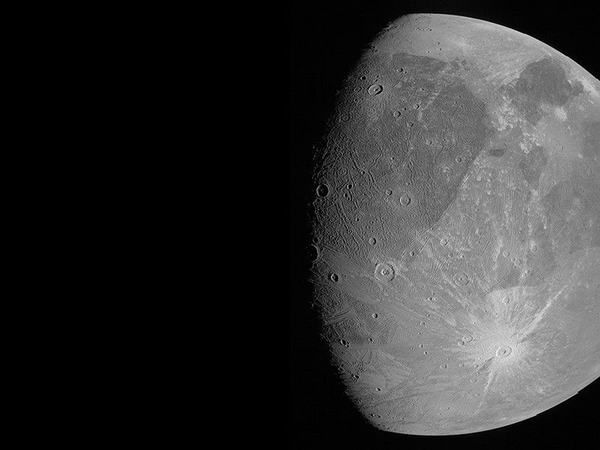
Ganymede, the largest moon in our solar system, measures over 3,200 miles across—larger than Mercury itself.
What sets Ganymede apart is that it is the only moon known to have its own magnetic field, which scientists think is generated by a hidden, flowing layer of liquid metal deep inside the moon.
A recent study by researchers at the California Institute of Technology proposes that Ganymede’s metal core might still be forming even billions of years after its initial formation.
Published in Science Advances, the study challenges conventional ideas of Ganymede’s development. Instead of forming with a hot, metal-rich core, the moon may have started off cold and gradually heated up over time.
Magnetic fields are typically produced by a process called a “dynamo,” where circulating liquid metal within a planet or moon generates magnetic energy. Earth, for example, has a magnetic field thanks to its partly molten iron core.
Previously, scientists believed Ganymede formed hot, with its metal core developing quickly after its birth around 4.5 billion years ago, and then cooling slowly over the eons. The movement of liquid metal inside was thought to sustain its magnetic field to this day.
However, new computer simulations suggest Ganymede may have initially been a cold mix of ice, rock, and metal. Over billions of years, heat from radioactive decay and internal processes might have gradually warmed the interior. This means its metal core could still be growing and evolving even now.
Lead researcher Kevin Trinh notes that this new perspective might explain why Ganymede has a magnetic field while similarly sized moons like Callisto do not. Both formed around Jupiter and are comparable in size and density, yet they behave quite differently beneath the surface.
This research could reshape our understanding of magnetic fields across the solar system. Many planets and moons, including Earth, Mercury, and even ancient Mars, have or once had planetary dynamos. The findings suggest some magnetic signatures might result not just from cooling cores, but from ongoing core formation.
Further insights are anticipated when the European Space Agency’s Jupiter Icy Moons Explorer (JUICE) mission arrives at Jupiter’s moons in 2031. Its mission is to gather detailed data about Ganymede’s magnetic environment and interior, which could shed light on whether the moon is still internally warming.
Source: California Institute of Technology.
 ChatGPT
 Perplexity
 Gemini AI
 Grok AI