Select Language:
The World’s Top Economies in 2026: An In-Depth Look at Global GDP Rankings
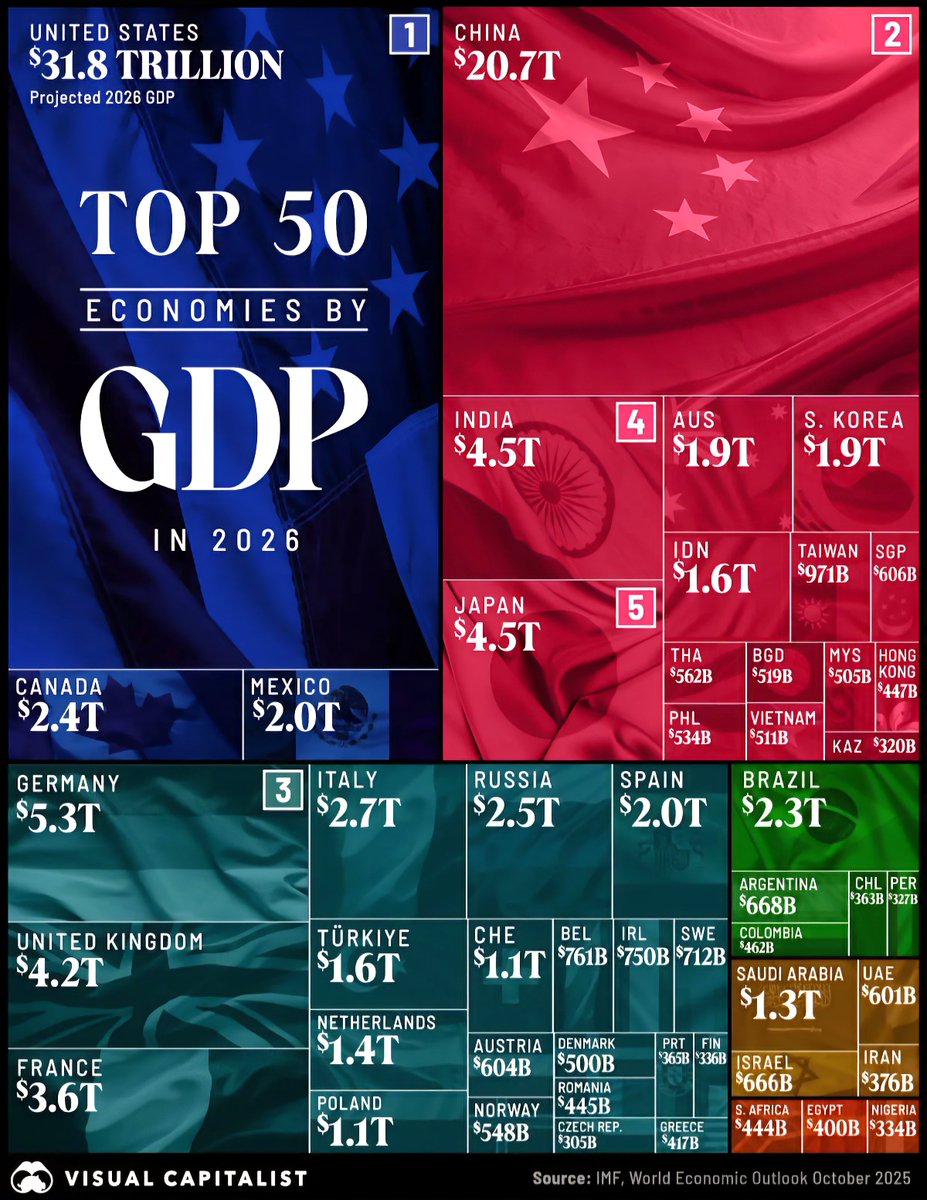
As of 2026, the global economic landscape continues to evolve, showcasing changes driven by emerging markets, technological advancements, and geopolitical shifts. Below, we delve into the 50 leading countries by Gross Domestic Product (GDP), painting a comprehensive picture of economic powerhouses across the world.
The United States Holds Its Dominant Position with Impressive Numbers
At the top of the list is the United States, boasting a staggering GDP of $31.82 trillion. Despite global economic uncertainties, the U.S. maintains its economic leadership, largely driven by technological innovation, a robust service sector, and a resilient consumer base. From Silicon Valley to its financial hubs, the U.S. economy remains a beacon of stability and growth.
China Continues Rapid Expansion
China maintains its second-place spot with a GDP of $20.65 trillion. Over the past few years, China’s focus on technological development, infrastructure, and manufacturing has significantly propelled its economy. The nation’s Belt and Road Initiative and strategic investments bolster its position on the global stage.
Europe’s Top Economies Steady with Germany and the UK
Germany, Europe’s largest economy, is valued at $5.33 trillion. Its strong manufacturing sector and export-driven economy underpin its stability. The United Kingdom follows with a GDP of $4.23 trillion, reflecting its leadership in finance, technology, and creative industries, despite navigating post-Brexit transitions.
Asia’s Emerging Powers Dominate Middle-Tier Rankings
India, with a GDP of $4.51 trillion, continues its ascent as a global economic force thanks to its expanding technology, manufacturing, and service industries. Japan’s economy stands at $4.46 trillion, backed by technological innovation and advanced manufacturing.
South Korea has cemented its position at $1.94 trillion, leveraging its prowess in electronics and automobile manufacturing. Meanwhile, Indonesia and Turkey, with $1.55 trillion and $1.58 trillion respectively, highlight the rising economic influence of Southeast Asia and the Middle East.
North American Countries Continue to Grow
Beyond the U.S., Canada remains a key player with a GDP of $2.42 trillion, driven by its natural resources, technology, and finance sectors. Mexico, at $2.03 trillion, benefits from manufacturing, trade, and regional economic integration.
South American Brilliance in GDP Growth
Brazil, South America’s largest economy, has a GDP of $2.29 trillion, with substantial growth propelled by agriculture, mining, and energy sectors. Argentina and Colombia are also among the continent’s notable economies.
Middle Eastern and African Economies on the Rise
Saudi Arabia ($1.32 trillion) and the UAE ($601.16 billion) continue to diversify from oil dependence, investing heavily in technology, tourism, and finance. South Africa’s economy, at approximately $443.64 billion, exemplifies growth amid regional challenges. Nigeria and Egypt remain pivotal economies within Africa, with GDPs of over $334 billion and $399 billion, respectively.
European Small States and Technology Hubs
Switzerland, Ireland, and Sweden maintain their positions with strong financial and technological industries. Hong Kong, although technically a special administrative region, ranks with a GDP of $446.65 billion, emphasized by its financial services and trade importance.
Upcoming Economies to Watch
Vietnam ($511.06 billion), the Philippines ($533.92 billion), and Bangladesh ($519.29 billion) exemplify the rapid growth of Asian emerging markets, fueled by manufacturing, exports, and digital innovation.
The year 2026 underscores the ongoing shifts in global economic power, with emerging countries increasingly gaining ground. As technology, geopolitics, and demographics evolve, these GDP rankings may shift, reflecting the dynamic nature of the world economy.
Source: IMF World Economic Outlook, October 2025
 ChatGPT
 Perplexity
 Gemini AI
 Grok AI