Select Language:
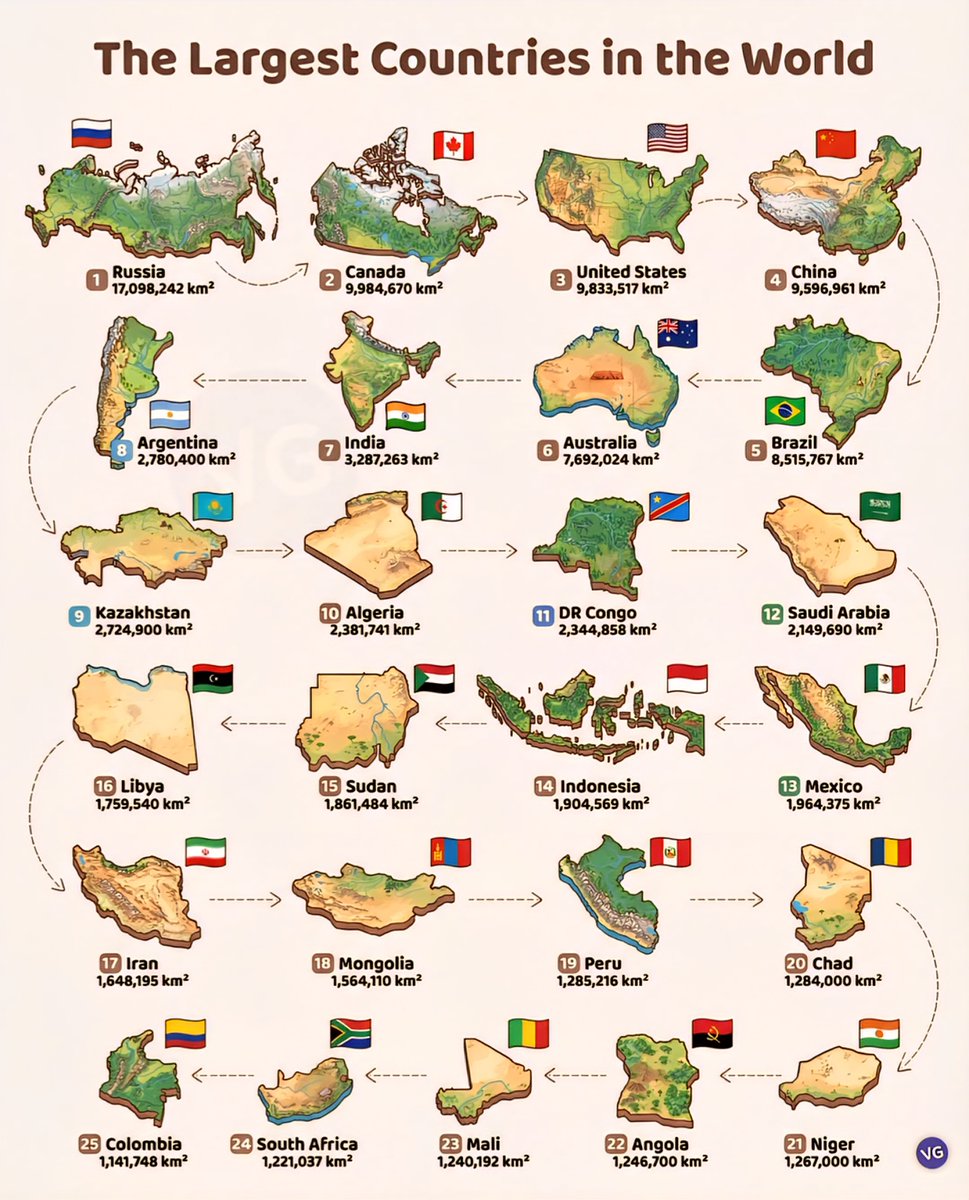
The World’s Largest Countries in 2025: A Closer Look at Global Landmass
Russia Takes the Crown as the Largest Country Globally
Spanning over 17 million square kilometers, Russia continues to hold its position as the world’s largest country. Its vast expanses stretch across Eastern Europe and northern Asia, covering a diverse range of climates and landscapes, from Arctic tundra to dense forests and mountain ranges. Russia’s extensive territory makes it a key player in global geopolitics, with significant natural resources and strategic importance.
Canada Ranks Second with Nearly 10 Million Square Kilometers
Canada claims the second spot, boasting almost 10 million square kilometers of land. Its expansive wilderness areas, freshwater lakes, and mountain ranges make it one of the most scenic countries globally. The country’s large landmass is sparsely populated, with most Canadians residing near the U.S. border.
United States and China Close Behind in Landmass
The United States, with approximately 9.83 million km², remains one of the foremost landmass giants, with its size attributed to diverse landscapes ranging from the Rocky Mountains to the Great Plains. China follows closely, covering about 9.6 million km², with a rich tapestry of mountains, deserts, and fertile plains fueling its economic growth and cultural diversity.
Brazil and Australia: The Largest in South America and Oceania
Brazil, home to the Amazon Rainforest, spans over 8.5 million km², making it South America’s largest country. Its vast biodiversity and natural resources are vital globally. Australia, the continent country, covers around 7.69 million km², characterized by deserts, tropical rainforests, and unique wildlife.
India and Argentina: Major Continents in Land Area
India, with approximately 3.29 million km², is the seventh-largest country and the largest democracy, with a rising economic profile. Argentina, covering about 2.78 million km², possesses a diverse landscape from mountainous Andes to pampas plains.
Central Asian Steppes and North African Deserts
Kazakhstan (around 2.72 million km²) and Algeria (roughly 2.38 million km²) are key players in Eurasian and North African regions respectively. Their extensive territories are primarily steppes and deserts, holding significant natural resources.
Central Africa’s Expansive Congo and the Arabian Peninsula
The Democratic Republic of Congo spans over 2.34 million km², dense with rainforests. Saudi Arabia covers approximately 2.15 million km², dominating the Middle Eastern landscape with deserts and oil-rich sands.
Mexico, Indonesia, and Sudan: Diverse and Strategic Territories
Mexico, with about 1.96 million km², is a pivotal cultural and economic link between North and Latin America. Indonesia, the world’s largest island nation, covers nearly 1.9 million km² with thousands of islands. Sudan’s land mass of roughly 1.86 million km² contains deserts and fertile regions.
North Africa and West Africa’s Expansive Nations
Libya (about 1.75 million km²), Iran (around 1.65 million km²), and Mongolia (approximately 1.56 million km²) are notable for their geographical significance. Niger, Chad, Angola, Mali, and South Africa further illustrate Africa’s extensive terrain, with each country contributing unique landscapes ranging from deserts to savannas.
South America’s Land Tremendous Colombia
Rounding out the top 25, Colombia covers approximately 1.14 million km², characterized by lush rainforests, mountains, and coastlines, making it a vital part of South America’s ecological diversity.
Sources: World Bank / UN Data, 2025
This list underscores the sheer scale of these nations, highlighting their geographical importance, natural resources, and strategic positions in global affairs.
 ChatGPT
 Perplexity
 Gemini AI
 Grok AI