Select Language:
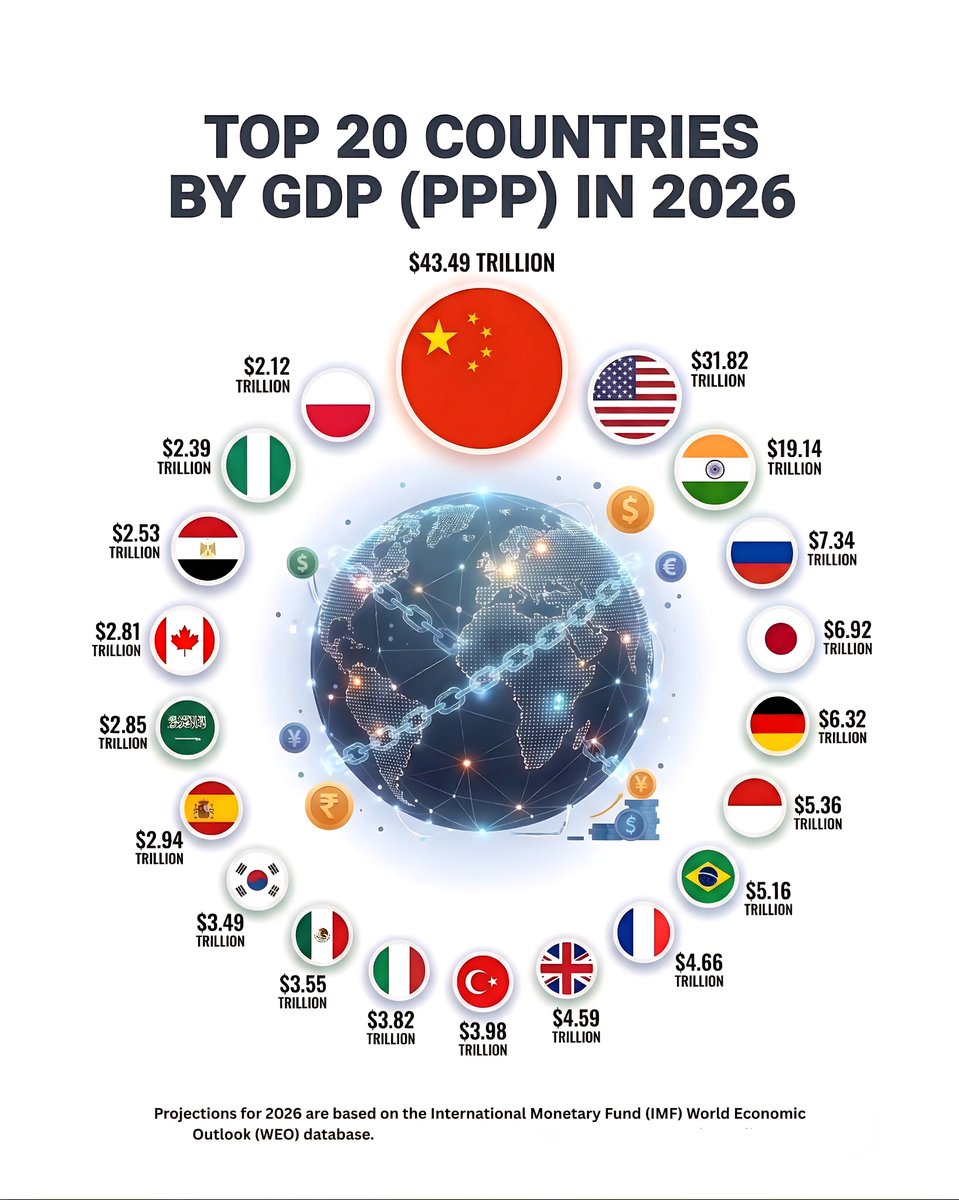
The world’s economy continues to evolve at a rapid pace, with some nations rising swiftly while others steady their trajectories. As of 2025, the global economic landscape features significant shifts, with growth dynamics influenced by technological innovation, geopolitical developments, and demographic changes. Below is a detailed look at the top 20 biggest economies in 2026, based on GDP figures adjusted for purchasing power parity (PPP).
China Maintains Its Global Economic Leadership
Leading the pack once again is China, with an estimated GDP of $43.49 trillion. China’s economic growth has remained resilient, driven by advancements in technology, manufacturing, and exports. The country continues to invest heavily in infrastructure and innovation, solidifying its position as the world’s largest economy. Its large internal market and government-led initiatives have kept it ahead of rivals.
The United States: A Strong Second
Close behind is the United States, with a GDP of $31.82 trillion. The American economy benefits from its diverse industrial base, technological prowess, and dynamic service sector. In 2025, the US’s focus on sustainable energy, digital transformation, and AI-driven industries has further fueled growth, keeping it a global economic power.
India Surges into the Top Three
India has seen impressive growth, reaching a GDP of $19.14 trillion, positioning it as the third-largest economy. Its expanding middle class, investments in technology, and infrastructure development have propelled economic expansion. India’s strategic focus on manufacturing and digital services continues to attract substantial foreign investments.
Russia’s Economy Cautiously Expands
Russia’s economy reaches $7.34 trillion, reflecting cautious growth amidst geopolitical tensions and sanctions. The nation is increasingly focusing on energy exports and building economic resilience through diversification efforts, aiming to reduce dependence on oil and gas.
Japan’s Steady Performance
Japan maintains its position with a GDP of $6.92 trillion. A leader in robotics and technology, Japan continues to innovate, though demographic challenges and an aging population slightly temper growth prospects. Infrastructure modernization remains a priority for sustaining economic stability.
Germany: Europe’s Largest Economy
Germany, Europe’s economic powerhouse, boasts a GDP of $6.32 trillion. Its manufacturing sector, particularly automotive and machinery, remains vital. Investment in green technology and digital transformation is key to maintaining competitiveness in the evolving global economy.
Indonesia Rises Significantly
Indonesia emerges as one of Southeast Asia’s largest economies, with a GDP of $5.36 trillion. Its large population, expanding middle class, and focus on infrastructure and technology are key drivers. The country’s strategic location positions it poorly for future trade and commerce.
Brazil’s Steady Growth
With a GDP of $5.16 trillion, Brazil continues to be South America’s economic leader. Agricultural exports, natural resources, and emerging tech sectors contribute to its growth. Political stability and economic reforms are expected to further boost its prospects.
France Settles as a Top European Economy
France, with an economy valued at $4.66 trillion, remains core to Europe’s economic landscape. Its diverse sectors—luxury goods, aerospace, and technology—maintain its global influence. Reform efforts aim to stimulate innovation and attract foreign investment.
The UK Rebounds Slightly
The United Kingdom’s economy stands at $4.59 trillion, rebounding from previous economic uncertainties. Financial services, technology, and creative industries are leading sectors. Post-Brexit trade agreements continue to shape its economic strategies.
Turkey’s Strategic Growth
Turkey’s economy, worth $3.98 trillion, benefits from its strategic geopolitical position. Investments in infrastructure, tourism, and manufacturing continue to boost its GDP, making it a key regional player.
Italy’s Resilience
At $3.82 trillion, Italy remains a vital European economy. Its luxury goods, automotive, and fashion industries contribute significantly to its GDP. Structural reforms are underway to boost productivity and innovation.
Mexico: A North American Powerhouse
Mexico with $3.55 trillion capitalizes on manufacturing, technology, and a growing consumer market. Its favorable trade agreements with the US and Canada mirror its strategic importance in North America.
South Korea’s Innovation Edge
South Korea’s economy, valued at $3.49 trillion, remains at the forefront of technology and manufacturing. Semiconductor dominance and advanced electronics underpin its economic strength.
Spain and Saudi Arabia: Regional Leaders
Spain, with a GDP of $2.94 trillion, benefits from tourism, renewable energy, and technology-driven industries. Meanwhile, Saudi Arabia’s $2.85 trillion economy pivots on diversification efforts and investments in renewable energy and tourism sectors.
Canada and Egypt: Rising Economies
Canada, at $2.81 trillion, maintains stability through natural resources and technology sectors. Egypt, with a GDP of $2.53 trillion, benefits from strategic investments in infrastructure, energy, and tourism.
Nigeria and Poland: Emerging Markets
Nigeria’s economy, valued at $2.39 trillion, is bolstered by its oil, agriculture, and expanding tech industries. Poland’s $2.12 trillion reflects steady growth driven by manufacturing, services, and EU integration.
In a rapidly changing global landscape, these economies demonstrate diverse strengths—ranging from technological innovation to natural resources—that will shape the world’s economic future in 2026.
 ChatGPT
 Perplexity
 Gemini AI
 Grok AI