Select Language:
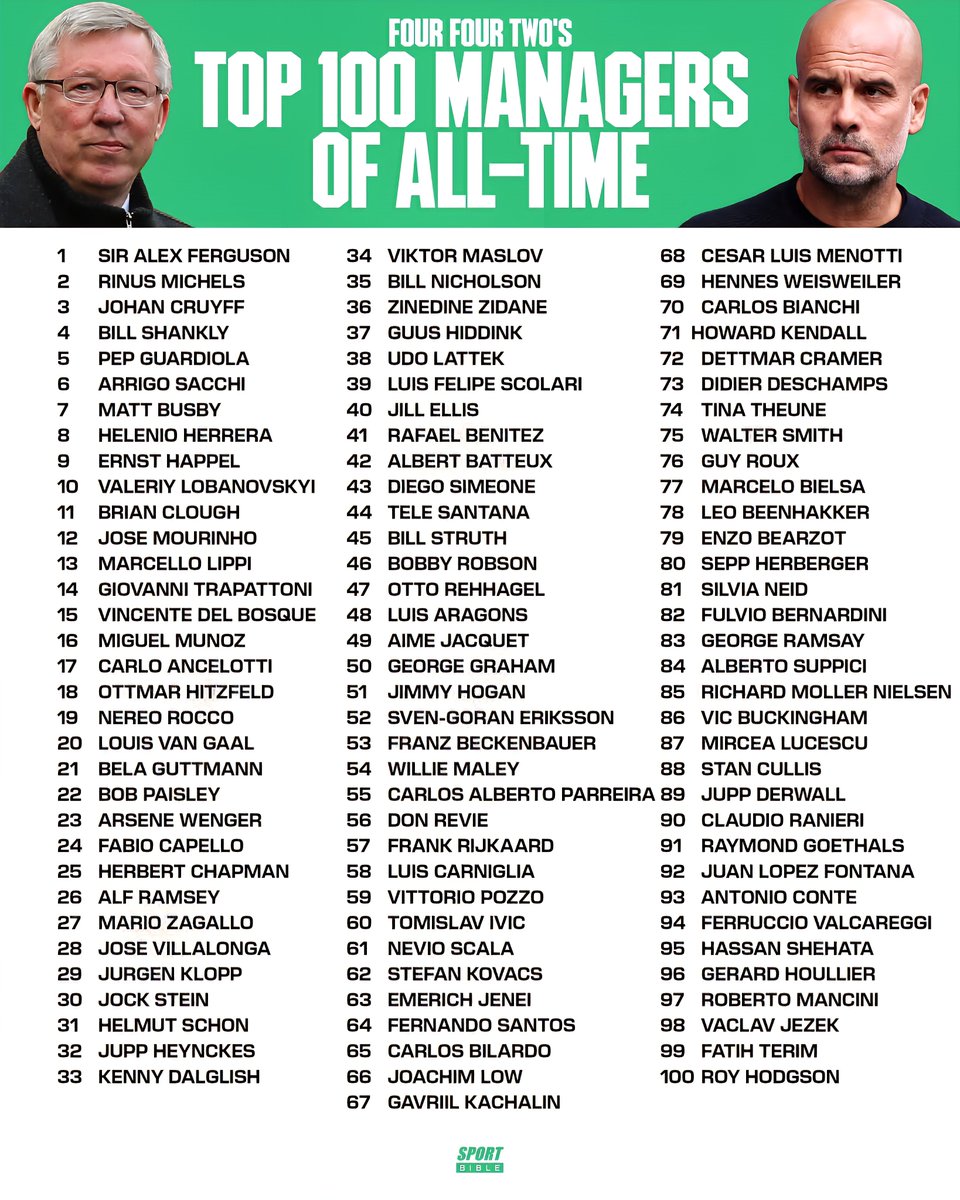
Top 100 Soccer Managers of All Time: 2025 Edition
1. Sir Alex Ferguson (United Kingdom)
The legendary Scotsman redefined football management with a record-breaking tenure at Manchester United. Known for his tactical brilliance and exceptional ability to develop young talent, Ferguson led the Red Devils to 13 Premier League titles, 2 UEFA Champions League trophies, and numerous domestic cups, solidifying his reputation as one of the greatest managers in football history.
2. Rinus Michels (Netherlands)
Often credited with pioneering “Total Football,” Michels revolutionized the game in the 1970s. His innovative approach led the Netherlands national team and Ajax to multiple successes, including European triumphs and a legacy that influenced generations of coaches worldwide.
3. Johan Cruyff (Netherlands)
A visionary player and coach, Cruyff’s tactical insights shaped modern football. As a manager, he guided Barcelona to their first European Cup victory in 1992 and established a playing style that remains influential today, creating a blueprint for stylish, attacking football.
4. Bill Shankly (United Kingdom)
Liverpool’s iconic manager transformed the club into a football powerhouse during the 1960s and 1970s. Known for his charismatic leadership, Shankly won three league titles and laid the foundation for Liverpool’s future successes.
5. Pep Guardiola (Spain)
Arguably the most tactically astute manager of the modern era, Guardiola’s innovative tactics at Barcelona, Bayern Munich, and Manchester City have redefined coaching standards. His teams are renowned for their possession-based style and relentless pressing, earning numerous league titles and European crowns.
6. Arrigo Sacchi (Italy)
The architect behind some of AC Milan’s most successful years in the late 1980s, Sacchi introduced highly organized pressing and fluid, attacking football. His influence is still felt across European coaching philosophies.
7. Matt Busby (United Kingdom)
The legendary manager of Manchester United post-World War II, Busby built the ‘Busby Babes’ and navigated tragedy with resilience. His leadership culminated in the club’s first European Cup triumph in 1968.
8. Helenio Herrera (Argentina/Spain)
Known as the mastermind behind Inter Milan’s ‘Grande Inter’ team of the 1960s, Herrera popularized the catenaccio system, emphasizing organized defense combined with quick counter-attacks, yielding continental dominance.
9. Ernst Happel (Austria)
One of Europe’s most successful managers, Happel claimed league titles in four countries and secured European titles with Feyenoord and Hamburg, known for his tactical flexibility and leadership.
10. Valeriy Lobanovskyi (Ukraine)
A true innovator, Lobanovskyi emphasized scientific training and tactical discipline. His Dynamo Kyiv team was renowned for its disciplined, attacking style, bringing Ukrainian football onto the global stage.
11. Brian Clough (United Kingdom)
Clough’s short but impactful tenure at Nottingham Forest yielded two European Cups and multiple league titles. His charismatic personality and tactical acumen made him a revered figure in football.
12. Jose Mourinho (Portugal)
The ‘Special One’ is famous for his strategic mastery and psychological tactics, winning league titles across Portugal, England, Italy, and Spain, as well as two UEFA Champions League titles with Porto and Inter Milan.
13. Marcello Lippi (Italy)
Lippi’s tactical versatility led Juventus to multiple Serie A titles and a FIFA World Cup victory with Italy in 2006, showcasing his adaptability and leadership in both club and international football.
14. Giovanni Trapattoni (Italy)
A tactician renowned for his disciplined, organized football, Trapattoni won league titles in Italy, Germany, and Portugal, making him one of the most decorated managers in European football.
15. Vicente del Bosque (Spain)
Del Bosque managed Spain’s golden generation, winning two European Championships and the 2010 World Cup. His calm leadership and tactical flexibility earned him global recognition.
16. Miguel Muñoz (Spain)
Guided Real Madrid through an era of dominance in the 1950s and 1960s, clinching five European Cups and numerous domestic titles, cementing his legacy in Spanish football history.
17. Carlo Ancelotti (Italy)
A tactically versatile coach, Ancelotti has won league titles in Italy, England, France, and Germany, along with three UEFA Champions League trophies, demonstrating his adaptability and winning mentality.
18. Ottmar Hitzfeld (Germany)
Hitzfeld’s managerial career includes stunning successes with Borussia Dortmund and Bayern Munich, securing numerous Bundesliga titles and UEFA titles.
19. Nereo Rocco (Italy)
The pioneer of the ‘catenaccio’ system, Rocco led AC Milan to multiple Serie A titles and European cups, influencing defensive tactics worldwide.
20. Louis van Gaal (Netherlands)
Known for his tactical innovation and emphasis on developing young talent, Van Gaal led FC Barcelona and the Netherlands national team to major successes, including the 2014 World Cup semi-finals.
21. Bela Guttmann (Hungary)
Famous for his innovative tactics and charismatic leadership, Guttmann’s legacy includes multiple titles with Benfica, including two European Cups, and a lasting influence on European football.
22. Bob Paisley (United Kingdom)
During his tenure at Liverpool, Paisley secured six league titles and three European Cups, emphasizing team-building and tactical discipline.
23. Arsène Wenger (France)
Revolutionized English football with his emphasis on youth and attacking play at Arsenal, winning three Premier League titles including the famous Invincible season.
24. Fabio Capello (Italy)
Known for his pragmatic and disciplined tactics, Capello’s successes span Italian, English, and Russian clubs, and the Italian national team.
25. Herbert Chapman (United Kingdom)
A visionary innovator at Arsenal, Chapman introduced tactical formations and training methods that advanced the game significantly during the 1920s and 1930s.
The list continues to honor legendary coaches from around the world, showcasing a blend of tactical brilliance, innovative philosophies, and leadership that have shaped the beautiful game.
(Note: The flags highlight the nationality of each manager, noting historical and contemporary distinctions.)
 ChatGPT
 Perplexity
 Gemini AI
 Grok AI