Select Language:
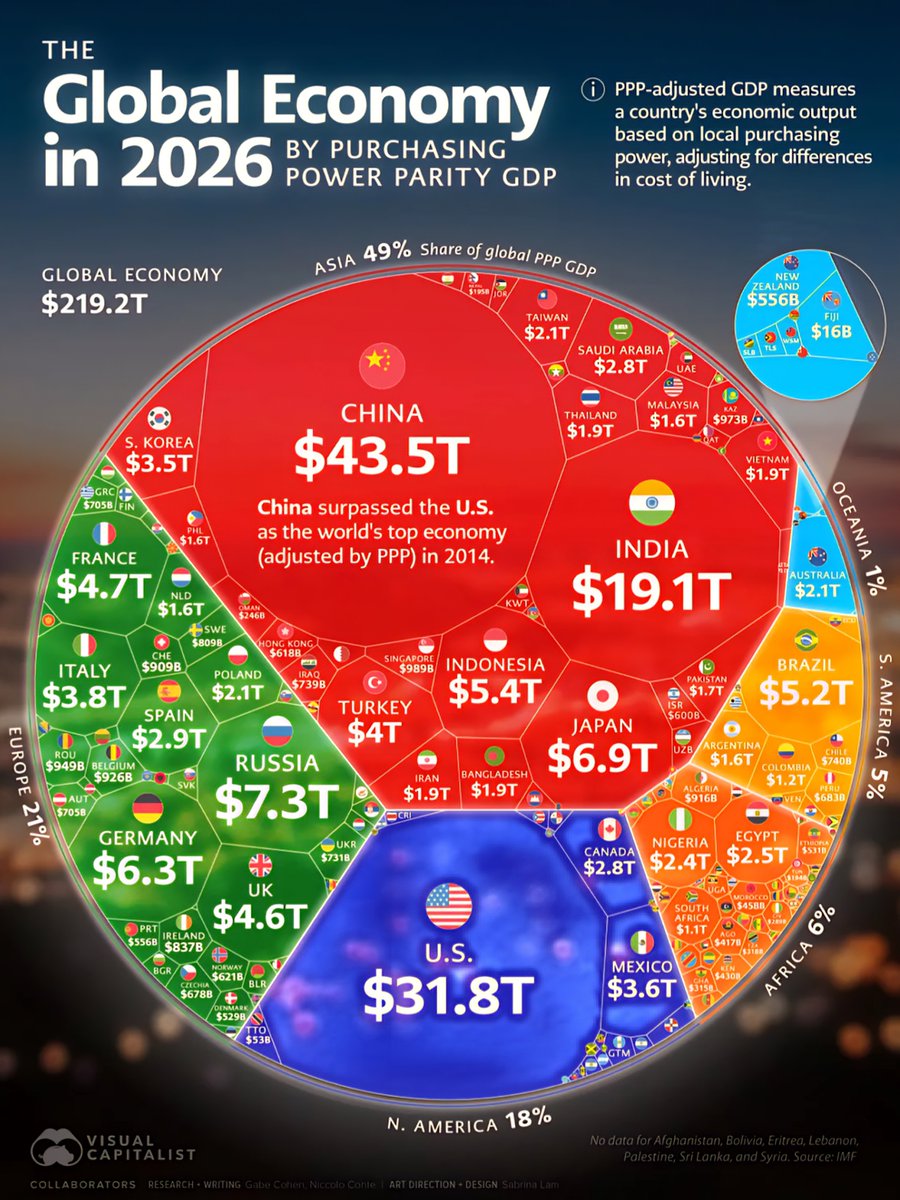
Top 100 Largest Economies in 2025
1. China Dominates the Global Economy
China maintains its position as the largest economy in the world with a staggering GDP of $43.49 trillion. Its rapid growth over the past decade, fueled by technological innovation, infrastructural development, and a robust manufacturing sector, keeps the country at the forefront of global economic Powerhouses.
2. United States Continues Its Lead in Wealth and Innovation
With a GDP of $31.82 trillion, the U.S. holds second place. The country’s strength lies in its technological innovations, financial markets, and a large consumer base. The United States’ leadership in Silicon Valley and a resilient economy help sustain its position among the top.
3. India’s Rapid Economic Expansion
India surges to a GDP of $19.14 trillion, reflecting its expanding middle class, youthful population, and increasing investments in infrastructure and technology sectors. India’s economic growth is poised to shape global trade and geopolitics in the coming years.
4. Russia’s Strategic Position
Russia’s economy hits $7.34 trillion, supported by its energy exports, especially oil and natural gas. The nation’s strategic geopolitical position also influences its economic trajectory.
5. Japan’s Steady Rebound
Japan’s economy, valued at $6.92 trillion, remains resilient through technological innovation and a strong manufacturing sector, particularly in automotive and electronics.
6. Germany’s Engineering Excellence
Germany continues its dominance in Europe with a GDP of $6.32 trillion, known for its engineering, automotive industry, and Export prowess.
7. Indonesia’s Growing Market
Indonesia’s economy hits $5.36 trillion, making it Southeast Asia’s largest economy, driven by a young population, mineral resources, and rising domestic consumption.
8. Brazil’s Resource Wealth
Brazil’s GDP stands at $5.16 trillion, mainly backed by agriculture, mining, and oil industries, positioning it as the leading South American economy.
9. France’s Economic Resilience
France maintains its position with a GDP of $4.66 trillion, strengthened by tourism, luxury goods, and aerospace industries.
10. The United Kingdom’s Academic and Financial Power
The UK’s economy, valued at $4.59 trillion, benefits from its global financial services center and innovation-driven sectors.
11. Turkey’s Strategic Growth
Turkey’s economy reaches $3.98 trillion, experiencing growth through its diversified industries, including manufacturing, agriculture, and tourism.
12. Italy’s Industrial Heritage
Italy’s GDP is $3.82 trillion, supported by fashion, automotive, and food industries, maintaining its European economic influence.
13. Mexico’s Expanding Market
Mexico’s economy, valued at $3.55 trillion, benefits from manufacturing exports, particularly to the U.S., and its emerging technology sectors.
14. South Korea’s Technological Edge
South Korea’s economy, worth $3.49 trillion, remains central to global electronics, semiconductors, and automobile manufacturing.
15. Spain’s Tourism and Agriculture
Spain’s GDP hits $2.94 trillion, driven by tourism, renewable energy, and agriculture.
Additional countries follow suit, showcasing diverse economies ranging from resource-rich nations like Saudi Arabia ($2.85 trillion) and Canada ($2.81 trillion), to emerging markets such as Nigeria ($2.39 trillion) and Vietnam ($1.94 trillion).
Click here to view the full global list.
Why These Numbers Matter
In 2025, the economic landscape continues to evolve, reflecting technological advancements, demographic shifts, and geopolitical strategies. China’s sustained growth bolsters its global influence, while the United States retains its leadership in innovation. Emerging markets like India, Indonesia, and Nigeria are becoming significant players, shaping future trade patterns.
Market Trends to Watch
- Green Energy & Sustainability: Countries investing heavily in renewable energies are expected to see increased GDP contributions.
- Tech Innovations: Nations leading in AI, biotech, and digital infrastructure will likely climb higher in future rankings.
- Geopolitical Alliances: Strategic partnerships and trade agreements will shape economic forecasts, particularly for resource-rich and tech-forward nations.
Keep an eye on these economies as they develop, influencing not just global markets but also geopolitical stability and technological progress in 2025 and beyond.
 ChatGPT
 Perplexity
 Gemini AI
 Grok AI