Select Language:
The Largest Economies of 2026: A Closer Look
China Continues Its Economic Dominance
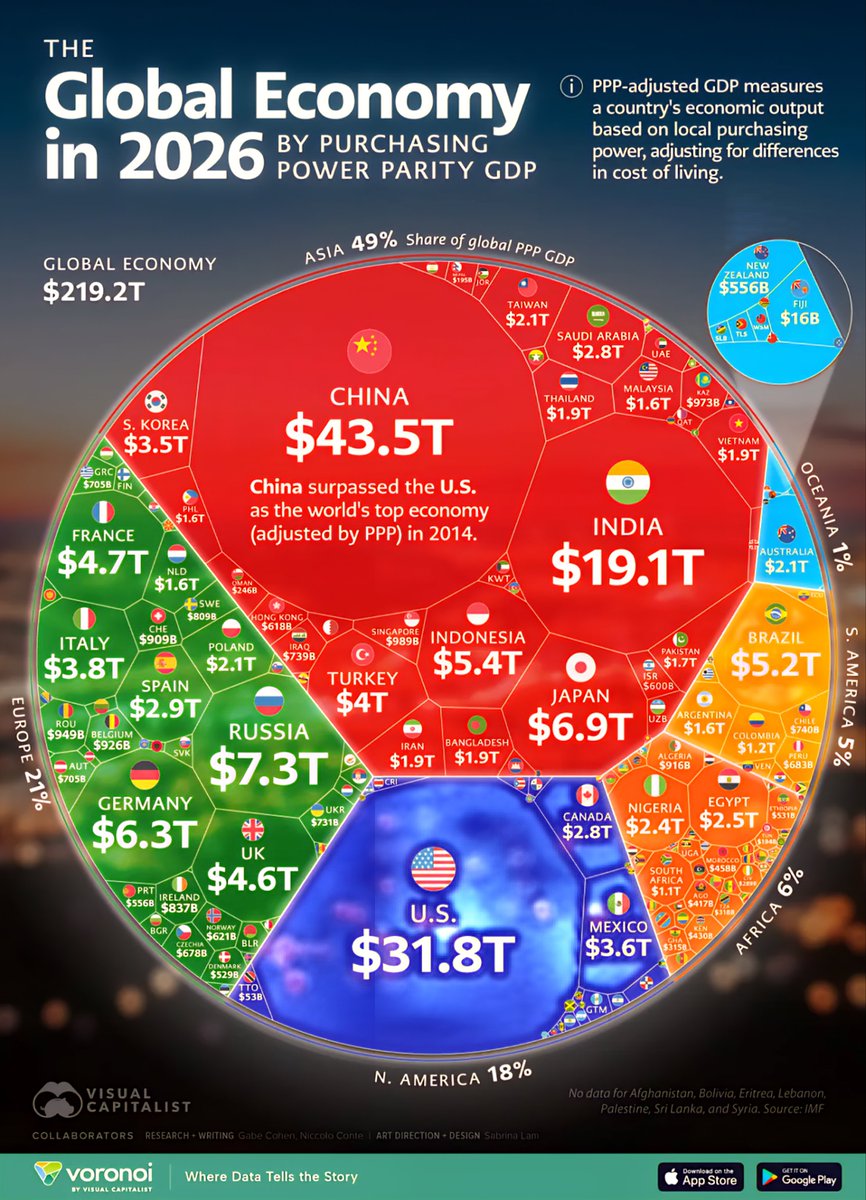
Leading the way globally, China’s economy has surged to an estimated \$43.49 trillion in 2026, solidifying its position as the world’s largest economy. The country’s ongoing investments in technology, manufacturing, and infrastructure development have driven this growth, making it a key player on the international stage. China’s GDP surpasses the next biggest economy by a significant margin, reflecting decades of rapid development.
The United States Holds Steady in Second Place
Despite China’s rise, the United States maintains its position as the second-largest economy with a GDP of approximately \$31.82 trillion. The U.S. economy benefits from technological innovation, a highly developed services sector, and a resilient consumer market. While growth has slowed compared to previous decades, the U.S. remains a major economic hub.
India’s Rapid Ascent
India’s economy has experienced unprecedented growth and now stands at around \$19.14 trillion, placing it firmly in third position globally. With a young population, technological advancements, and increased foreign investment, India is expected to continue expanding its economic influence through 2026.
Russia and Japan: Major Players
Russia is the fifth-largest economy with a GDP of \$7.34 trillion, primarily driven by energy exports and natural resources. Japan, closely following, has a GDP of approximately \$6.92 trillion, thanks to its advanced manufacturing and technology sectors. Both nations remain influential in regional and global markets.
Europe’s Economic Landscape
Germany remains Europe’s largest economy, valued at about \$6.32 trillion, with sectors like automotive and machinery manufacturing fueling growth. France and the United Kingdom follow, with economies valued at \$4.66 trillion and \$4.59 trillion, respectively. Despite challenges, these countries maintain significant economic influence.
Southeast Asia’s Rising Power
Indonesia continues its impressive growth trajectory, boasting a GDP of \$5.36 trillion, making it the largest economy in Southeast Asia. Vietnam(\$1.94 trillion) and Thailand (\$1.92 trillion) are also notable movers, reflecting the region’s rapid industrialization and increasing foreign investment.
Latin America’s Top Economies
Brazil, with an economy valued at \$5.16 trillion, leads Latin America. Mexico and Argentina follow, with respective GDPs of \$3.55 trillion and \$1.58 trillion. These nations are vital players in regional trade and geopolitics.
The Wealth of Middle Eastern Markets
Saudi Arabia’s economy stands at \$2.85 trillion, bolstered by oil exports and diversification efforts like Vision 2030. The United Arab Emirates also features prominently with a GDP of \$1 trillion, emphasizing its position as a financial and trade hub.
Noteworthy Small and Developing Economies
Countries like Singapore (\$988.8 billion), Kazakhstan (\$973.4 billion), and Romania (\$949.3 billion) are emerging markets showing substantial growth. African nations such as Nigeria (\$2.39 trillion), Kenya (\$430.3 billion), and Ethiopia (\$530.8 billion) demonstrate the continent’s expanding economic presence.
The Power of Technology and Innovation Hubs
Hong Kong (\$618.1 billion), Israel (\$600.5 billion), and Ireland (\$836.7 billion) exemplify the global importance of financial centers and technology clusters. These economies wield influence disproportionate to their size, thanks to innovation-driven sectors.
Regional Variations in Growth and Challenges
While some nations have experienced exponential growth, others face slowdowns or economic challenges. Countries such as Venezuela (\$231.4 billion) and Zimbabwe (\$144.9 billion) grapple with economic instability, illustrating disparities across different regions.
Final Insights
The global economic landscape in 2026 showcases a diverse and interconnected array of nations. China’s rise continues to challenge the traditional dominance of Western economies, with India emerging rapidly on the scene. Southeast Asia, Africa, and Latin America are gaining prominence, highlighting shifting economic power centers. Meanwhile, technological innovation remains a key driver for many countries’ growth trajectories.
Source: IMF via Voronoi by Visual Capitalist, 2025. All figures based on Purchasing Power Parity (PPP).
 ChatGPT
 Perplexity
 Gemini AI
 Grok AI