Select Language:
What if materials typically discarded could help address some of our most pressing environmental issues? New research from RMIT University indicates that eucalyptus bark, often dismissed as forestry waste, could be transformed into an effective resource for water purification, air filtration, and even carbon capture.
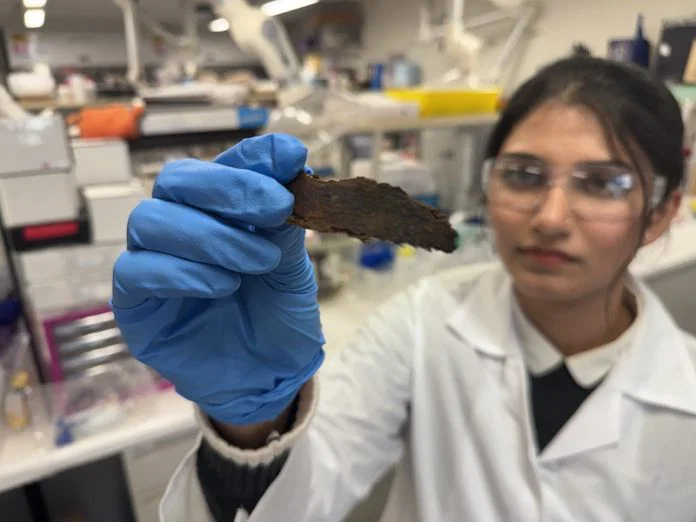
Eucalyptus trees are widespread across Australia, and their bark is usually stripped from logs and thrown away during processing. However, scientists have discovered a way to convert this low-value waste into something significantly more useful. By applying a straightforward treatment, they turn the bark into specialized carbon with a porous structure. These microscopic pores allow the material to trap harmful pollutants and molecules as air or water flows through.
This type of material, known as porous carbon, is already common in filters and purification devices. Its efficacy relies on its structure rather than the original raw material. When liquids or gases pass through, unwanted particles become lodged within the tiny holes, effectively cleaning the air or water.
Lead researcher Pallavi Saini was impressed by how well eucalyptus bark performed in these tests. The study revealed that something often overlooked could be repurposed into a valuable environmental solution. The fabrication process is simple—requiring only a single activation step—which makes production potentially more affordable and accessible compared to other forms of porous carbon that often need more complex, energy-intensive methods.
The research, published in Biomass and Bioenergy, highlights the creative potential of utilizing natural waste materials. Dr. Deshetti Jampaiah emphasized that the simplicity of this process is a major advantage, especially given its reliance on a widely available resource and minimal production steps. This approach could be more practical for real-world applications.
With over 900 species of eucalyptus and related trees in Australia, the possibilities for using different varieties are vast. The research team plans to collaborate with Indigenous communities, whose deep ecological knowledge could help identify the best species for this purpose. This partnership aims to blend scientific innovation with traditional ecological wisdom in a respectful manner.
Another benefit is that eucalyptus bark is a byproduct of forestry and doesn’t compete with food crops. Using it aligns with circular economy principles, where waste is repurposed instead of discarded, promoting sustainability and resource efficiency.
Future applications for this porous bark-derived material may include cleaning polluted water, enhancing air quality, and capturing carbon dioxide emissions. Nonetheless, further research is necessary to evaluate its durability, long-term performance, and scalability.
This study demonstrates that innovative solutions to environmental concerns can sometimes emerge from unexpected sources. By reimagining waste materials such as eucalyptus bark, scientists are paving the way toward cleaner air, safer water, and a more sustainable planet.
 ChatGPT
 Perplexity
 Gemini AI
 Grok AI