Select Language:
The World’s Largest Economies in 2025: A Look at the Top Players
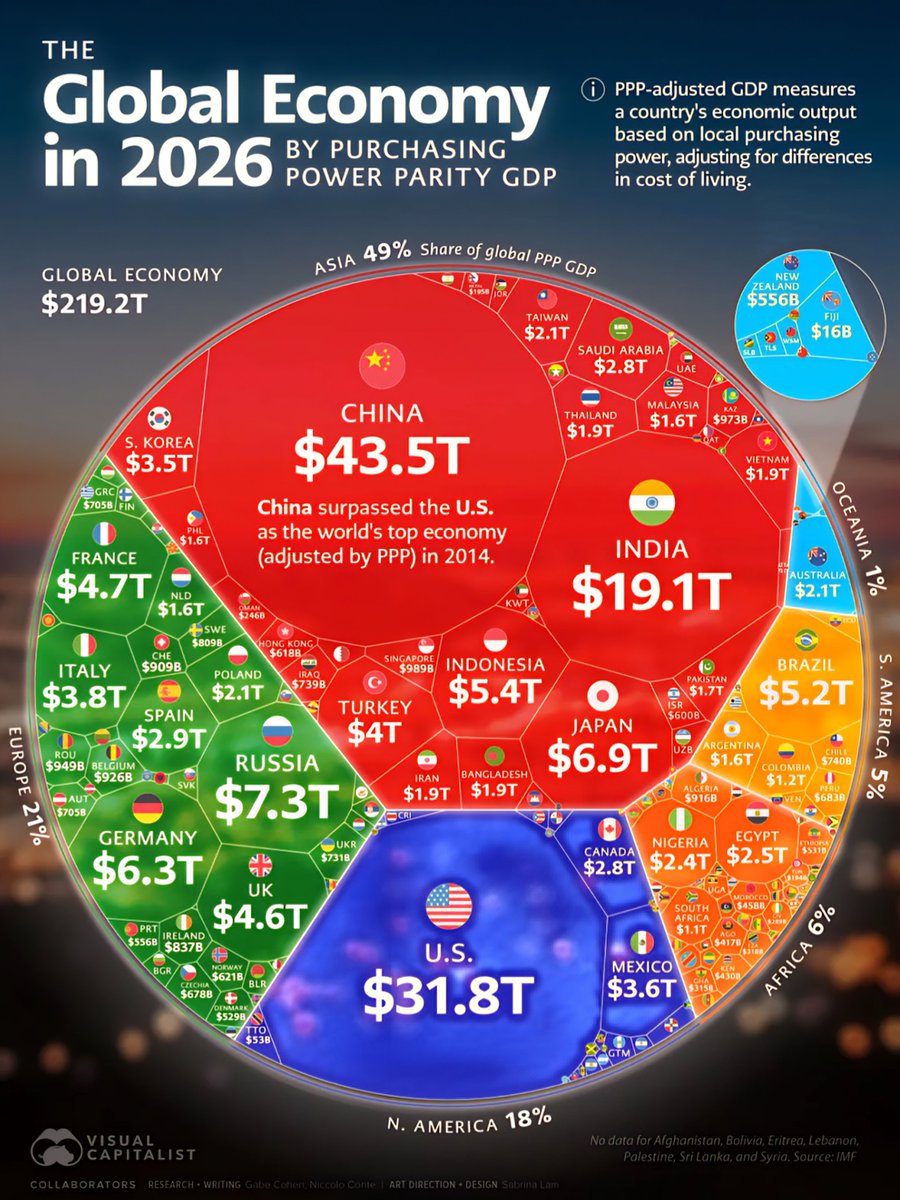
China maintains its global economic dominance with a staggering $43.5 trillion GDP
China continues to lead as the world’s largest economy, boasting an unprecedented $43.49 trillion in GDP based on Purchasing Power Parity (PPP). Its rapid infrastructure development, technological innovations, and manufacturing powerhouse status solidify its position at the top of global economic rankings for 2025. With a population exceeding 1.4 billion, China’s economic strategies focus heavily on advanced technology and green initiatives, ensuring it remains a dominant force.
The United States remains in second place with over $31.8 trillion in economic output
Despite challenges, the U.S. economy continues its resilience with a GDP of $31.82 trillion. The nation’s diverse economy, driven by technology, finance, healthcare, and consumer goods, keeps it firmly anchored as the second-largest economy globally. Silicon Valley’s innovation ecosystem and continued investment in AI and renewable energy play crucial roles in shaping the country’s economic trajectory.
India leaps forward, breaking past $19 trillion
India’s economy is experiencing exponential growth, now valued at $19.14 trillion. With a burgeoning middle class, rapid urbanization, and a focus on digital transformation, India is closing in on more established economies. Large investments in infrastructure, technology, and manufacturing sectors have propelled the nation into the top three, reflecting its emerging status as a global economic powerhouse.
Russia and Japan round out the top five with GDPs of $7.34 trillion and $6.92 trillion
Russia maintains its position with a GDP of $7.34 trillion, relying heavily on energy exports and natural resources. Meanwhile, Japan holds steady at $6.92 trillion, driven by technological innovation and a highly developed manufacturing sector. Both countries focus on diversification and technological advancements to sustain growth.
European giants Germany and France showcase stability
Germany, with a GDP of $6.32 trillion, remains Europe’s economic leader, boasting strengths in automotive, machinery, and chemicals. France follows at $4.66 trillion, with a robust service sector, luxury goods, and aerospace industry underpinning its economic resilience. Both nations are pivotal within the European Union and continue to attract global investments.
Brazil and Indonesia lead economic growth in Latin America and Southeast Asia
Brazil’s economy is valued at $5.16 trillion, driven by agriculture, mining, and energy sectors. Indonesia, with a GDP of $5.36 trillion, benefits from its vast natural resources, youthful population, and expanding digital economy. These nations highlight the dynamic growth occurring in their respective regions.
The UK, Turkey, Italy, and Mexico hold their positions in the top 15
The United Kingdom’s economy stands at $4.59 trillion, underpinned by finance, technology, and manufacturing. Turkey’s economic footprint is $3.98 trillion, with a strategic location and diversified industries fueling growth. Italy and Mexico, valued at $3.82 trillion and $3.55 trillion respectively, continue to leverage manufacturing, tourism, and exports.
Asian economies like South Korea, Taiwan, and Vietnam see substantial gains
South Korea maintains a $3.49 trillion economy, focusing on electronics and automotive sectors. Taiwan, a key player in semiconductor manufacturing, reaches $2.07 trillion. Vietnam’s rapid development propels it to $1.94 trillion, bolstered by manufacturing and exports.
Middle East and African countries emerge as significant economies
Saudi Arabia leads the Middle East with $2.85 trillion, mainly driven by oil exports and diversification efforts. Nigeria and Egypt also show promising growth, with economies valued at $2.39 trillion and $2.53 trillion, respectively. Africa’s emerging markets are increasingly integrated into the global economy, focusing on resource extraction, agriculture, and now, technology.
Smaller but rapidly growing economies close the global rank
Countries like Colombia ($1.24 trillion), South Africa ($1.06 trillion), and the UAE ($1 trillion) demonstrate notable economic development, focusing on industry diversification, tourism, and technology. The global economy continues to evolve, with numerous nations paving their paths to growth amid shifting geopolitical landscapes.
In the current landscape of 2025, the global economic map is more dynamic than ever. The continuous rise of Asian economies, strategic investments in technology and infrastructure, and diversification efforts underpin the shifting balances of power. Countries not only compete but increasingly cooperate, shaping a resilient and interconnected international economy.
 ChatGPT
 Perplexity
 Gemini AI
 Grok AI