Select Language:
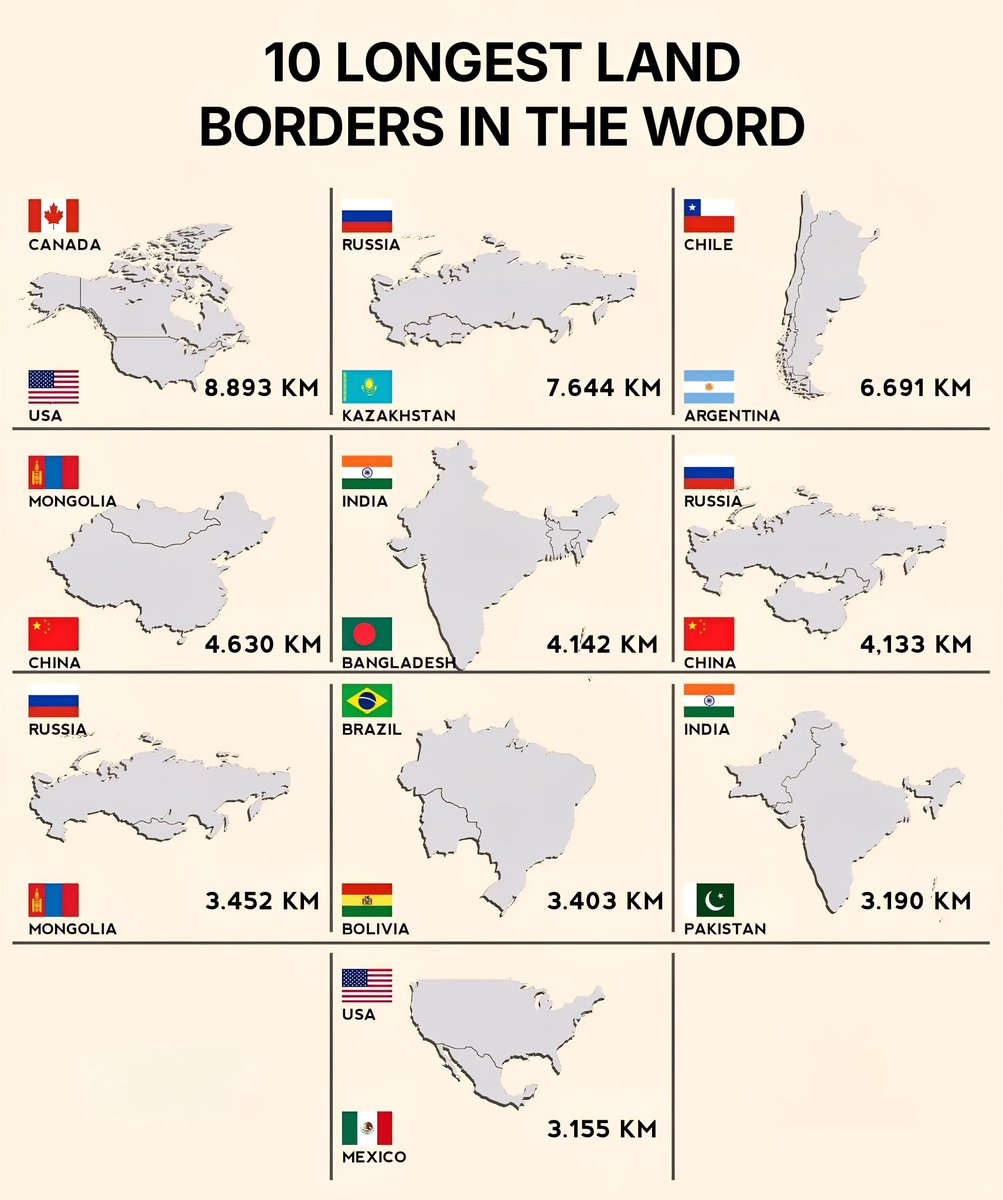
The 10 Longest Land Borders on Earth
1. Canada and the United States – 8,893 km
Topping the list is the expansive border between Canada and the United States, stretching nearly 8,900 kilometers. This border, often referred to as the world’s longest undefended boundary, spans from the Atlantic to the Pacific, crossing diverse terrains including lakes, forests, and urban areas. The U.S.-Canada border is a symbol of relatively peaceful relations that have persisted for over a century. It includes notable crossings in cities like Buffalo and Vancouver, and extensive wilderness areas like the Alaska-Canada border, which remains largely untouched.
2. Russia and Kazakhstan – 7,644 km
Russia shares its longest border with Kazakhstan, covering approximately 7,644 kilometers. This boundary traverses the vast Central Asian steppes, deserts, and mountain ranges, forming a historical corridor of trade and cultural exchanges. The boundary’s length reflects the intertwined histories of both nations, with numerous border crossings facilitating commerce and migration. Given the immense terrains, this border remains significant for geopolitical stability in the region.
3. Chile and Argentina – 6,691 km
South America’s two giants, Chile and Argentina, boast a border stretching nearly 6,700 kilometers along the Andes mountain range. This boundary is characterized by rugged terrains, glaciers, and volcanoes. While generally peaceful, the area has seen territorial disputes in the past, notably over the Beagle Channel. The long border supports cross-border trade and cultural ties, with shared resources like water and mineral deposits vital to both countries.
4. Mongolia and China – 4,630 km
Mongolia’s border with China is about 4,630 kilometers long, marking a significant boundary between the two nations. This extensive border runs through semi-arid steppes and rugged mountainous terrains. Historically, these countries enjoyed close relations, but the boundary remains sensitive due to regional geopolitics. The border points facilitate trade, particularly in commodities like minerals, livestock, and textiles.
5. India and Bangladesh – 4,142 km
India’s border with Bangladesh spans roughly 4,142 km, making it one of Asia’s longest land boundaries. The border winds through rivers, rural villages, and densely populated regions. It has been a site of challenges, including border management and migration issues. In recent years, efforts have intensified to improve border security while promoting cross-border cooperation, especially in trade and cultural exchanges.
6. Russia and China – 4,133 km
Sharing almost the same length as the Mongolia-Russia border, Russia’s boundary with China is approximately 4,133 km. The border crosses diverse terrains, including mountain ranges, forests, and grasslands. Relations between Russia and China have improved significantly, fostering economic partnerships. The boundary has several official crossings, blueberries and mineral resources are some of the commodities exchanged across this border.
7. Russia and Mongolia – 3,452 km
The third border involving Russia is with Mongolia, covering around 3,452 kilometers. It’s an important strategic boundary that has historically served as a buffer zone. The border traverses remote areas, with limited development but vital for regional security and cooperation. Past military exchanges and joint development projects highlight the importance of this border.
8. Brazil and Bolivia – 3,403 km
South America’s Amazon rainforest hosts a lengthy boundary between Brazil and Bolivia, measuring approximately 3,400 kilometers. The border features dense forests, river systems, and indigenous territories. It’s vital for resource extraction, including minerals and timber, and has been central to regional environmental discussions. Both nations continue to work on border security and sustainable development initiatives.
9. India and Pakistan – 3,190 km
One of the most geopolitically sensitive borders globally, the India-Pakistan boundary stretches about 3,190 kilometers and encompasses the disputed Kashmir region. The line is marked by heavily fortified borders, including the Line of Control, and has long been a flashpoint promoting military tensions. Despite conflicts, trade and cultural relations continue at various points, with ongoing efforts toward peace.
10. United States and Mexico – 3,155 km
Completing the list is the U.S.-Mexico border, about 3,155 kilometers long. This border has seen significant migration, trade, and cultural exchange. It features diverse environments from the deserts of Arizona to the forests in Texas. In recent years, border security and immigration policies have been central topics of national debate, influencing cross-border cooperation efforts.
The vast and varied landscapes of these borders reflect complex histories, geopolitical strategies, and cultural exchanges that shape their nations. As global tensions shift and regional partnerships evolve, these boundaries will continue to be vital in defining the relationships and futures of the countries they divide.
 ChatGPT
 Perplexity
 Gemini AI
 Grok AI