Select Language:
The Future Powerhouses: Top Economies Expected in 2075
As we look ahead to 2075, the landscape of global economic power is set to undergo significant transformations. Based on current trends, technological advances, demographic shifts, and strategic developments, here are the leading economies expected to dominate the world stage in 2075.
1. China: The Rising Superpower
China is poised to maintain its position as the largest economy by 2075. With its continued emphasis on innovation, urbanization, and a robust manufacturing sector, the nation is likely to leverage its enormous population of over 1.6 billion people. The Chinese government’s strategic investments in artificial intelligence, renewable energy, and high-tech infrastructure will propel its economic growth, cementing its influence across Asia and beyond.
2. India: The Future Economic Giant
India’s rapid development over the last few decades suggests it will surpass many nations to become a global economic superpower by 2075. With a youthful population projected to reach nearly 1.8 billion, India’s demographic advantage will fuel consumer markets, workforce productivity, and technological innovation. If India continues its trajectory of reforms and infrastructure development, it is likely to be a central hub for finance, technology, and manufacturing.
3. United States: An Enduring Powerhouse?
Despite emerging competitors, the United States is expected to remain one of the top economies in 2075. Its technological leadership, strong higher education system, and innovative capacity will sustain its influence in digital industries, aerospace, and advanced manufacturing. However, demographic changes and economic shifts may challenge its dominance, necessitating strategic adaptations to maintain its competitive edge.
4. Africa: The Continent on the Rise
Africa’s economic prospects for 2075 are promising. Driven by urbanization, abundant natural resources, and a burgeoning young population, the continent could feature multiple leading economies. Countries like Nigeria, Ethiopia, and the Democratic Republic of Congo are on track to become significant players on the global stage, especially as technology and infrastructure develop across the continent.
5. European Union: A Cohesive Economic Entity
While individual European nations face challenges, the European Union is anticipated to evolve into a more unified economic bloc by 2075. With advancements in green energy, sustainable industry practices, and digital infrastructure, the EU might regain a prominent role in global finance and innovation. Its focus on climate-friendly policies could also position Europe as a leader in the green economy.
6. Brazil: South America’s Largest Economy
Brazil’s rich natural resources, large consumer base, and potential for technological growth can amplify its economic status by 2075. Sustainable agriculture, export expansion, and investments in renewable energy are expected to bolster its market position. If the country addresses internal political and infrastructural challenges, Brazil could emerge as a regional economic hub in South America.
7. Russia: Strategic and Resource-Driven Strength
Russia’s economy in 2075 is likely to centralize around its vast natural resources, especially in energy and minerals. Its strategic positioning and investments in military technology and space exploration can enhance its geopolitical influence. Digital innovation and diversification efforts may also diversify Russia’s economic portfolio, supporting its long-term growth.
8. Indonesia: Southeast Asia’s Leading Power
Indonesia, with its strategic location and large population, is projected to be a prominent Southeast Asian economy. Its focus on infrastructure, digital economy, and sustainable development could propel it into the top rankings by 2075. As one of the fastest-growing economies of the region, Indonesia’s influence in politics and trade is expected to expand significantly.
9. Japan: Reinventing Its Global Role
Japan’s aging population presents challenges, but its technological innovation, advanced manufacturing, and sustainable solutions could allow it to remain a significant economic actor. With investments in robotics, AI, and green energy, Japan may redefine itself as a global leader in innovative industries, maintaining a prominent position in international markets.
10. Mexico: A Key North American Player
Mexico’s strategic proximity to the United States and its growing manufacturing and technology sectors position it as a rising economy. Continued investments, trade agreements, and urban development will likely boost its standing in the global economy by 2075. It may also serve as a crucial link between North and Latin America’s economic development.
Visual Representation of Future Economies
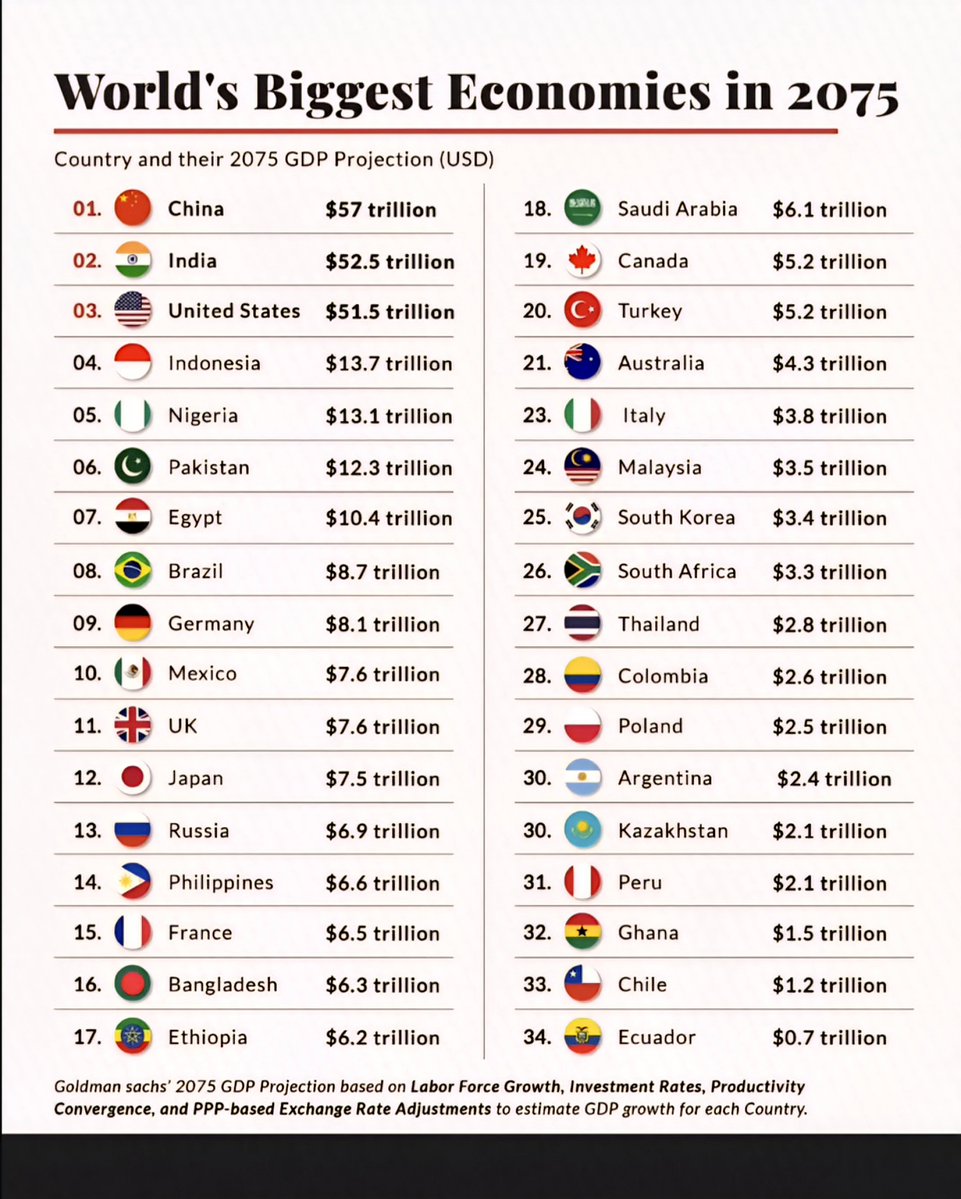
Looking to the Future
The global economic landscape in 2075 is set to be more dynamic and diverse than ever before. Countries that adapt to technological changes, invest in sustainable development, and foster demographic growth will lead the way. While traditional powers like the US and Europe will retain influence, the rise of nations like India, China, and many African countries will reshape global relations, markets, and industries, heralding a new era of economic plurality and innovation.
 ChatGPT
 Perplexity
 Gemini AI
 Grok AI