Select Language:
The Future of Muslims in Europe: Top 10 Countries Expected to Lead by 2050
As Europe continues its demographic evolution, projections for 2050 highlight a significant increase in Muslim populations across the continent. Here’s a detailed look at the countries set to host the highest numbers of Muslims, according to recent studies and high migration scenario forecasts.
Germany to Remain on Top with Nearly 18 Million Muslims
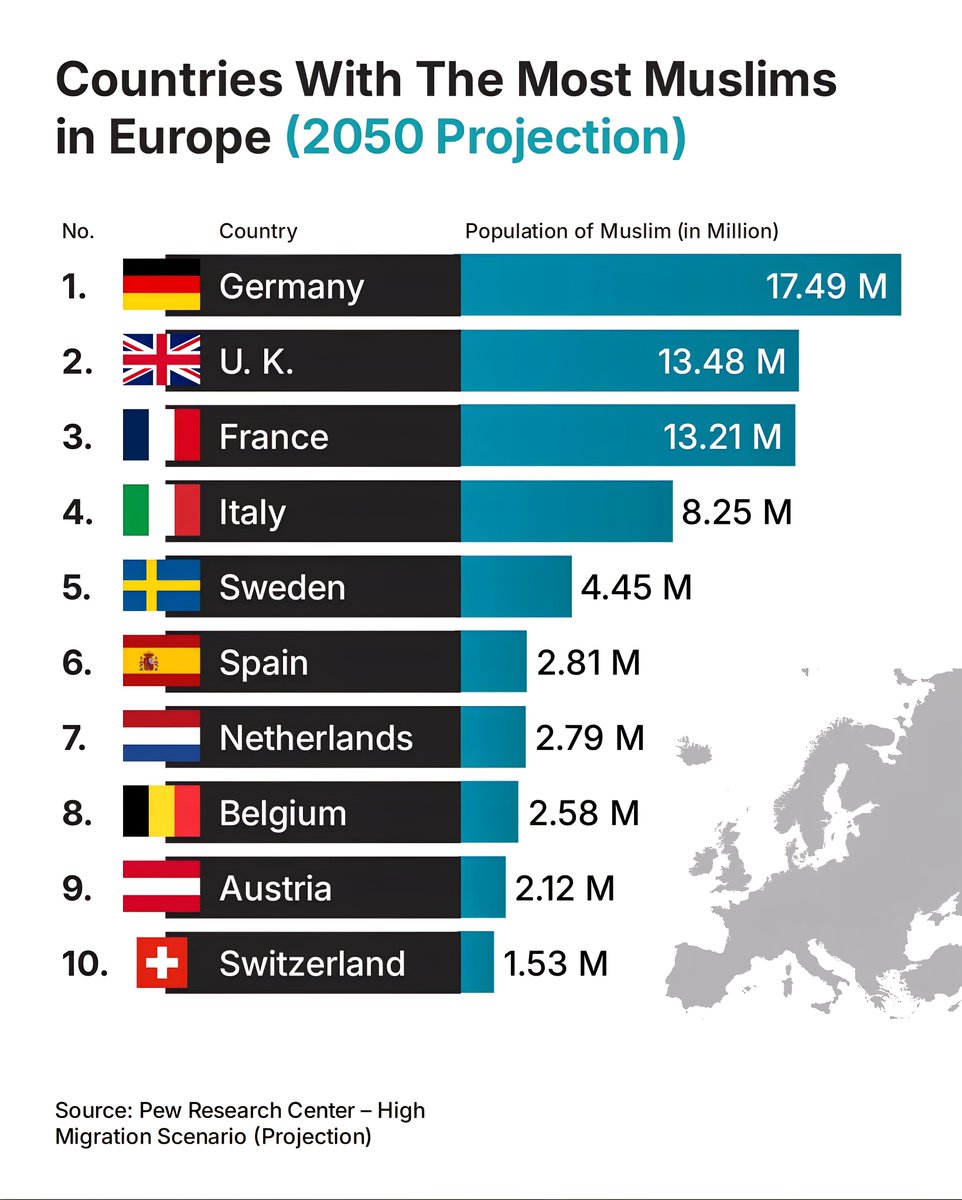
Germany is projected as the leader in Muslim populations, with an estimated 17.49 million Muslims by 2050. This substantial growth reflects ongoing migration patterns, higher birth rates within Muslim communities, and continued cultural integration. Germany’s diverse Muslim community encompasses Turkish, Middle Eastern, South Asian, and African origins, influencing the country’s social fabric significantly.
United Kingdom’s Muslim Population to Reach Over 13 Million
The United Kingdom is expected to see its Muslim demographic swell to roughly 13.48 million by mid-century. London’s multicultural environment continues to attract diverse Muslim communities, fueling this growth. The UK’s relatively open immigration policies and established Muslim institutions further support this demographic trend.
France’s Muslim Residents Likely to Surpass 13 Million
France, home to one of Europe’s largest Muslim populations, is projected to reach around 13.21 million Muslims. Immigration from former colonies, particularly North Africa, and high birth rates are key factors. France’s vibrant Muslim communities influence its cultural, economic, and political spheres, making it a pivotal hub for Muslim life in Europe.
Italy’s Muslim Population Approaching 8.3 Million
Italy is expected to witness its Muslim community grow to approximately 8.25 million. The nation’s proximity to North Africa and increasing labor migration have contributed to the expansion. Italian cities like Rome and Milan are rapidly becoming centers of Muslim culture and commerce.
Sweden: A Growing Muslim Presence with 4.45 Million
Sweden’s Muslim population is projected to be around 4.45 million. The country’s reputation for social openness and asylum policies has historically drawn many Muslim migrants. Community centers, mosques, and religious schools are becoming familiar sights throughout the country’s urban landscape.
Spain’s Muslim Community to Reach Nearly 3 Million
Spain anticipates its Muslim population to reach about 2.81 million by 2050. Migration from North Africa and continued natural population growth are driving this increase. Spanish cities such as Barcelona and Madrid are becoming increasingly diverse, with growing Muslim neighborhoods.
Netherlands and Belgium: Close Contenders with Nearly 2.8 Million and 2.58 Million Muslims
The Netherlands is forecasted to have a Muslim population of approximately 2.79 million, while Belgium’s Muslim communities are expected to number around 2.58 million. Both countries’ moderate immigration policies and active Muslim communities contribute to these figures. Mosques and cultural centers are expanding across major cities, signifying their growing influence.
Austria and Switzerland: Small but Significant Muslim Populations
Austria’s Muslim residents are expected to number about 2.12 million, with Switzerland following at approximately 1.53 million. Despite their smaller sizes, these communities are vibrant and integrated, shaping the cultural landscape.
Key Factors Influencing the Growth Trends
This projected demographic shift results from multiple influences:
- Migration Patterns: Countries with more open immigration policies continue to attract Muslim communities from diverse regions.
- Higher Birth Rates: Muslim populations tend to have higher fertility rates than the European average, contributing to natural growth.
- Cultural Integration and Community Development: Increasing community infrastructure supports the sustenance and expansion of Muslim populations.
Impact on European Societies
The growing Muslim demographic across Europe is poised to influence social, political, and economic spheres. From expanding religious and cultural institutions to shaping policy debates around immigration and multiculturalism, these changes will redefine Europe’s identity in the coming decades.
Source: Pew Research Center – High Migration Scenario (Projection) 2025
Note: The figures are projections based on current demographic trends and migration policies, subject to changes in global or regional circumstances.
 ChatGPT
 Perplexity
 Gemini AI
 Grok AI