

Select Language:
A long time before dinosaurs dominated the Earth, the planet was home to bizarre creatures unlike anything we see today.
One such newly discovered reptile, called Labrujasuchus expectatus, offers scientists a captivating glimpse into that odd ancient world. This species lived during the Triassic Period, over 200 million years ago, a time when the earliest dinosaurs and many other reptile groups were still diversifying into various shapes and lifestyles.
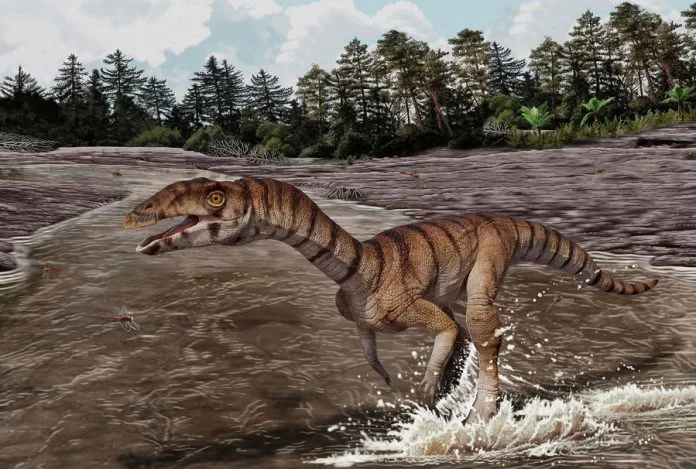
At first glance, Labrujasuchus resembled ostrich-like dinosaurs that appeared much later during the Cretaceous Period. It moved on two legs, had tiny arms, and featured a toothless beak instead of the sharp teeth typical of crocodile relatives. Despite its bird-like look, Labrujasuchus actually belonged to the lineage of reptiles that eventually gave rise to today’s crocodiles. This makes it especially intriguing because modern crocodiles are bulky, four-legged predators with powerful jaws filled with teeth—entirely opposite to Labrujasuchus’s slender, bird-inspired form.
The discovery was detailed in the Journal of Vertebrate Paleontology by researchers including Alan Turner and Nate Smith. Scientists classify Labrujasuchus within a rare group called shuvosaurids, unusual crocodile ancestors that evolved body shapes similar to small, meat-eating dinosaurs. This scenario is an example of convergent evolution, where unrelated animals independently develop similar features because they adapt to comparable lifestyles.
Researchers note that the Triassic Period was full of evolutionary experiments like this. During that era, Earth was bustling with strange reptiles boasting unusual body plans. Some relatives of dinosaurs evolved into flying pterosaurs, while others gained bizarre claws, tree-climbing skills, or armored aquatic bodies. Labrujasuchus adds another piece to this strange prehistoric puzzle.
The fossil was uncovered at Ghost Ranch, a renowned site famous for preserving exceptionally detailed Triassic animals. The area also gained fame through artworks by Georgia O’Keeffe. The name Labrujasuchus combines the Spanish phrase “Ranchos de los Brujos,” meaning “Ranch of the Witches,” with the Greek word for crocodile. The species name “expectatus” refers to how scientists had anticipated finding an animal like this based on previous discoveries.
Prior to this find, scientists had already identified two related shuvosaur species from slightly older and younger layers of rock in the same region. This suggested that another species, like Labrujasuchus, must have existed in between those layers—even before the fossil was discovered.
Findings like this help scientists understand how animals evolved before dinosaurs took full control of Earth’s ecosystems. While many of these peculiar Triassic creatures eventually disappeared, some of their successful body designs persisted in later animals. For example, bipedal movement, bird-like bodies, and beaks appeared long before modern birds.
The researchers also point out that studying ancient ecosystems can improve our understanding of today’s biodiversity and extinction risks. By examining how life adapted and changed after past environmental upheavals, scientists hope to better predict how current species might respond to future challenges.
 ChatGPT
 Perplexity
 Gemini AI
 Grok AI


