
Select Language:
NASA scientists have identified a new heat-resistant material that could assist future astronauts in utilizing moon rocks for construction, oxygen production, and supporting extended missions on the lunar surface. The breakthrough was made at NASA’s Glenn Research Center during research focused on processing lunar soil, or regolith.
This advancement could significantly contribute to NASA’s goal of enabling astronauts to “live off the land” on the moon, reducing the need to transport all materials from Earth. The idea is to extract useful resources directly from lunar materials, such as melting rocks to obtain metals for building structures and oxygen for fuel and life-support systems.
A major challenge, however, is that molten lunar dust is highly corrosive. Kevin Yu, one of the researchers, explained that when lunar rock is heated, it behaves much like lava, which can quickly erode common heat-resistant materials. Yu started investigating this issue while collaborating with Jamesa Stokes through a NASA graduate fellowship.
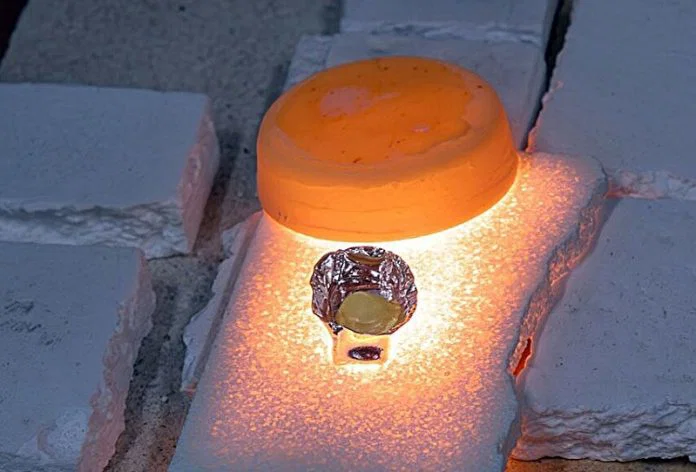
Around six months into their work, the team unexpectedly created a new material while experimenting with simulated lunar dust mixed with scandium oxide. When heated in a furnace to temperatures over 2,900°F, they observed the formation of an unfamiliar substance. Scientists checked extensive databases containing over a million known materials, but they found no match, indicating they had created something entirely novel.
Further analysis revealed the composition of this new material. Additional samples were produced by grinding and mixing in the lab. Initially appearing as a bright pink powder, it turned beige after heating—a visual sign that the chemical reaction had succeeded. Testing confirmed the material’s durability in extreme conditions, showing resistance to corrosion from molten lunar dust and the ability to withstand temperatures far beyond those tolerated by standard industrial materials.
This material has the potential to be used in constructing equipment for resource extraction on the moon, such as pipes, containers, or processing systems that hold molten lunar rock. Although it contains scandium oxide, which can be expensive, experts note it is still more cost-effective than rare metals like platinum often used in high-temperature applications.
Interestingly, the team also found that the material could have practical uses on Earth. It is lighter, less dense, and offers superior heat insulation compared to some of today’s advanced protective coatings used in jet engines.
The scientists aim to continue refining this material to improve its purity and lower production costs. Stokes emphasized that advanced materials research is crucial for future space exploration since even the most sophisticated spacecraft or habitats require materials capable of enduring harsh environments. Additionally, they believe that innovations driven by space research often translate into beneficial technologies on Earth, potentially enhancing energy systems, aviation, and industrial manufacturing through the push to explore the moon.
 ChatGPT
 Perplexity
 Gemini AI
 Grok AI