
Select Language:
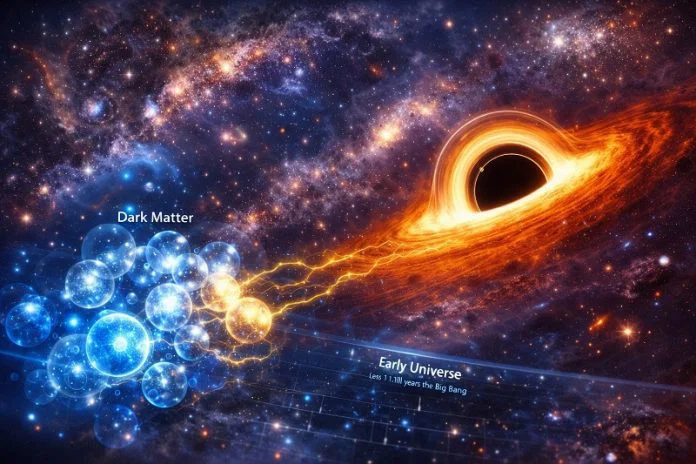
Astronomers have long been intrigued by the presence of massive black holes in the early universe. Some of these black holes, discovered less than a billion years after the Big Bang, are as large as a billion times the mass of our Sun. Traditional theories suggest there wasn’t enough time for these giants to form through standard growth processes. However, a recent study offers a potential explanation involving dark matter.
Led by researchers at the University of California, Riverside, the study proposes that a gradual “decay” of dark matter particles might have created favorable conditions for rapid black hole formation. This research was published in the Journal of Cosmology and Astroparticle Physics.
Dark matter, which accounts for approximately 85% of all the matter in the universe, remains one of science’s greatest mysteries. It doesn’t emit or reflect light, making it invisible to telescopes. Yet, its gravitational pull influences galaxy formation and the large-scale structure of the cosmos. In this new investigation, scientists examined what could happen if dark matter particles slowly release tiny amounts of energy as they decay over time.
While each particle would emit an incredibly small amount of energy—far too little to influence everyday devices—this energy might have had a significant impact in the early universe. At that time, galaxies primarily consisted of simple hydrogen gas, which is highly responsive to even minimal energy changes.
Typically, this hydrogen gas cools and forms stars. The researchers found that if the decay of dark matter adds just enough energy, it can alter the gas chemistry in a way that hinders star formation. Instead, large amounts of gas could directly collapse into black holes—a process known as “direct collapse”—which accelerates the formation of black holes far beyond the normal timeline.
The discovery of unexpectedly large black holes by the James Webb Space Telescope in the early universe has challenged traditional models. The new research suggests that dark matter decay could have increased the frequency of direct collapse events, helping to explain these observations.
Using sophisticated computer simulations, the team analyzed how gas would behave under the influence of decaying dark matter. They identified specific ranges of dark matter particle masses that could produce the ideal conditions for direct collapse, adding an important piece to the puzzle of how the first galaxies and black holes emerged.
This idea also bridges different areas of physics, linking cosmology and particle physics. It demonstrates how tiny effects at the atomic level could have driven the evolution of the universe as a whole.
Though further research is necessary to confirm this hypothesis, the findings present a compelling new perspective on one of astronomy’s most profound mysteries. If proven correct, it would mean that dark matter not only shaped galaxies through gravity but also directly contributed to the creation of some of the universe’s earliest and most massive objects.
 ChatGPT
 Perplexity
 Gemini AI
 Grok AI