Select Language:
Scientists in South Korea have developed an innovative biotechnology that utilizes engineered microbes to convert biodiesel waste into a key ingredient used in plastics, textiles, and cosmetics. This advancement could reduce reliance on petroleum-based chemicals while offering a sustainable way to recycle industrial waste that would typically be discarded.
The research was led by scientists at KAIST in partnership with Hanwha Solutions, and their findings were published in the journal Nature Chemical Engineering.
Traditionally, the petrochemical industry depends heavily on naphtha, a petroleum-derived raw material used to produce plastics and synthetic fibers, among other products. However, increasing costs and supply instability have driven efforts to find cleaner, more reliable alternatives.
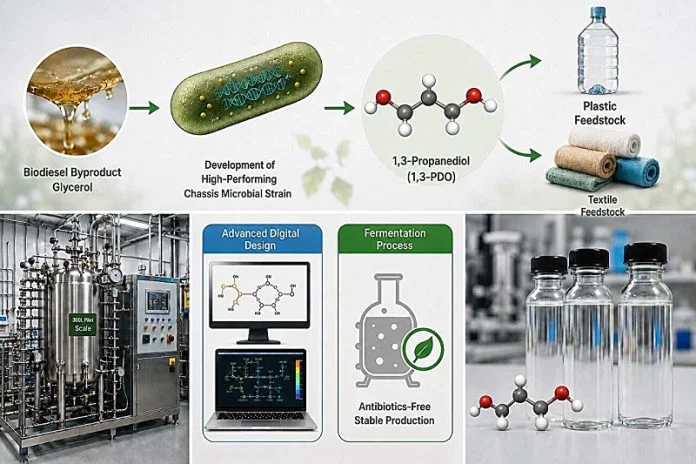
This new technology focuses on glycerol, a byproduct generated during biodiesel production. Globally, large amounts of glycerol are produced, most of which holds limited economic value. Instead of treating glycerol as waste, researchers engineered microorganisms capable of converting it into a valuable chemical called 1,3-propanediol (1,3-PDO). This compound is commonly used in manufacturing plastics, cosmetics, coatings, and textiles.
To maximize efficiency, the scientists genetically modified microbes to produce higher yields of 1,3-PDO. They employed computer simulations to identify which genes to tweak, enhancing the microbes’ production capabilities.
One of the most significant achievements was scaling up the process from the lab to a 300-liter pilot fermentation system. Demonstrating stable production at this size marks an important step toward industrial application. Scaling microbial processes often presents challenges, as microorganisms can behave differently in larger systems, but maintaining performance in the pilot system suggests potential for commercial use.
Another notable aspect of this development is the removal of antibiotics during fermentation. Many industrial microbial processes rely on antibiotics to maintain genetic stability, but their use raises concerns about antimicrobial resistance and regulatory hurdles—especially for products related to food, cosmetics, or healthcare. Eliminating antibiotics makes the process safer and more appealing for commercialization.
This project reflects nearly a decade of collaboration between KAIST and Hanwha Solutions, starting in 2015. Over the years, their partnership has resulted in numerous scientific publications and patent applications, serving as a successful model for university-industry cooperation in South Korea.
The researchers believe their work demonstrates that microorganism-driven chemical production can transition from laboratory experiments to viable industrial solutions. Such technologies have the potential to foster a more sustainable chemical industry by reducing dependence on fossil fuels, minimizing waste, and producing materials through environmentally friendly methods. Similar approaches could eventually be adapted to produce many other chemicals currently derived from petroleum.
As industries seek greener production techniques, engineered microbes are poised to become increasingly vital in transforming waste into valuable resources.
 ChatGPT
 Perplexity
 Gemini AI
 Grok AI