Select Language:
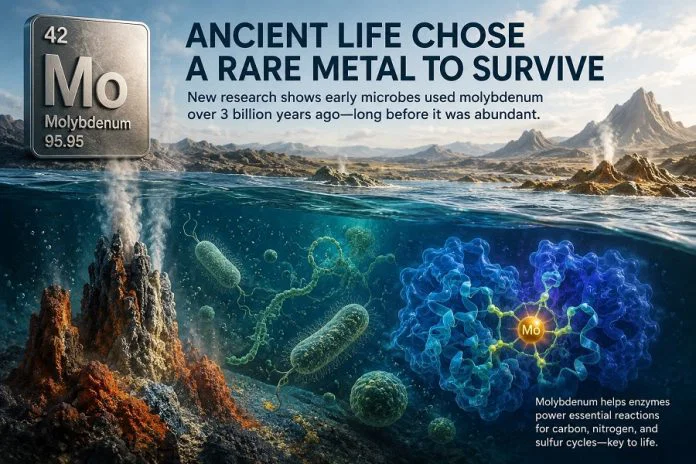
Over three billion years ago, life on Earth encountered a significant challenge. The oceans contained only trace amounts of molybdenum, a rare metal crucial to many biological processes today. However, recent research indicates that some of the earliest living organisms were already utilizing this metal long before it became more abundant in Earth’s environment.
This discovery shifts the current understanding of how early life evolved and persisted on a primitive Earth. The study, published in Nature Communications, suggests that the use of molybdenum by ancient microbes occurred much earlier than previously thought. Although molybdenum might seem unfamiliar, it plays a vital role inside cells by aiding enzymes that drive key chemical reactions involving carbon, nitrogen, and sulfur. These reactions are fundamental to energy production and the transport of nutrients within ecosystems. Without molybdenum, such processes would be far too slow to sustain life.
Betül Kaçar, the senior author of the study and head of the Kaçar Lab at the University of Wisconsin–Madison, explains that understanding when early life first began using molybdenum helps scientists pinpoint when some of Earth’s earliest metabolic systems came into existence. Today, molybdenum is quite common, but during the Archean Eon—over 3 billion years ago—Earth’s oceans held only tiny amounts of it.
Previously, scientists believed that early organisms mainly relied on tungsten, a metal with similar properties, which some microbes in extreme environments still use today. This led to the popular “tungsten first” theory, proposing that ancient life initially evolved with tungsten and only transitioned to using molybdenum after oxygen levels increased, making molybdenum more readily available.
The recent study challenges this idea. By examining geological records and reconstructing the history of metal utilization across evolutionary history, researchers found evidence that both molybdenum and tungsten were already in use by microbes between approximately 3.7 and 3.1 billion years ago—well before the Great Oxidation Event about 2.45 billion years ago. This major shift in Earth’s atmosphere, driven by photosynthetic microorganisms, marked a significant increase in oxygen levels.
The scientists suggest that early life might have found tiny pockets of molybdenum deep within the oceans, near hydrothermal vent systems on the seafloor. These underwater volcanic vents release various metals—including iron, copper, nickel, cobalt, tungsten, and molybdenum—creating specialized environments where early microbes could access scarce resources.
Despite its scarcity, molybdenum may have provided significant advantages. Its effectiveness in supporting enzyme functions under diverse chemical conditions might explain how early life evolved methods to find and utilize this metal against the odds.
These findings also have implications for the search for extraterrestrial life. They remind us that alien ecosystems might not follow the same pathways or rely on the same chemicals as modern Earth life. Instead of only targeting planets that resemble Earth, scientists may need to consider a broader range of environments where alternative metals, chemicals, or oxygen levels could support life.
Overall, the research demonstrates that life can be remarkably adaptable, finding creative ways to survive and thrive even in the most challenging conditions.
 ChatGPT
 Perplexity
 Gemini AI
 Grok AI