Select Language:
Scientists have released the largest catalog of gravitational wave detections to date, marking a significant milestone in understanding black holes and the universe’s workings.
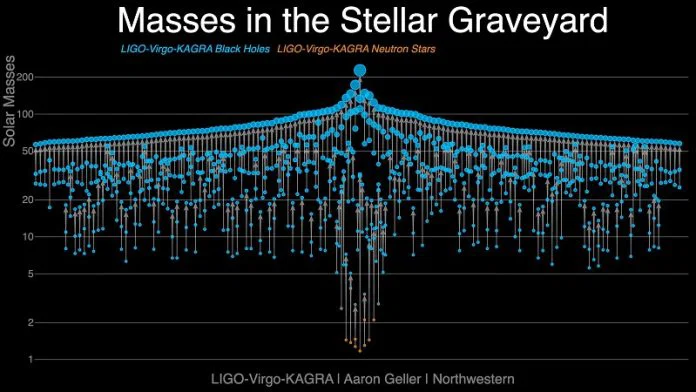
The new compilation, called GWTC-5, includes 161 confirmed signals from merging black holes detected between April 2024 and January 2025.
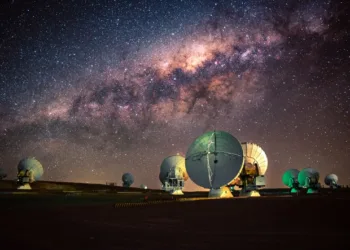
This breakthrough was achieved by the international LVK collaboration, which manages advanced gravitational wave observatories—LIGO in the U.S., Virgo in Italy, and KAGRA in Japan.
With these latest additions, the total count of detected gravitational wave signals now stands at 390.
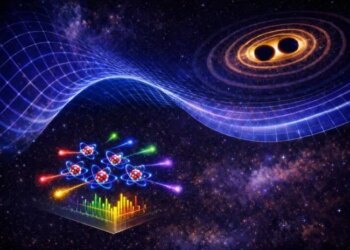
Gravitational waves are minuscule ripples in spacetime caused by catastrophic cosmic events like black hole collisions.
Detecting these waves is extraordinary challenging because they shift space by less than an atom’s width. Researchers rely on highly sensitive instruments to observe these tiny disturbances.
For decades, researchers at the University of Glasgow have been pioneers in gravitational wave science.
They contributed to developing essential technology for LIGO, including the ultra-sensitive mirror suspension systems that enable detection of these faint signals.
Since the first confirmed detection in 2015, the number of discoveries has surged as the detectors have become more refined. Currently, scientists identify around three to four signals weekly.
The latest catalog features several record-setting events. One, known as GW240615, provided the most precise localization of a gravitational wave source ever achieved, narrowing down its origin to just six square degrees in the sky—an extraordinary feat for such measurements.
This event involved the collapse of two black holes, roughly 26 and 30 times the mass of the sun, merging more than 3 billion light-years away.
The updated catalog is also playing a key role in addressing one of cosmology’s biggest mysteries: the universe’s expansion rate, expressed by the Hubble constant.
Gravitational wave data offers a new approach to measuring cosmic distances. By estimating how far away these black hole mergers happen—and sometimes identifying their host galaxies—scientists can refine calculations of the universe’s expansion rate.
The return of Virgo during this observing period significantly enhanced the ability to pinpoint signal origins. Additionally, researchers utilized 236 gravitational wave events in their analyses, nearly doubling the data used previously.
Another notable event, GW250114, stands out as the clearest gravitational wave detection to date, with an exceptionally high signal-to-noise ratio, allowing for precise analysis.
This merger involved two nearly identical black holes, about 32 and 34 solar masses, merging over a billion light-years away.
Thanks to the clarity of this signal, scientists performed some of the most rigorous tests of Einstein’s theory of general relativity to date. The data also supported Stephen Hawking’s black hole area theorem, which suggests the surface area of black holes should increase after a merger.
Evidence continues to grow for the existence of “second-generation” black holes—those formed from previous black hole mergers rather than direct collapse from a star.
In late 2024, two events revealed strong signs of this process, indicating these repeated mergers likely happen within dense star clusters where black holes frequently interact and collide.
By studying hundreds of these events, scientists are beginning to identify patterns in black hole masses, spins, and formation pathways. The expanding catalog is revealing that these phenomena are not isolated incidents but part of a larger structure within the universe’s black hole population.
Source: University of Glasgow.
 ChatGPT
 Perplexity
 Gemini AI
 Grok AI