Select Language:
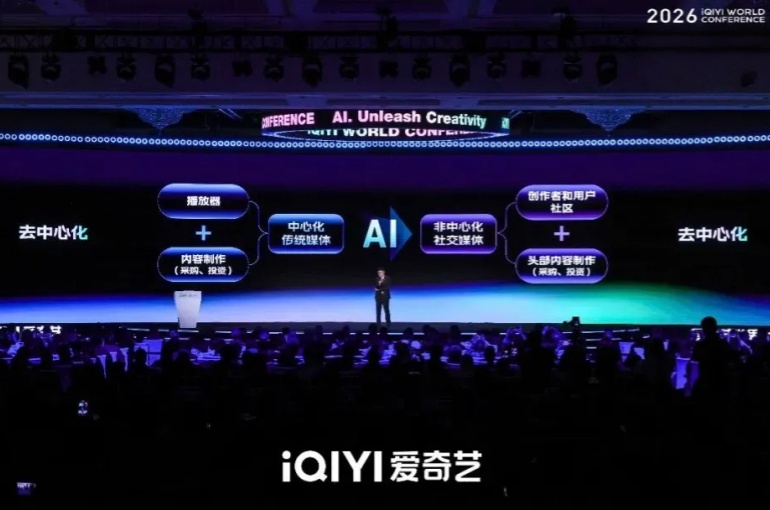
Chinese streaming platform announced that it will transition to a decentralized content creation model and unveiled the commercial version of its artificial intelligence production platform, Nadou Pro, during the latest global conference. This new approach grants creators greater independence over their productions and revenue streams.
This shift signifies a major restructuring of their traditional content strategy, as the company anticipates that AI advancements will dramatically cut production costs and speed up timelines. As the number of creators and content output increases, centralized editorial oversight becomes less feasible. The platform now allows creators access to its intellectual property library, talent network, digital assets, distribution channels, and revenue-sharing systems.
The CEO explained that the economy of AI is fueling this transformation. Lower production costs and faster speeds are expected to lead to an exponential rise in both creators and content—potentially increasing output by at least 100 times. Citing the Jevons paradox, they argued that efficiency improvements driven by AI in film and television production will, paradoxically, boost overall output rather than decrease resource consumption, similar to how more efficient steam engines led to increased coal use.
The company aspires to evolve into a social media-like platform where creators own their intellectual property, maintain direct relationships with audiences, and earn substantial profits. Their focus is on fostering a new content ecosystem through close collaboration with creators.
Under this new model, creators will have full autonomy to decide what to produce, fund their projects independently, and upload completed works to compete directly for viewer attention. Earnings will be performance-based, with no fixed cap. The platform will primarily provide the technological infrastructure, distribution channels, and basic guidelines, while stepping back from managing editorial content.
The key component of this infrastructure is Nadou Pro, now available for commercial use. This AI-driven production platform integrates nearly 70 AI tools covering scriptwriting, directing, visual design, editing, and more, in a seamless workflow designed to maintain character and scene consistency—an ongoing challenge for AI-generated videos.
Creators can license content from the company’s IP library, work with affiliated talent, and access a shared digital asset library comprising virtual sets, props, and AI-generated characters, all linked to distribution and monetization systems. Revenue sharing depends on project performance, and a 20% subsidy is being offered for mid-form series created with AI through the end of 2026.
The content chief emphasized that traditional storytelling is still vital to the company’s strategy. “AI cannot replace high-quality intellectual property,” he stated. “Compelling stories will always fetch top value.” Additionally, over 350 new titles across dramas, variety shows, films, and animations were announced.
However, the announcement also sparked controversy regarding actors’ authorization. The company reported that more than 100 actors had joined its AI talent database in Nadou Pro. Yet, some actors’ studios publicly clarified that they had not consented to AI likeness use, with legal teams pursuing clarifications. They stressed that inclusion in the database only indicates willingness to discuss potential collaborations, and any project involving an actor’s image or voice would require separate agreements and consent. An internal review found 117 artists listed as of the announcement.
The leadership admitted that AI-generated content still faces creative challenges. Despite advances in visual quality, fully developed and emotionally engaging storytelling remains scarce. They described this as a “last half-kilometer” problem, noting that most AI content currently concentrates on visually driven genres like sci-fi and fantasy.
The company observes two diverging trends: traditional filmmakers with storytelling expertise but less technical aptitude, and AI-native creators with strong visuals but weaker narrative skills. Overcoming this divide will require convergence, and the decentralized platform aims to unify these diverse creators into one ecosystem.
 ChatGPT
 Perplexity
 Gemini AI
 Grok AI