Select Language:
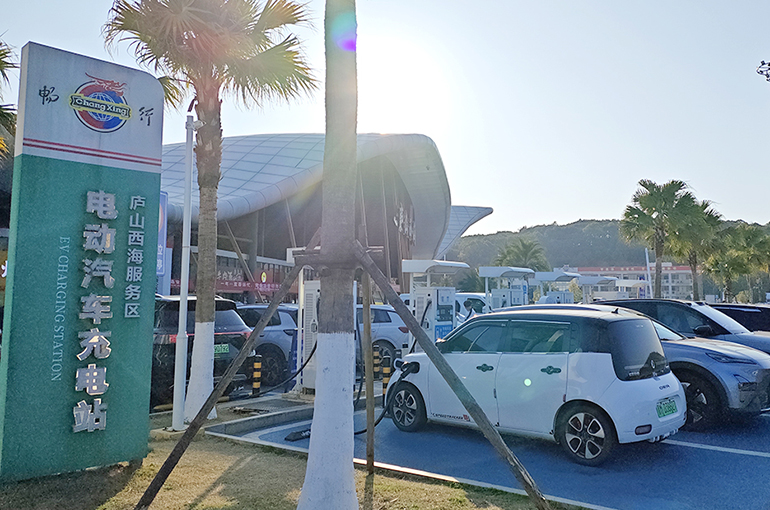
More Chinese migrant workers could now return home more easily this Chinese New Year thanks to the expansion of the country’s electric vehicle charging network in rural areas and small towns.
Xu Qiang, who works in Guangzhou, hails from Hunan Province. Over the past three years, he has driven his electric vehicle approximately 700 kilometers to celebrate the holiday with his family. He shared that three years ago, he relied on an extension cord to charge his car at home, which took about two days for a full charge because only one fast-charging station was available in his town and a nearby town.
This year, the number of fast-charging stations in his area increased to nine, with the closest being just a kilometer away. “Charging your electric vehicle in rural areas is now nearly as convenient as in city centers,” he explained.
He recalled that three to four years ago, it was common to wait in line for up to four hours just to get a one-hour charge. “Now, if there’s no major traffic jam, I can charge immediately upon arrival,” he added.
Last year, China added nearly 7.3 million EV charging stations, a 72% increase from 2024, bringing the total count to over 20 million by the end of last year, according to data from the National Energy Administration. It took 13 years to reach the first million charging stations, five years to increase from one million to ten million, and only 18 months to go from ten million to twenty million.
The share of EV charging stations in the top 10 provinces has decreased to 66% last year from 71% in 2022, with 19 provinces achieving complete coverage of rural areas as of December 31, 2025.
On February 15, the first day of the nine-day Chinese New Year holiday, the national highway charging volume reached 15.28 million kilowatt-hours, a 116% increase compared to the previous year, according to the NEA. In the first three days of the holiday, 1.4 million EVs were charged along highways, which is a 63% rise from the same period last year.
The NEA has launched a ‘three-year doubling’ plan, targeting the installation of 28 million charging facilities by the end of 2027, which is expected to attract investments exceeding 200 billion yuan (around 29 billion USD), according to Xing Yiteng, deputy director of the NEA’s development planning department, at a recent press conference.
 ChatGPT
 Perplexity
 Gemini AI
 Grok AI