Select Language:
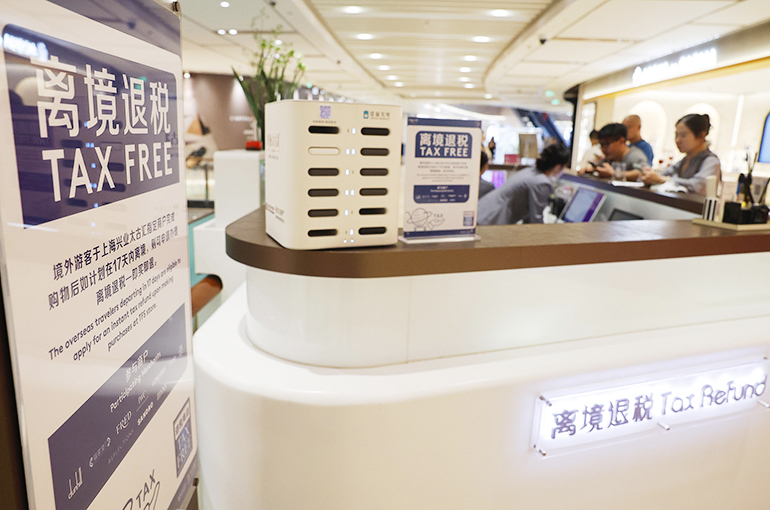
China has introduced eight new measures aimed at further refining its departure tax policy for international travelers to support the high-quality growth of the retail and tourism sectors, thereby boosting inbound tourism spending.
These measures, set to take effect on July 1, were announced yesterday by the Ministry of Commerce and five other government agencies. Key provisions include expanding the list of participating stores, streamlining the verification process, and encouraging digital, paperless procedures.
For products priced under CNY10,000 (approximately USD1,468), tax refund applications will now be randomly selected for checks instead of mandatory physical inspections. This change is expected to reduce customs workload and shorten wait times at ports, enabling travelers to enjoy a more seamless “apply-and-go” experience, according to Fan Yong, dean of the School of Public Finance and Taxation at the Central University of Finance and Economics.
With the shift to paperless processing, travelers will be able to complete their tax refunds electronically, retrieving necessary information directly from the system, even if they lose their physical receipts or application forms.
The scope of tax refunds on purchases will also expand from a pilot initiative to a nationwide mutual recognition system, allowing visitors to receive their refunds immediately and spend the money further.
Additionally, travelers will now have the option to finalize their departure tax refund procedures at different departure ports from where they arrived, and the allowable departure window will be uniformly extended to 28 days. This flexibility will make it more convenient for tourists visiting multiple cities to claim refunds.
Last year, the value of goods eligible for tax refunds nearly doubled compared to 2024, with sales matching the total accumulated in the past decade, according to Sheng Qiuping, China’s Vice Minister of Commerce.
The number of people claiming tax refunds hit 270,000 in 2025—a fourfold increase from the previous year. Sheng also noted that the number of tax refund stores increased four times to reach 14,000 since the end of 2024.
 ChatGPT
 Perplexity
 Gemini AI
 Grok AI