Select Language:
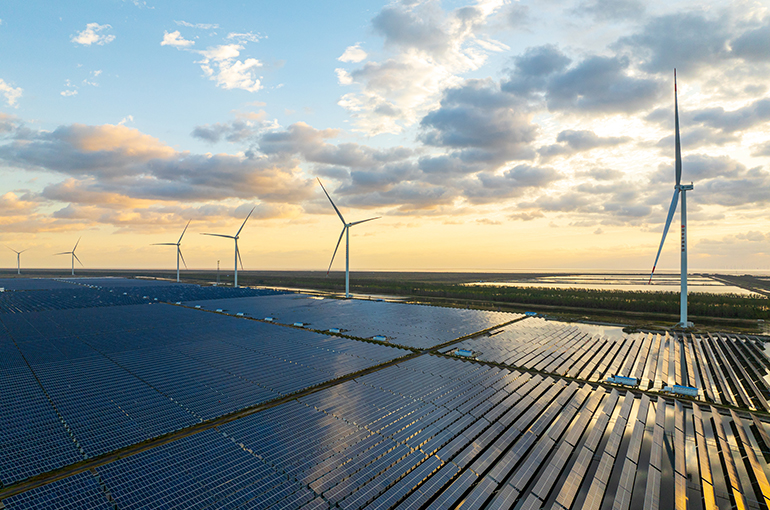
China has introduced a new policy today aimed at encouraging investments in multi-user direct green power connection projects to advance transparent green production and increase local renewable electricity consumption.
This initiative aligns with the tightening global carbon regulations and China’s ongoing efforts to meet its dual-carbon targets. It represents another significant step by Chinese energy authorities to enhance domestic renewable energy use and facilitate a transition towards greener industrial processes.
Jointly issued by the nation’s top economic planning agency and the national energy administration, the policy states that users seeking green electricity can leverage nearby renewable energy resources to develop multi-user direct green power connection projects. Industrial parks, zero-carbon zones, and expanding power distribution networks are permitted to independently organize such projects for some or all of their users.
The document emphasizes that priority will be given to emerging industries and future-oriented sectors, including computing infrastructure and the production of green hydrogen, ammonia, and methanol, encouraging them to adopt direct green power connection models.
Promotion of Local Renewable Energy Use
These multi-user connection projects involve multiple independent legal entities that consume green electricity. Under the off-grid setup, renewable energy generated is supplied solely to participating users through regional, self-built power networks. In the grid-connected format, renewable power is first delivered to users via dedicated networks, with excess electricity transmitted to the public grid through designated interfaces.
Because the project’s internal power system remains physically separate from the public grid—covering infrastructure, operational management, and metering—users can accurately trace the origin of their electricity.
A spokesperson explained, “This new policy offers a more cost-effective green electricity consumption model compared to single-user projects and marks a significant move towards improving nearby renewable energy consumption mechanisms.”
The energy administration’s policy clarification states that the multi-user model builds upon the previous year’s single-user direct green power connection policy, aiming to elevate local renewable energy consumption levels.
Stringent Consumption Standards
The policy mandates that at least 60% of a project’s total available power generation must be used self-sufficiently each year. Currently, green electricity used internally must comprise at least 30% of a project’s total electricity consumption, with a goal to increase that share to 35% by 2030. Additionally, grid-connected projects are generally restricted from transmitting more than 20% of their total generated power to the public grid after start-up to promote local use.
The policy also stipulates that the primary operator of a multi-user green power project must be an independent legal entity. Such entities are typically formed jointly by power generators and consumers, though they can also be established separately. For industrial parks, park management entities may collaborate with third-party organizations to set up project operators.
Data from the energy administration in February indicated that 84 green power connection projects across the country had been approved, with a combined capacity of 326 gigawatts. These projects attracted investments from state-run enterprises and private firms alike.
 ChatGPT
 Perplexity
 Gemini AI
 Grok AI