Select Language:
Alibaba’s semiconductor division announced today the launch of a next-generation AI chip that outperforms the previous model by three times. This new chip highlights the company’s ongoing efforts to bolster its artificial intelligence hardware infrastructure.
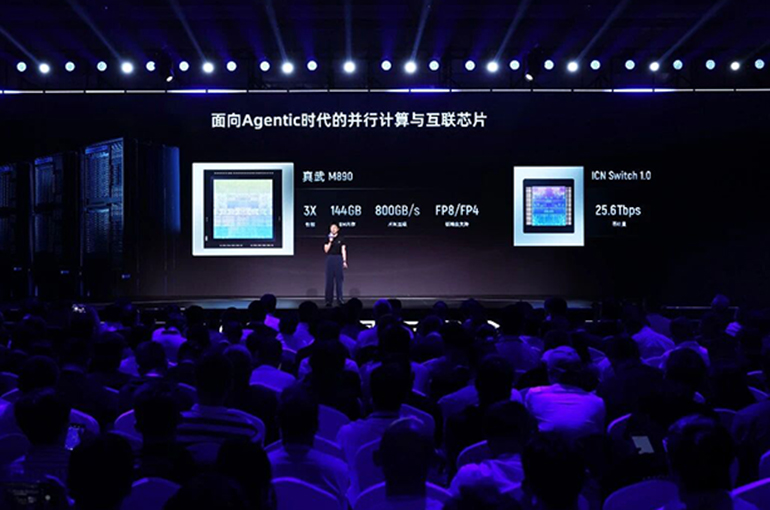
The new AI training and inference processor, dubbed Zhenwu M890, comes equipped with 144 gigabytes of memory and boasts an inter-chip bandwidth of 800 gigabytes per second. When paired with the company’s own ICN Switch 1.0 interconnect chip, it facilitates full-bandwidth connectivity among 64 chips, drastically enhancing the efficiency of large-scale AI computing clusters.
In addition to the chip, the company introduced a 128-chip supernode server that minimizes communication delays to the hundred-nanosecond range. This system addresses the increasing needs for simultaneous inference and model training in AI applications. The announcement was made at the company’s cloud summit held in Hangzhou.
The company has laid out plans to accelerate its chip development schedule further, targeting the release of the Zhenwu V900 in the third quarter of next year, which is expected to triple current performance levels. Long-term plans also include launching the Zhenwu J900 in the third quarter of 2028.
Founded in 2018 through the merger of Alibaba’s Damo Academy chip team and C-Sky Microsystems—a company fully acquired by Alibaba—this division initially introduced the Zhenwu 810E in January. That chip featured 96 gigabytes of memory and an inter-chip bandwidth of 700 gigabytes per second.
To date, shipments of the Zhenwu series have totaled 560,000 units, serving over 400 clients across more than 20 industries. Key customers include China Telecom, FAW Group, and Shanghai Pudong Development Bank.
In recent months, the company has stepped up its AI initiatives by creating the Token Hub business group and establishing an AI Technology Committee, both directly overseen by its CEO. During a March earnings call, the CEO revealed the company’s goal to grow its annual cloud and AI revenue from approximately 14.7 billion USD to 100 billion USD within the next five years.
Reports from early this year indicated the company is considering a potential future independent IPO for its semiconductor division.
 ChatGPT
 Perplexity
 Gemini AI
 Grok AI