Select Language:
In the realm of artificial intelligence, the United States and China are engaged in a fierce competition. While American companies currently hold the upper hand with top-tier models, their technological advantage is narrowing, fueling concerns about falling behind. As a result, there’s an ongoing effort among U.S. firms to suppress Chinese AI enterprises.
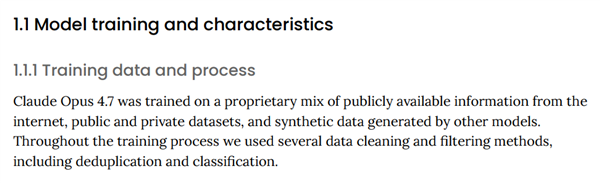
Anthropic, one of the most aggressive players in this domain, recently launched a public attack against Chinese AI companies. The firm accused them of “distilling” their large models to enhance capabilities, a practice widely regarded as standard in AI development. Interestingly, Anthropic itself has been engaging in similar activities. Not long after releasing its Claude Opus 4.7 model, the company disclosed details about its training methodologies, revealing that the model was trained on a proprietary blend of internet data, both public and private datasets, as well as synthetic data generated by other models.
This admission essentially means that Claude Opus 4.7 was trained using information from a variety of sources, including data derived from other large models—an example of the very practice they critique in Chinese companies. Anthropic has not specified which companies’ data they used, likely to avoid controversy or legal repercussions, especially if any Chinese enterprise was involved.
In the AI sector, model distillation — the process of transferring knowledge from one model to another — is a routine and widely accepted technique. The use of internet data for training large models is considered standard practice. However, Anthropic’s recent achievements have propelled them to the forefront of the industry, and they are now leveraging their dominant position to criticize competitors. Moreover, the company has teamed up with other U.S. giants like Google and OpenAI to form an alliance against the practice of distillation, which they now frame as problematic.
This coalition has even gone as far as collaborating with U.S. lawmakers to introduce legislation aiming to sanction companies that engage in distillation, portraying them as threats to national interests. The boldness of these moves—essentially labeling distillation as a harmful practice—exposes a strategic push to curb the growth of Chinese and other foreign AI firms, illustrating a level of rivalry that has become quite intense in the industry.
 ChatGPT
 Perplexity
 Gemini AI
 Grok AI