
Select Language:
Recently, a surge in affordable Chinese AI models has caught the attention of international users, many of whom have become enthusiastic customers of various domestic large models. However, an issue has emerged: foreign buyers are discovering that their subscription costs are significantly higher than those paid by Chinese users for similar plans.
China’s AI industry has seen rapid advancements, particularly in programming and coding capabilities. Models like Zhipu’s GLM-5.1 have not only climbed close to or even surpassed the performance of top-tier models like Claude Opus in some rankings but also deliver impressive user experiences. Meanwhile, Claude Opus 4.6 has recently experienced noticeable declines in performance, making the gap between these models even narrower.
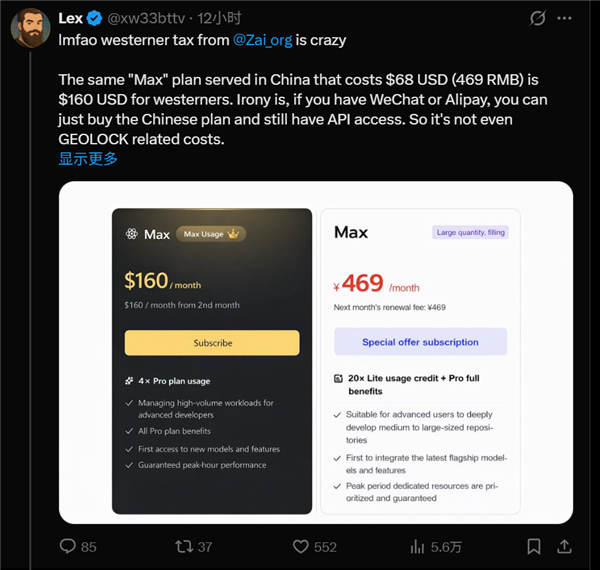
Zhipu’s Coding Plan packages have become popular, with demand surging both domestically and internationally. However, prices differ considerably depending on the user’s location. A foreign user recently pointed out that the same Max plan costs 469 RMB (about $68) per month for Chinese customers, but those abroad are required to pay over $160 each month — more than twice the price. The user labeled this discrepancy as a “Westerner tax,” noting that paying with platforms like WeChat or Alipay would align the price with local Chinese rates.
This criticism has sparked strong reactions overseas, with some even describing the pricing gap as downright “evil.” The foreign user expressed frustration at what they see as unfair pricing practices, portraying it as a form of exploitation.
For those in China, however, this foreign criticism seems to symbolize how much the world has changed. Over the past few decades, Chinese consumers have faced many more severe issues with pricing than this. Many Western companies operating in China have often set prices that are significantly higher than in their home markets—sometimes even more than double when considering exchange rates. Such practices have long been common, with international firms charging Chinese consumers premiums for many products and services.
Traditionally, global companies are expected to set prices based on a combination of standard rates plus local taxes, adhering to principles of fairness and non-discrimination—Apple’s iPhone is often cited as an example of this approach. Yet, many Western firms in China do not follow this model. Instead, they adopt a strategy of “pricing based on the market,” transforming affordable Western offerings into luxury brands once they enter the Chinese market, with prices often inflated far beyond their original scope. Even after currency conversion, these prices tend to be higher, effectively “overcharging” Chinese consumers.
Today, as Chinese companies become more competitive in AI, they are implementing targeted pricing strategies tailored to different regions. This approach has some foreign users struggling to accept these differences, highlighting the ongoing shifts in the global digital economy.
 ChatGPT
 Perplexity
 Gemini AI
 Grok AI