
Select Language:
Recent updates in the artificial intelligence arena reveal that the dominant players continue to be the United States’ top AI giants. Notably, Elon Musk’s xAI has fallen behind in performance and has been integrated into SpaceXAI. Musk’s latest disruptive move, however, may have been leaked ahead of official announcement.
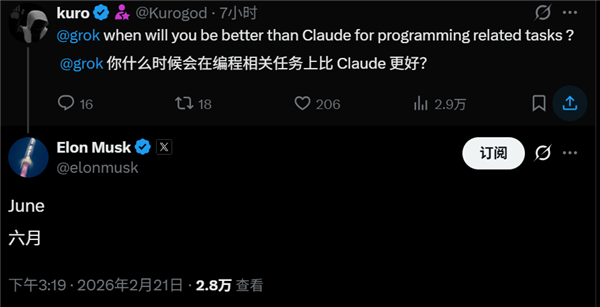
The most promising and lucrative sector within AI development appears to be AI programming assistants. Musk previously announced plans to release a new large language model (LLM) by June, aiming to surpass current industry leader Claude in coding capabilities.
Speculation suggests that this upcoming advanced tool is likely the recently leaked platform-independent desktop coding assistant called Grok Build. An unexpected test portal for Grok appeared on its web platform, allowing users to toggle between local folders and Google Drive seamlessly.
Grok Build is compatible across all major operating systems — macOS, Linux, and Windows — and notably departs from traditional chat-first models. Instead, it functions as an agent-based workflow application capable of autonomous, multi-step development tasks. It offers extensive local permissions from the outset, enabling deep integration with local development environments.
The platform boasts a comprehensive extension system, supporting integration with MCP (Model Context Protocol), official skills, and various plugins. It can directly access Git repositories, manage local files, and even autonomously boot developer servers. Grok Build also offers task planning features, a built-in browser for web browsing, and specialized modes for managing complex, multi-step workflows.
The default high-performance model for Grok Build is expected to be Grok 4.3 Early Access, known for its exceptional code generation capabilities.
Images included in recent reports showcase the interface of Grok Build and highlight its potential to rival or even surpass existing coding AI tools.
Elon Musk has also hinted at training several larger models, with a total of seven in development. These include:
– Imagine V2, a new iteration for image and video generation
– Two variants of a 10,000-billion-parameter model
– Two variants of a 1.5-trillion-parameter model
– A 6-trillion-parameter model
– A 10-trillion-parameter model
To compete with Claude’s Opus-level models — which are believed to be around 50 trillion parameters — Musk’s team is aiming for at least a 60-trillion-parameter model. Smaller models with only 10 to 20 trillion parameters are unlikely to outpace Opus effectively.
If Grok Build manages to make a significant impact, it probably will leverage the upcoming Grok 5 large model generation, providing developers with an alternative that could reduce reliance on Claude’s ecosystem.
As this development unfolds, industry watchers are eager to see how Musk’s ambitious models will perform, potentially reshaping AI coding tools and developer workflows in the coming months.
[This article originally appeared on Kuai Technology. All rights reserved.]
 ChatGPT
 Perplexity
 Gemini AI
 Grok AI