Select Language:
Last January, the launch of DeepSeek R1 marked a significant turning point, leading to a dramatic reshuffling in the tech market. Nvidia faced a staggering $600 billion wipeout in a single day amid speculation that the demand for computing power was reaching its peak. However, the narrative didn’t imply that the money had disappeared; rather, it had shifted direction. Capital flowed eastward, fueling a rally for Alibaba, Tencent, and Meituan, culminating in a collective re-evaluation of Chinese assets that marched smoothly and confidently.
Over a year later, DeepSeek V4 made its debut. Unlike the previous scene of chaos, Nvidia’s stock didn’t plunge. Instead, after a brief hesitation of about an hour, it closed up by 4.32%, smashing previous highs. The US semiconductor sector continued its impressive run with 18 consecutive days of gains, and domestic concepts centered on powerful computing surged, with XiZhi Technology soaring an astounding 383% on its first day of trading—an indication of the market’s buoyant confidence. Meanwhile, Chinese giants like Alibaba, Tencent, and Meituan experienced quiet pressure on their stock prices, hinting at a more nuanced market sentiment.
The same company, the same overarching narrative, but radically different market reactions—what exactly transpired in between?
A key insight lies in understanding that as model strength increases, so does the “cost” of the tools used to build and deploy such models. The evolution from V4-pro’s 685 billion parameters to an astonishing 1.6 trillion, with a context window expanding to 1,000K and API output prices rising sevenfold, illustrates that improved capabilities come with higher inference costs. Essentially, advancing large models amounts to an “ability-for-computation” trade-off—more power requires more resources.
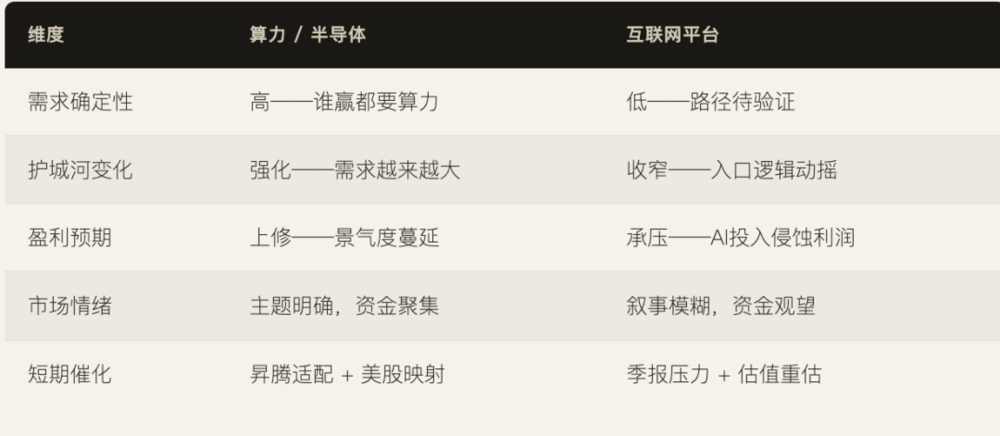
Financial markets echoed this reasoning. The Philadelphia Semiconductor Index marked its 18th straight day of gains, breaking the previous longest streak of 14; the SOXX ETF, which tracks semiconductor giants, tripled during this period. Intel’s first-quarter results, often criticized in the past, posted unexpectedly strong figures driven by AI demand. Texas Instruments also reported stellar performance, signaling that the prosperity extends beyond just cloud computing into industrial sectors. It’s a full-blown, semiconductor-wide feast.
Within this landscape, domestically produced chips like V4 and the Ascend series by Huawei serve as immediate catalysts. Observers note that the positive momentum surrounding DeepSeek V4 aligns well with the frenzy for Chinese semiconductors, forming a logical and emotional upward trajectory for local chipmakers. In this context, whoever wins the race of superior large models will inevitably benefit from growing computational demand. The companies supplying these tools, the “shovel sellers,” are poised to profit regardless.
Today, XiZhi Technology’s debut on the market was met with a staggering 383% surge, with intraday gains reaching 443%, driven by investor enthusiasm rooted in nearly 5,800-fold oversubscription during the IPO phase. The market’s confidence in infrastructure as the foundation of AI is evident, with a clear pricing signal.
Yet, the semiconductor space is showing signs of overheated enthusiasm. After 18 days of gains, profit-taking pressure is mounting. Should Nvidia or other major players encounter earnings misses, a correction is possible. The most expensive part of a bull market has always been the excessive, unanimous optimism.
Meanwhile, the flip side of the story reveals why platform stocks like Alibaba, Tencent, and Meituan are under pressure. At first glance, it appears to be a simple rotation of funds, but beneath that lies a fundamental rift in valuation narratives.
Traditionally, the valuation of internet giants was based on more than just current profits—it’s about “traffic monopoly times monetization efficiency.” As long as users kept flowing through their platforms—search engines via Baidu, shopping via Taobao, food delivery through Meituan—these multiples justified high valuations. But with V4’s advent, this precondition is subtly being challenged.
There are three main sources of disruption:
-
Direct Substitution: Powerful models that can be deployed privately undermine the need to pay for platform-driven traffic. Commercial scenarios previously dependent on ecosystem attachment are now more self-sufficient with API-based solutions.
-
Entry Shift: When AI can instantly answer questions like “what’s nearby to eat,” consumers might skip platforms like Meituan altogether. As AI becomes a new traffic gateway, platforms risk degenerating into mere query-able databases, losing their pricing power.
-
Arms Race Fatigue: Big tech companies are pouring billions into large model development. However, DeepSeek V4 demonstrates that capability advantages built purely on computation are being rapidly eroded by smarter architectures. Without distinct differentiation, this AI competition risks becoming an endless, pricey war of attrition.
What markets value now isn’t just present profits, but the future “moats” of these firms. When confidence in these defenses cracks, revaluation follows. It’s not that Alibaba or Tencent will disappear, but the pressing question is: what are their moats in this AI age? The market has yet to see convincing answers.
Putting these factors into a comparative table clarifies the situation:
| Company | Market’s Desired Narrative | Current Progress |
|---|---|---|
| Alibaba | Cloud AI monetization increase | Rising share of AI revenue; more concrete business cases emerging |
| Tencent | Deep integration of AI assistants | Strong integration into user scenarios; slow C-end penetration |
| Meituan | AI-driven cost efficiency & traffic retention | Improving AI dispatch systems; but AI entry points’ defensive logic still uncertain |
| JD.com | Supply chain AI for efficiency | Enhancing fulfillment with AI; weaker impact seen on consumer-facing perceptions |
The core issue is: these large internet firms aren’t facing a performance crisis; they’re experiencing a narrative crisis. The old valuation benchmarks—traffic dominance, user base, monetization efficiency—are starting to loosen. But the new parameters—what kind of defenses and growth engines will thrive in the AI era—remain unestablished in investor minds.
In this “narrative vacuum,” capital is simply reallocating toward the more certain logic of computational power. The question now is: which company will be the first to craft a convincing new story, backed by solid financial evidence? Until then, valuation pressures will persist.
A century ago, the Californian Gold Rush proved that the real and sustained profits came from selling the tools—like the cowboys who sold jeans and shovels. Today’s equivalent? NVIDIA and Cambri, the providers of GPUs—the digital “shovels”—are the key players. Meanwhile, the actual miners—the giants like Alibaba, Tencent, Meituan, and JD—are still digging, waiting for that next big find. The market’s waiting for them not just to report quarterly earnings, but to articulate a compelling new business narrative rooted in the evolving AI landscape.
 ChatGPT
 Perplexity
 Gemini AI
 Grok AI