
Select Language:
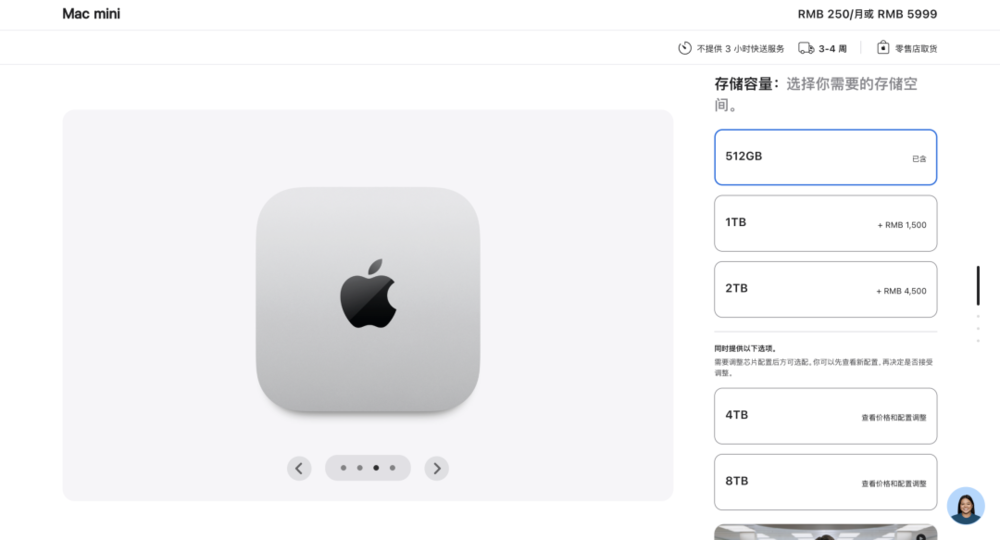
Recently, Apple quietly removed its entry-level Mac mini from the official website, now only offering models with 16GB of RAM and 512GB of storage, with prices starting at $5999. The previous 256GB base model has vanished, signaling a significant shift in Apple’s product lineup. This move appears to be part of a broader industry trend driven by surging demand for high-memory hardware in the era of artificial intelligence (AI).
Apple CEO Tim Cook recently acknowledged during a quarterly earnings call that Mac products are experiencing severe supply constraints, attributing the issues to unexpectedly high demands for Mac mini and Mac Studio as powerful AI and intelligent tool platforms. The popularity of these machines as AI workhorse devices has caused a ripple effect across the hardware industry.
The current chip and memory shortages are not isolated to Apple but stem from a global industry-wide crisis often dubbed “RAMageddon.” The term describes a situation where shortages of high-capacity memory—both DRAM and NAND flash—are intensifying due to massive investments and demand from AI data centers. Leading memory manufacturers like Samsung and SK Hynix have shifted their spending towards DRAM to meet AI-related orders, thereby reducing investments in NAND flash production, which impacts consumer electronics.
As a result, suppliers have reportedly demanded price hikes of up to 100 percent for storage components. Apple, faced with rising costs, has shifted to higher starting prices for the Mac mini, moving from 256GB to 512GB base configurations to offset these increased expenses. The move indicates a grim reality: the cost curves for AI-optimized hardware and traditional consumer devices are diverging sharply, making it necessary for buyers to pay a premium for memory-intensive devices.
This hardware crunch is largely driven by the demands of AI training and inference, which require enormous amounts of high-bandwidth memory and storage. Manufacturing high-performance HBM memory for AI workloads consumes triple the wafer capacity of typical consumer RAM and involves complex 3D stacking processes with lower yields. Simultaneously, AI data centers rely heavily on vast enterprise-grade SSDs for building data lakes, further pushing demand upward.
Due to these factors, semiconductor factories are prioritizing high-margin AI enterprise clients over consumer market devices. Industry analysts confirm that clients not purchasing components for AI servers are currently at the bottom of the priority list. Companies like Micron have even scaled back their consumer brands, redirecting resources toward AI sectors, which highlights how consumer storage devices are becoming increasingly marginalized.
Compounding these issues are geopolitical tensions, such as the recent Middle East conflicts, which threaten supply chains further. Critical materials like helium and bromine—essential for semiconductor manufacturing—are predominantly sourced from sensitive regions, and conflicts risk disrupting supplies that are crucial for chip production.
This mounting hardware scarcity isn’t limited to high-end servers and data centers; it filters down to everyday consumer products. To maintain profit margins amid rising component costs, many tech brands are adopting “shrinkflation,” quietly downgrading hardware specifications in new devices without lowering prices. This affects everything from smartphones aimed at emerging markets to flagship phones, gaming consoles, and even laptops.
Looking ahead, the industry faces grim prospects. For example, the release timeline of Sony’s anticipated PlayStation 6 may be delayed to 2028 or beyond, as high-end GDDR7 memory chips become scarce and expensive. Similarly, Nintendo’s Switch 2 is also expected to see cost-driven delays and possible price increases due to soaring memory costs.
Even for productivity devices, the rise in component prices impacts daily work tools, with major OEMs like Dell and HP experiencing increased costs for memory and SSDs. Microsoft, in accommodating AI features such as Copilot, now requires PCs to start with at least 16GB of RAM, further raising the baseline for affordable computers. Meanwhile, the cost of high-capacity solid-state drives has surged nearly fourfold; a 2TB SSD that once sold for around $173 now costs over $649.
This hardware inflation story has profound implications. Over the past two decades, reduced device costs and simplified software have democratized access to technology, allowing individuals to perform complex tasks—from editing videos to starting online businesses—with modest equipment. The expansion of affordable smartphones and computers has enabled a new era of digital equality, giving countless ordinary users unprecedented access to education, commerce, and self-expression.
But as AI becomes central to this transformation, the physical barriers to participation seem to be rising. The high costs of memory, processing, and storage are creating new entry hurdles. Instead of being a democratizing force, AI’s infrastructure demands threaten to deepen the gap, leaving many ordinary people priced out of the newest technological advancements.
In essence, the rush to scale AI models is reshaping the hardware landscape, with supply chain constraints and geopolitical factors amplifying the challenge. The industry’s shift toward high-margin enterprise tech is squeezing out affordable consumer options, casting a shadow over the promise of AI as an equalizer. As these unseen costs ripple through to the everyday devices we rely on, the broader societal impacts are becoming impossible to ignore—where an invisible “AI tax” is gradually burdening all of us, whether we realize it or not.
 ChatGPT
 Perplexity
 Gemini AI
 Grok AI