Weight on Other Planets: Calculator for Every World in the Solar System
A 70 kg person weighs about 26.5 kg on Mars and about 176.9 kg on Jupiter, because weight depends directly on the surface gravity of the celestial body you stand on. While your physical mass remains completely unchanged wherever you travel in space, the gravitational pull exerted on you changes dramatically with each world's mass and radius.
Planetary Gravity & Weight Reference Table
Every planetary body in our Solar System exerts an acceleration due to gravity governed by Newton’s law of universal gravitation: g = GM / r², where G is the gravitational constant, M is the mass of the celestial body, and r is the radius from its center of mass to its surface. The table below lists standard surface acceleration values compiled directly from NASA Planetary Fact Sheets alongside the resulting weight of a standard 70 kg (154.3 lbs) observer.
| World | Surface Gravity (m/s²) | Gravity vs. Earth | Weight (70 kg Person) | Measurement Reference Level |
|---|---|---|---|---|
|
Sun
|
274.00 | 27.94× | 1,955.7 kg (4,311.6 lbs) | Visible Photosphere |
|
Mercury
|
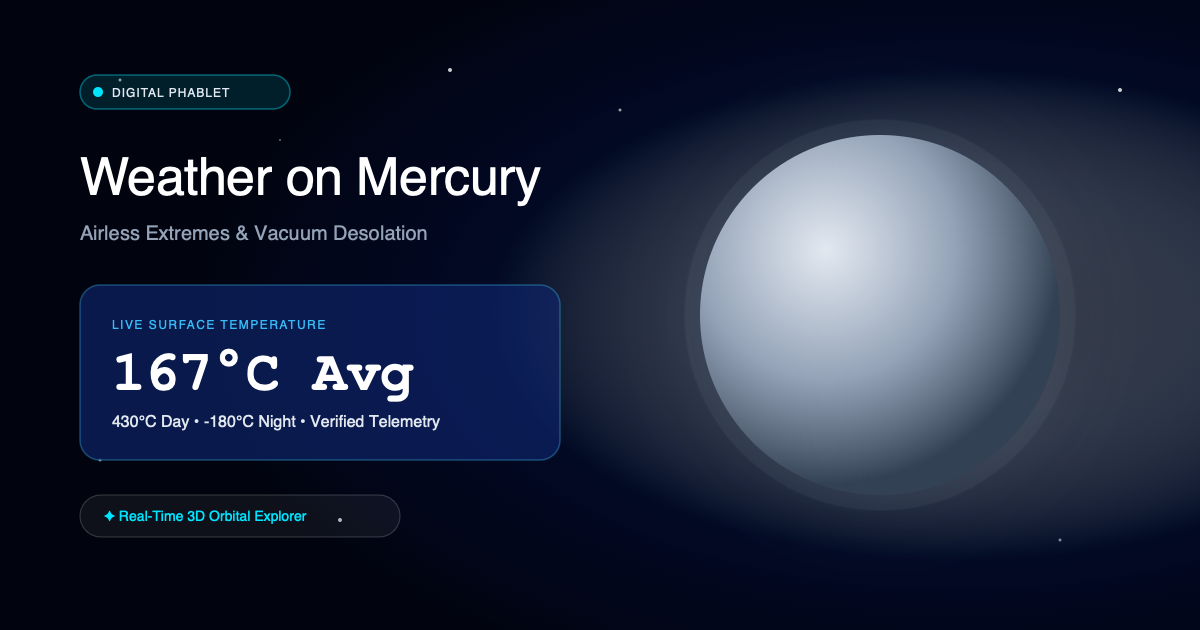
3.70 | 0.38× | 26.4 kg (58.2 lbs) | Solid Planetary Crust |
|
Venus
|
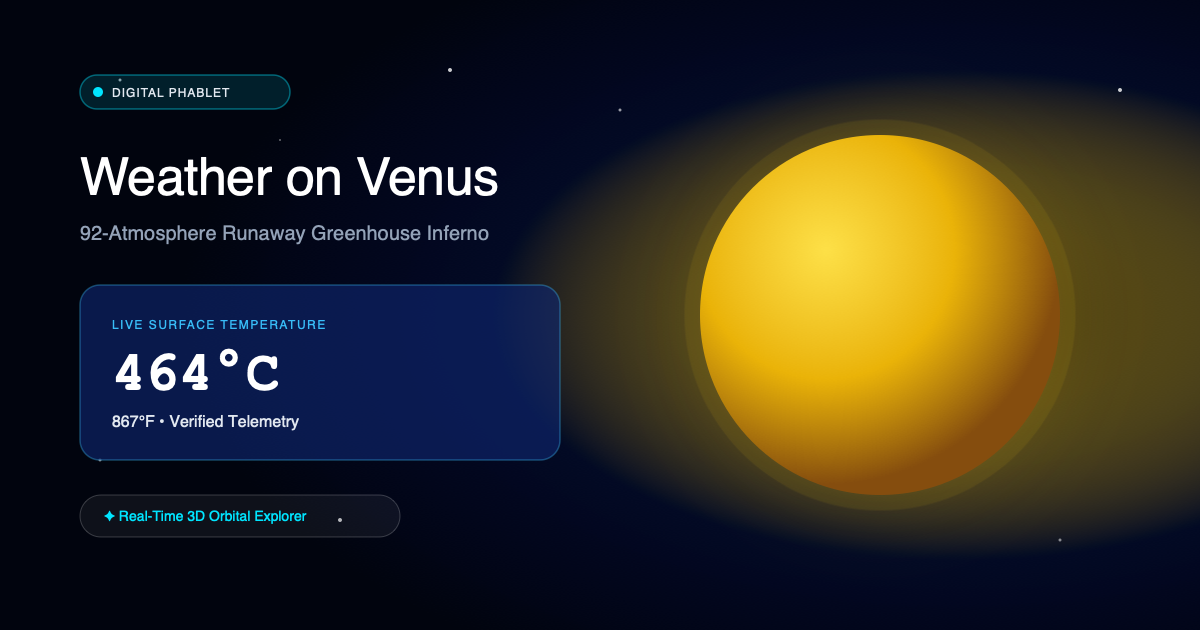
8.87 | 0.90× | 63.3 kg (139.6 lbs) | Solid Surface (92 bar) |
|
Earth
|
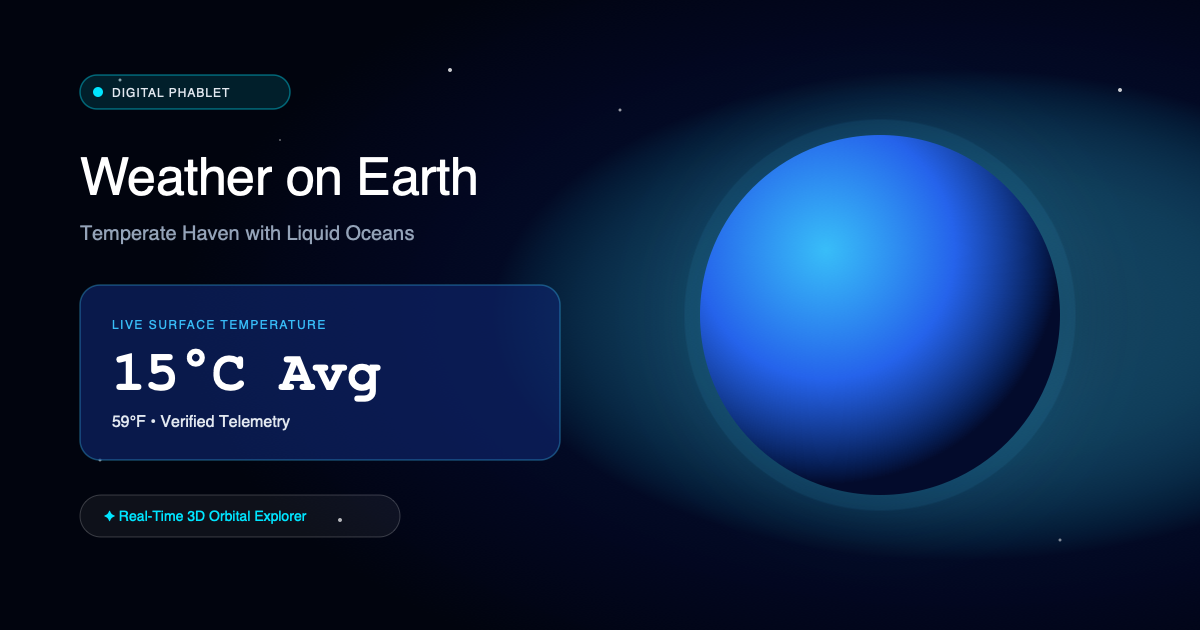
9.81 | 1.00× | 70.0 kg (154.3 lbs) | Standard Sea Level |
|
Moon
|
1.62 | 0.17× | 11.6 kg (25.5 lbs) | Lunar Regolith |
|
Mars
|
3.71 | 0.38× | 26.5 kg (58.4 lbs) | Solid Planetary Crust |
|
Jupiter
|
24.79 | 2.53× | 176.9 kg (390.1 lbs) | 1-Bar Atmospheric Level |
|
Saturn
|
10.44 | 1.06× | 74.5 kg (164.3 lbs) | 1-Bar Atmospheric Level |
|
Uranus
|
8.87 | 0.90× | 63.3 kg (139.6 lbs) | 1-Bar Atmospheric Level |
|
Neptune
|
11.15 | 1.14× | 79.6 kg (175.4 lbs) | 1-Bar Atmospheric Level |
|
Pluto
|
0.62 | 0.06× | 4.4 kg (9.8 lbs) | Nitrogen Ice Crust |
Weight vs Mass: Understanding the Fundamental Difference
In everyday conversation, the words "mass" and "weight" are often used interchangeably, but in physics and planetary science they describe two fundamentally distinct physical properties. Mass is an intrinsic scalar property that quantifies the total quantity of matter inside an object or living organism, directly proportional to the number of atoms it contains. Mass is measured in kilograms (kg) or grams (g). Whether you are standing in your living room on Earth, floating weightlessly aboard the International Space Station, or walking across the dust plains of Mars, your mass never changes by a single gram.
Weight, by contrast, is a vector force: specifically, the downward gravitational force exerted on an object by the celestial body beneath it. Under Sir Isaac Newton’s second law of motion (F = m · a), weight is calculated as:
Because gravitational acceleration (g) varies from world to world, your weight changes the moment you step foot on another planet. On Earth, standard gravity accelerates freely falling objects at approximately 9.80665 m/s². On the Moon, where gravity accelerates objects at only 1.62 m/s², bathroom scales (which measure normal contact force) compress only about one-sixth as far. You feel featherweight, able to leap meters into the air, yet every muscle and cell in your body retains its identical 70 kilograms of physical mass.
When our calculator reports your weight on other worlds in "kg" or "lbs", it displays the equivalent scale reading you would see on an Earth-calibrated spring scale placed on that planet's surface. In rigorous scientific SI units, weight is expressed in Newtons (N): a 70 kg human weighs 686.5 N on Earth, 113.4 N on the Moon, and an enormous 1,735.3 N at Jupiter’s 1-bar boundary.
Why Gravity Differs Between Planets
The strength of gravity on any planet or moon is not an arbitrary number. It is governed strictly by two competing physical characteristics: the total mass of the planet and its mean physical radius. This mathematical relationship is described by Newton's universal law of gravitation:
Here, G is the universal gravitational constant (6.67430 × 10⁻¹¹ m³ kg⁻¹ s⁻²), M is the celestial body's mass in kilograms, and r is the distance from the planet's gravitational center of mass to its surface in meters.
Notice that the radius term is squared in the denominator. This inverse-square relationship means that planetary size exerts an enormous damping effect on surface gravity. A world can be exceptionally massive, but if its radius is also immense, its visible surface is pushed far away from the center of mass, diluting the gravitational pull experienced at the cloud tops.
Saturn provides the most striking real-world demonstration of this law in our Solar System. Saturn contains 95.2 times more mass than Earth. However, because Saturn is a low-density gas giant composed primarily of light hydrogen and helium, its equatorial radius swells to 60,268 kilometers—over nine times that of Earth. When you square that colossal distance in the denominator, the intense mass is balanced by the massive radius. Consequently, if you could stand at Saturn's 1-bar cloud level, its surface gravity is 10.44 m/s²—only 6.5% greater than what you experience on Earth right now. A 70 kg individual on Saturn weighs a remarkably modest 74.5 kg.
Where Would You Weigh the Most and Least?
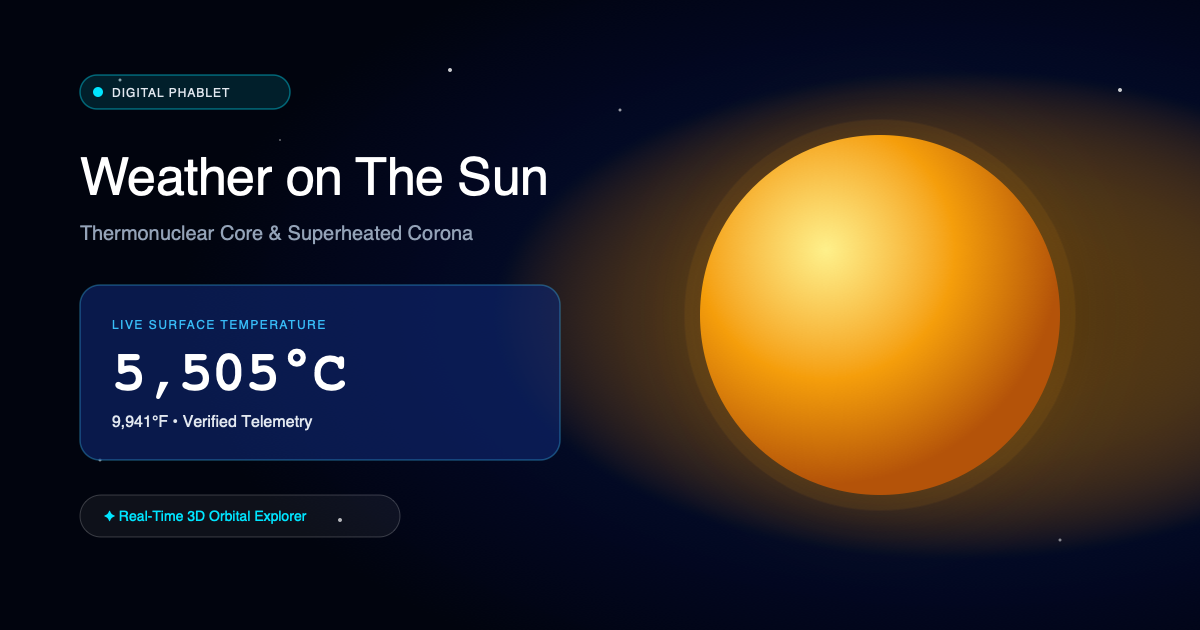
Across the breadth of the Solar System, human weight spans a staggering dynamic range. At the extreme upper boundary lies the Sun. Containing 99.86% of all mass in the Solar System, the Sun’s gravitational acceleration at its visible photosphere reaches an unfathomable 274.0 m/s²—nearly 28 times Earth’s pull. A 70 kg human being would register nearly two metric tons (1,955.7 kg or 4,311.6 lbs) on a scale, crushing bones and organs instantly beneath the weight of their own tissues.
Excluding our central star and focusing solely on planets, Jupiter reigns as the heavyweight champion. As the most massive planet in our system (317.8 Earth masses), Jupiter’s 1-bar cloud tops pull down with a force of 24.79 m/s² (2.53× Earth). Walking or standing under 2.5G would feel like carrying another full-grown adult strapped to your back for every single step.
At the opposite extreme, the lowest surface gravity belongs to icy dwarf worlds in the outer Solar System. On Pluto, where gravity is barely 0.62 m/s² (0.06× Earth), your 70 kg body would weigh just 4.4 kg (9.8 lbs). Even a gentle jump could propel you dozens of meters into the cold black sky, taking over 15 seconds to gracefully drift back down to the frozen nitrogen plains.
| World Category | Celestial Body | Gravity Multiple | Weight Delta (70 kg Person) | Physical Sensation & Impact |
|---|---|---|---|---|
| Solar Maximum | The Sun | 27.94× | +1,885.7 kg (+4,157.3 lbs) | Lethal compression; structural collapse of human skeleton. |
| Planetary Maximum | Jupiter | 2.53× | +106.9 kg (+235.8 lbs) | Severe fatigue; walking requires maximum athletic effort. |
| Earth Baseline | Earth | 1.00× | 0.0 kg (0.0 lbs) | Natural human biological equilibrium. |
| Planetary Minimum | Mercury | 0.38× | -43.6 kg (-96.1 lbs) | Effortless strides; jumps reach nearly three times higher. |
| Dwarf Minimum | Pluto | 0.06× | -65.6 kg (-144.5 lbs) | Near-weightless leaping; slow-motion descents. |
Frequently Asked Questions
Would I weigh more on Jupiter?
Does my mass change on other planets?
Where would I weigh the least?
Why is gravity on Uranus lower than on Neptune?
Can you stand on Jupiter?
Scientific Sources & Mission References
Planetary mass, volumetric mean radii, and surface gravitational acceleration parameters used throughout this tool are cross-referenced directly from official astrophysical databases:
Explore Related Interactive Space Tools
Continue your exploration of the Solar System with our suite of free scientific models and simulators: