

Select Language:
Over 100 teams competed this year, with robots surpassing professional runners in speed and beating human winners by over 10 minutes.
During the second Beijing E-Town Half Marathon and Humanoid Robot Half Marathon on April 19, 2026, Tiangong Ultra, a humanoid robot, participated alongside human runners in Beijing, China.
Countless Chinese-made humanoid robots showcased their rapidly improving athletic abilities and autonomous navigation skills as they sped past human competitors, underscoring the sector’s swift technological advancements.
Last year’s inaugural race was marred by numerous mishaps, and most robots failed to complete the course. The reigning robot finished in 2 hours and 40 minutes—over twice as long as the human winner of the traditional race.
This year, the scene was quite different. The number of teams jumped from 20 to over 100, with many robots even outpacing professional athletes, beating human winners by more than 10 minutes.
Nearly half of the robots this year autonomously navigated the more challenging terrain during the 21-kilometer (13-mile) route, instead of relying on remote control. The robots and 12,000 human runners took parallel tracks to avoid collisions.
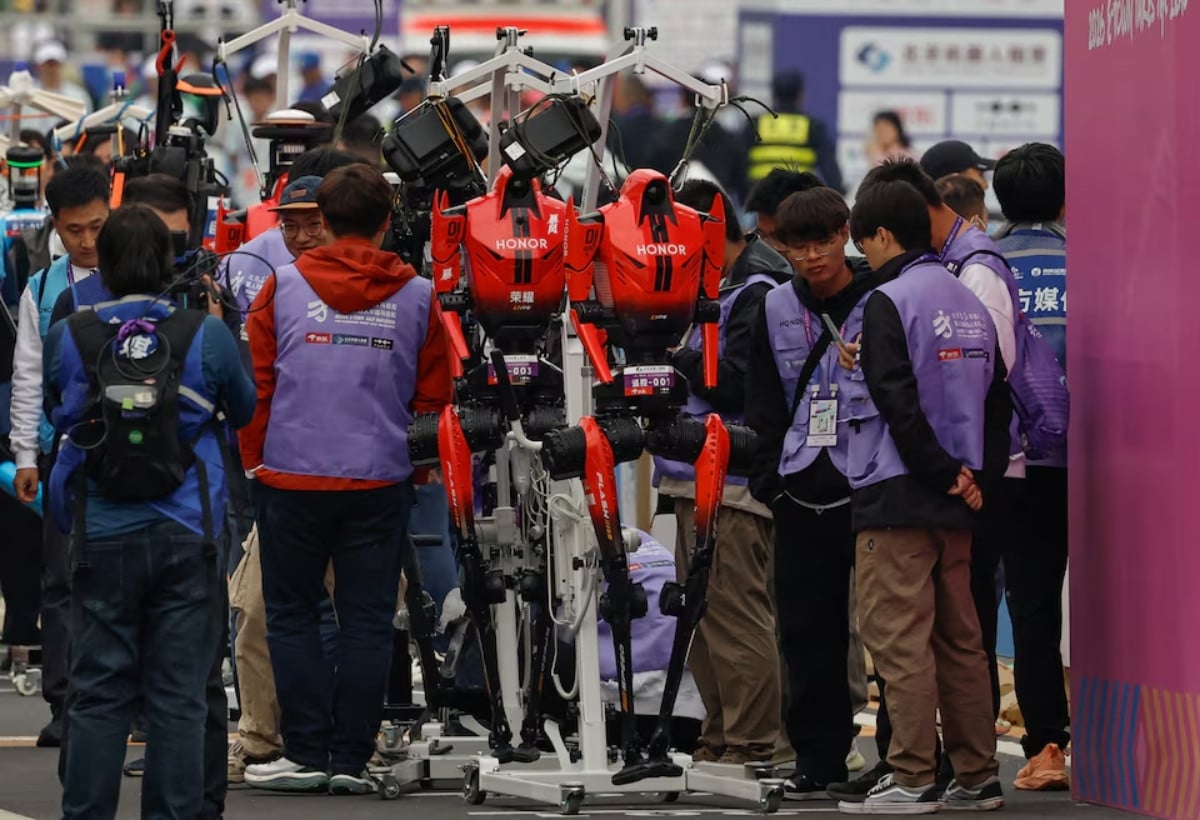
Honor, a Chinese smartphone brand, developed the winning robot, which completed the race in 50 minutes and 26 seconds—several minutes faster than the world record for the half marathon set by Ugandan runner Jacob Kiplimo last month in Lisbon.
[Image of Honor’s humanoid robots preparing for the race, REUTERS]
Honor’s teams claimed all three podium spots, with their robots being fully autonomous and setting new world records. Du Xiaodi, an engineer from Honor involved in the winning team, said their robot was developed over the course of a year. It features legs measuring 35 to 37 inches, mimicking the stride of elite human runners, and incorporates liquid cooling technology borrowed from their smartphones.
Du believes we’re still in the early stages of robotics development, but he’s confident humanoid robots will eventually transform multiple industries, including manufacturing.
“Running faster might not seem significant initially, but it facilitates technological transfer into areas like structural reliability and cooling, ultimately leading to industrial applications,” Du explained.
Advancements in Robotics
Spectators noted that the variety of humanoids on display, with different sizes and gaits, reflected China’s progress in robotics technology.
“The running postures of these humanoid robots are truly impressive… considering AI has only been evolving recently, I’m amazed at their performance,” said Chu Tianqi, a 23-year-old engineering student at Beijing University of Posts and Telecommunications.
He added, “The future is definitely AI-driven. If people don’t learn how to utilize AI now, especially those resistant to it, they’ll become obsolete.”
Another observer, 11-year-old Guo Yukun, expressed inspiration from the event, stating he plans to pursue a robotics degree in college. Guo attends advanced robotics classes and actively participates in his school’s team for the International Olympiad in Informatics, a global high school programming competition.
Real-World Applications and Challenges
Although commercial applications of humanoid robots are still mostly in trial phases, their showcased physical capabilities hint at potential to revolutionize sectors from hazardous labor to military operations.
However, Chinese robotics companies are still working to develop the AI software needed for humanoids to match human factory workers’ efficiency.
[Image of Honor Lightning humanoid robot nearing the finish line, REUTERS]
Experts note that skills demonstrated in the marathon—while entertaining—don’t yet translate into widespread industrial use, where manual dexterity, real-world perception, and complex task performance are critical.
China aims to lead globally in this emerging industry, enacting policies ranging from subsidies to infrastructure investments to foster local robotics firms.
In February, China’s most-watched TV program, the CCTV Spring Festival Gala, spotlighted the nation’s push to dominate humanoid robotics and the future of manufacturing. The show featured a lengthy martial arts display by over a dozen Unitree humanoid robots performing elaborate fight sequences—waving swords, poles, and nunchucks—near child performers, illustrating the country’s ambitions in this technology frontier.
 ChatGPT
 Perplexity
 Gemini AI
 Grok AI

