Select Language:
A Chery Omoda logo is visible on a vehicle as people sit inside it at the company’s booth during the Beijing International Auto Show, also known as Auto China, on April 24, 2026, in Beijing. PHOTO: REUTERS
Chery, China’s top exporter of automobiles, is drawing inspiration from two very distinct automakers—Toyota and Tesla—as it seeks to grow in Europe and other regions. Its highest-ranking executive shared these plans with Reuters.
The company is exploring options to increase production capacity in Barcelona, Spain, where it already has a joint venture. Additionally, it is actively seeking opportunities to collaborate with European automakers to share manufacturing facilities, according to Chairman Yin Tongyue in a recent interview.
Founded in 1996 along the banks of the Yangtze River, Chery produced its first vehicle in 1999. Initially, it was called Cheery and marketed as an affordable, cheerful brand. Today, Chery aims to emulate Toyota’s reputation for quality and Tesla’s reputation for innovation.
“Our strategy is what we call ‘double T,’” Yin explained at Chery’s global headquarters in Wuhu, located in eastern China. “Toyota plus Tesla.”
This approach involves manufacturing vehicles that combine long-term quality with cutting-edge technology to appeal to both traditional and younger consumers.
Chery, along with competitors BYD and Geely, is transforming the global auto industry with advanced electric vehicles priced well below those of traditional automakers. The annual Chinese auto show, held this year in Beijing and open to the public, has become the largest auto event worldwide.
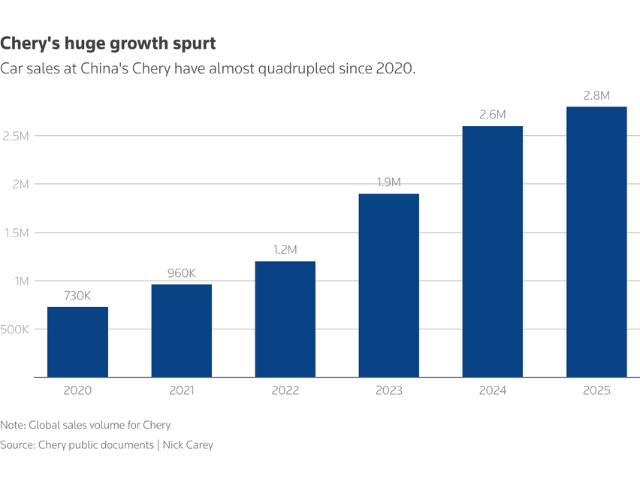
Chery sold 2.8 million cars last year, marking an increase of nearly 8% compared to the previous year, according to industry data. It is producing its Eboras in Spain through a joint venture at a former Nissan plant in Barcelona.
Yin stated, “Business is very good right now,” and mentioned plans to expand production capacity in Barcelona and possibly export vehicles to other markets.
However, shipping large volumes of cars internationally isn’t sustainable, he added. Instead, Chery plans to manufacture more vehicles locally and is actively exploring partnerships with European automakers to share production facilities, though he didn’t specify which countries are under consideration.
“We can share profits and models with our partners,” Yin said.
Global Growth Surge
Chery’s international sales have skyrocketed in recent years, nearly quadrupling from 2020 to 2025. Nonetheless, it still trails behind domestic rival BYD, which sold 4.6 million vehicles in 2025 and has become the fifth-largest automaker globally by volume.
The company introduced two new international brands—Omoda and Jaecoo—in 2023. Last year, combined sales of these brands reached 380,000 units. Over the weekend, Chery told dealers and staff in Wuhu that its goal is to reach one million vehicles sold across all markets in 2027.
The company hosted an international business summit in Wuhu recently, drawing around 4,000 attendees including international dealers and suppliers.
The Jaecoo 7 SUV has been particularly successful in some markets, even becoming Britain’s best-selling car in March.
Chery’s brands rely heavily on SUVs—2.3 million of the 2.8 million vehicles sold worldwide last year were SUVs—and the company is now developing smaller models to diversify its lineup.
This shift toward smaller vehicles also reflects Chery’s global ambitions. Chinese consumers tend to favor larger cars, unlike European customers, Yin noted.
Like its domestic competitors, Chery faces intense price competition in China, where more than 100 automakers are active. Yin, however, believes a significant industry consolidation is imminent.
“In a few years, only a few will remain and thrive,” he said. “It’s happening now.”
 ChatGPT
 Perplexity
 Gemini AI
 Grok AI