Select Language:
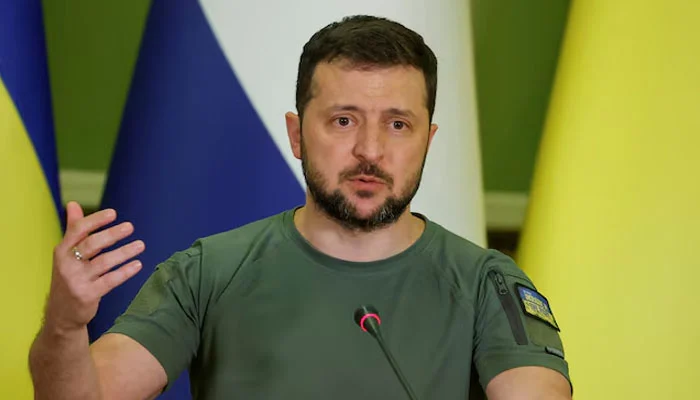
Ukraine’s President Volodymyr Zelensky was seen during a news briefing in Kyiv on July 11, 2022. —Reuters
– Moscow is examining a 20-point plan but may not agree to territorial terms.
– The proposal proposes partial troop withdrawals and the creation of demilitarized zones.
– Zelensky admits there are aspects of the plan he does not fully support.
Kyiv: Ukraine has secured some concessions in the latest draft plan, led by the US, aimed at ending the Russian invasion, according to President Volodymyr Zelensky. However, critical issues regarding territory and Moscow’s willingness to accept the new terms remain unresolved.
The 20-point plan, negotiated between US and Ukrainian officials, is under review by Moscow, but the Kremlin is unlikely to relinquish its firm demands for Ukraine to fully withdraw from the eastern regions.
Zelensky acknowledged that the document includes some points he disagrees with, but Ukraine has managed to remove immediate requirements for withdrawal from the Donetsk region or recognition of seized territories as Russian.
The plan hints at a possible route for Kyiv to pull back some troops, including from about 20% of the Donetsk region they currently control, with the establishment of demilitarized zones. It also eliminates demands that Ukraine legally renounce its NATO membership aspirations.
During a two-hour briefing, Zelensky presented the plan with a highlighted and annotated version on paper. He explained, “In the Donetsk, Lugansk, Zaporizhzhia, and Kherson regions, the de facto deployment lines as of this agreement are recognized as the contact lines.” He added, “A working group will be set up to determine force redeployments needed to end the conflict and to define the parameters of future economic zones.”
This suggests the plan paves the way for, but does not immediately implement, troop withdrawals and demilitarized zones—measures Ukraine was initially hesitant to consider. Zelensky stated, “Russia wants us to withdraw from Donetsk, but the US and others are exploring options to achieve a compromise, such as a demilitarized or free economic zone, that could satisfy both sides.”
US President Trump is reportedly attempting to mediate efforts to bring an end to the ongoing four-year conflict, initiated by Russia’s invasion in 2022. Thousands have been killed, Ukraine’s eastern cities devastated, and millions displaced.
Russian forces continue their advances, launching nightly missile and drone attacks that target cities and Ukraine’s energy infrastructure. On Wednesday, Ukraine’s defense ministry announced the capture of another settlement in the southern Zaporizhzhia region.
In 2022, Russia claimed to annex four Ukrainian regions—Donetsk, Kherson, Lugansk, and Zaporizhzhia—alongside Crimea, which it seized in 2014. President Vladimir Putin remains firm, demanding extensive territorial concessions and Ukraine’s full withdrawal, which Kyiv and its European allies see as capitulation.
Zelensky emphasized that any troop withdrawals would require a national referendum, particularly if Ukraine designates areas as demilitarized free trade zones. Regarding NATO, he affirmed Ukraine’s stance, “It’s up to NATO members whether to admit Ukraine. Our decision has been made. We have already moved away from constitutional amendments that would prevent Ukraine from joining NATO.” Still, prospects of accession remain slim, as the United States has expressed opposition.
Moscow has repeatedly claimed NATO membership for Ukraine is unacceptable, citing it as a primary reason for its invasion. The draft plan includes joint management of the Zaporizhzhia nuclear power plant, now occupied by Russia, though Zelensky opposes Russian oversight.
Ukraine plans to hold presidential elections only after an agreement is formalized, a request supported by both Putin and Trump. Moscow’s spokesperson Dmitry Peskov said Russia is “formulating its position” regarding the plan but declined to comment further. Throughout negotiations this year, Russia and Ukraine have failed to reach a breakthrough, with positions remaining far apart despite ongoing diplomatic efforts.
 ChatGPT
 Perplexity
 Gemini AI
 Grok AI