Select Language:
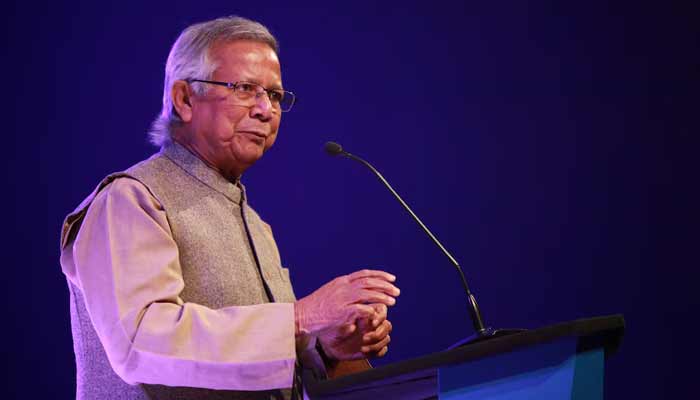
Bangladesh’s interim leader Muhammad Yunus resigned on Monday, delivering a farewell message to the nation before transitioning power to an elected government. At 85 years old, the Nobel Peace Prize laureate declared, “Today, the interim government is stepping down.” He urged that the progress made in democracy, free speech, and fundamental rights should not be halted.
Yunus made a return from self-imposed exile in August 2024, shortly after Sheikh Hasina’s authoritarian regime was ousted by a student-led uprising. She fled to India via helicopter. Reflecting on that pivotal moment, Yunus described it as “a day of great liberation,” expressing joy and tears of happiness as Bangladeshis worldwide celebrated the country’s newfound freedom from oppression.
Having served as the country’s chief adviser during the transition, Yunus now hands over power following a landslide victory for the Bangladesh Nationalist Party (BNP) and its leader Tarique Rahman in recent elections. Yunus praised the election process, highlighting how voters, political parties, and institutions set a positive example for future democratic practices. He noted, “This election has established a standard for the years ahead.”
Rahman, 60, who leads the BNP and comes from one of Bangladesh’s most influential political families, is expected to assume the role of prime minister, succeeding the outgoing interim administration. The new lawmakers are anticipated to be sworn in on Tuesday.
Prior to the elections, political clashes resulted in five deaths and injured over 600 individuals. Despite recent turbulence, voting went smoothly, and the country has responded to the results with calm.
On the same day as the elections, Bangladesh’s voters approved broad democratic reforms through a national referendum, a key aspect of Yunus’s transition plan following the uprising. The “July Charter” proposes measures like term limits for prime ministers, the establishment of an upper house of parliament, enhanced presidential powers, and increased judicial independence. Yunus emphasized that these reforms build on existing efforts: “We did not start from zero — we began with a deficit. By clearing the wreckage, we rebuilt institutions and charted a course for reforms.” While the referendum approved these changes, they still require ratification by the new parliament, with some parties questioning certain aspects.
Election results showed the BNP alliance securing 212 seats, while the Jamaat-e-Islami-led coalition won 77, according to the Election Commission. Jamaat leader Shafiqur Rahman acknowledged the loss but pledged to serve as a vigilant, principled opposition.
The upcoming legislative session is expected on Tuesday, where Tarique Rahman will likely become Bangladesh’s next prime minister. Throughout the campaign, police reports documented five fatalities and over 600 injuries from political clashes. Despite this, voting day proceeded peacefully, and the nation has responded with a degree of stability.
 ChatGPT
 Perplexity
 Gemini AI
 Grok AI