Select Language:
Young Chinese individuals, many of whom worry about age discrimination in their workplaces after turning 35, are increasingly launching “solo companies” powered largely by artificial intelligence. Smaller startups are already popular in Silicon Valley and other regions, with rapidly improving AI tools viewed as helpful teammates—even as they pose a threat to existing jobs.
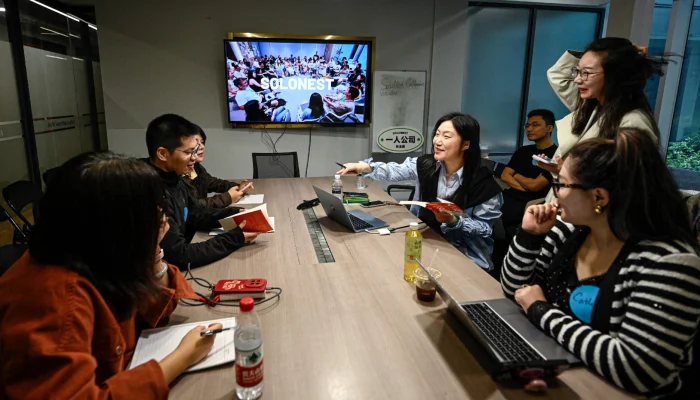
In China, more young people are adopting this model, supported by city governments offering millions of dollars in funding and rent subsidies in line with Beijing’s goal of “technological independence.” Karen Dai, founder of Shanghai-based SoloNest—which organizes weekend events for solo entrepreneurs—states, “The one-person company is a product of the AI era.” She notes that running a business alone was once very challenging, but the broad scope of AI assistance has dramatically lowered those barriers.
In Shanghai, about 20 individuals in their 20s and 30s gathered during a recent weekend at Dai’s three-hour idea-sharing session on solo entrepreneurship. One attendee, Wang Tianyi, now earns up to 40,000 yuan (approximately $5,800) a month by creating AI-generated commercials for businesses. Wang, who left his product manager role at an internet firm last year, believes solo ventures will become a major trend. “With AI empowering us, solo companies have an efficiency edge,” he explains.
On Chinese social media, the so-called “curse of 35”—a common perception of age discrimination in tech, government, and other competitive sectors—has been widely lamented. Dai, who is 38, remarks, “There’s this invisible barrier at 35. Companies sometimes reassess who’s better suited to stay on.” Despite this, young Chinese, having experienced a decade of rapid economic growth, remain eager to expand their horizons. Dai adds, “When you’re in your 30s or even younger, you start asking yourself: what should I do to prepare for that invisible line?”
Wei Xin, a Shanghai resident aged 34, anticipated her job as a document reviewer at an international consultancy would be replaced by AI before it actually happened. She enrolled in a course on Google’s Gemini AI and experimented with creating a digital version of herself, eventually shifting her focus to social media content creation. “There’s some AI anxiety,” Wei admits. “If I don’t adopt or learn how to use it, I might be left behind.”
Local governments are offering incentives to foster AI-driven sole proprietorships, using the acronym “OPC”—a rare instance of English in official policies. For example, Suzhou aims to develop over 10,000 OPC talents by 2028, investing around 700 million yuan ($100 million) into sectors like AI robotics, healthcare, and smart transportation. Chengdu has recently promised grants of up to 20,000 yuan to recent graduates to start AI-powered solo businesses. According to Kyle Chan, a researcher at the Brookings Institution, these initiatives are “carrots to help startups launch successfully.” They also serve as a low-cost way to address China’s youth unemployment rate, which currently stands at about 16% for those aged 16 to 24.
Many young Chinese are now choosing independent projects over traditional corporate roles. Wang, the former product manager, observes that more friends are exploring entrepreneurship through their own initiatives. Still, he cautions, “The key will be how to market these ventures; many struggle to make a profit at first.” Dai concludes that young Chinese are investing in backup plans and asking themselves whether they can use AI to help realize their personal aspirations. She emphasizes, “It’s about gaining a sense of control and unleashing creativity.”
 ChatGPT
 Perplexity
 Gemini AI
 Grok AI