

Select Language:
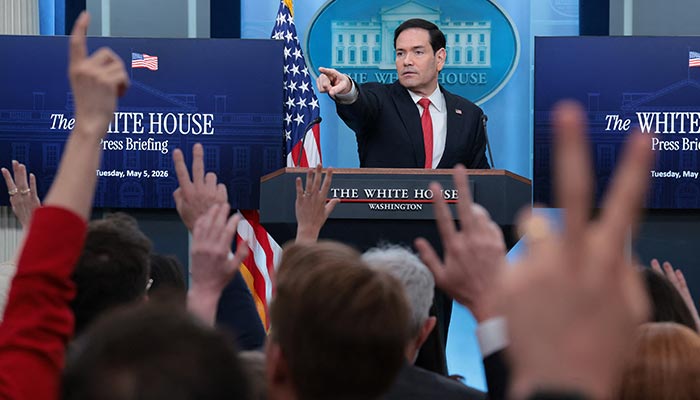
- The US and Gulf allies have drafted a UN Security Council resolution addressing Iran’s mining activities.
- Rubio describes the Hormuz resolution as a critical test for the UN, urging member states to oppose vetoes.
- The US states it is prepared to deliver a “devastating” response to any future attacks.
The United States has announced the conclusion of its offensive operations targeting Iran, according to Secretary of State Marco Rubio on Tuesday. Meanwhile, Washington cautioned that it stands ready to deliver a “devastating” response to any new threats or attacks on shipping through the Strait of Hormuz.
Rubio’s statement followed remarks from the top military official, who indicated that American forces remain prepared to resume combat if necessary, amidst ongoing tensions and clashes that threaten to disrupt a fragile ceasefire in the region.
Iran’s Revolutionary Guards navy issued a warning of a “firm response” if ships deviate from the authorized route through the strait. Iran’s chief negotiator added that Tehran “has not even begun yet,” in response to recent attacks along the vital trade corridor.
The UAE reported intercepting a barrage of missiles and drones from Iran for the second consecutive day, a claim Iran firmly denied. “The armed forces have not launched any missile or drone operation,” Iran’s Khatam al-Anbiya command asserted.
On Monday, Iran targeted US forces with missiles and drones, while Washington claimed to have struck six Iranian boats, accusing them of endangering commercial vessels. This marks the most serious escalation since a temporary ceasefire was established a month ago.
General Dan Caine of US Central Command reiterated that the US remains “ready to resume major combat operations… if ordered.” He added, “No adversary should mistake our current restraint for a lack of resolve.”
President Donald Trump urged Iran to “do the smart thing” and reach a deal, emphasizing that he wishes to avoid further loss of Iranian lives, even as the ceasefire remains fragile. Earlier, Trump dismissed the conflict as “a little skirmish,” confidently stating, “Iran has no chance.”
The Pentagon’s Secretary, Pete Hegseth, noted that the US is “not seeking a fight” but warned that any attacks would be met with “overwhelming and devastating” force.
Iran’s “Malign Presence”
Iranian parliamentary speaker Mohammad Bagher Ghalibaf declared that the status quo is “intolerable” and warned that the US “malign presence will diminish,” as Tehran affirms its intention to maintain control over the Strait of Hormuz.
The recent exchange of fire comes amid conflicting maritime blockades following President Trump’s directive to accelerate shipping out of the Gulf region. The ongoing conflict, ignited over two months ago by US-Israeli strikes, continues to undermine global economic stability despite a fragile ceasefire.
Israel’s air force chief, Omer Tischler, stated that the military is prepared to “deploy the entire air force eastward if necessary.” Eyal Zamir, the military chief, noted that forces remain on “high alert” to respond to threats in the Gulf.
Iran denies naval losses but accuses Washington of killing five civilians aboard boats. Despite rising tensions, shipping company Maersk confirmed one of its vessels transited the Strait of Hormuz under US escort.
The UAE called the recent attacks “a dangerous escalation,” with Saudi Arabia calling for renewed efforts towards a political resolution.
Rubio accused Iran of “holding the world’s economy hostage” through threats to shipping routes and the mining of the waters. He stated that the US and Gulf allies have drafted a UN Security Council resolution demanding Iran cease attacks, reveal the location of mines, and stop efforts to impose tariffs via the strait. A vote on the resolution is anticipated in the coming days.
European and US markets rose on Tuesday, whereas Asian markets faced pressure amid fears the ceasefire could break down. Thus far, only one round of direct negotiations has taken place, leaving talks deadlocked.
Iran’s President, Masoud Pezeshkian, expressed openness to dialogue but dismissed US “maximum pressure” tactics as “impossible.” Rising energy prices due to ongoing tensions are complicating the global economic outlook, adding political challenges ahead of US midterm elections.
European allies warned that prolonged instability would adversely affect their economies. EU chief Ursula von der Leyen posted on X, warning that Gulf security issues have “direct consequences for Europe.” German Chancellor Friedrich Merz, French President Emmanuel Macron, and UK Prime Minister Keir Starmer also called for Iran to return to negotiations.
 ChatGPT
 Perplexity
 Gemini AI
 Grok AI
