Select Language:
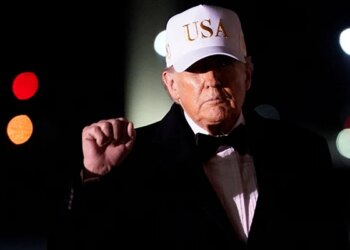
In the early hours of Saturday, President Donald Trump announced on his Truth Social platform that the U.S. had executed a daring operation to apprehend Venezuelan President Nicolas Maduro and his wife. The surprise action was the culmination of months of planning, which included meticulous rehearsals. Elite American forces, such as Delta Force, built an exact replica of Maduro’s secure residence and practiced the assault extensively.
Since August, a small team from the CIA had been on the ground gathering intelligence about Maduro’s routines, making a swift capture feasible. Additionally, the CIA reportedly had an asset close to Maduro monitoring his movements and ready to pinpoint his exact location during the operation.
The green light for the mission was given by Trump four days earlier, although military and intelligence officials advised waiting for clearer weather conditions with less cloud cover. The operation officially commenced in the early hours, while Trump watched a live feed from his Palm Beach club, Mar-a-Lago.
Details about the unfolding events come from interviews with four knowledgeable sources and Trump’s own disclosures. Following the operation’s completion, Trump shared on Fox News that he had never seen anything like it, highlighting the scale and precision of the mission.
The Pentagon stationed substantial forces in the Caribbean, including an aircraft carrier, 11 warships, and over a dozen F-35 jets. In total, more than 15,000 troops were deployed for what was officially described as anti-drug efforts but also supported the covert operation.
Key figures, such as senior aide Stephen Miller, Secretary of State Marco Rubio, Defense Secretary Pete Hegseth, and CIA Director John Ratcliffe, closely collaborated over months with frequent meetings and direct communication with the president. Late on Friday night and into Saturday morning, Trump and his advisors coordinated strikes against targets inside and near Caracas, including Venezuelan air defense systems. Trump described the aerial assault as involving a “massive” number of aircraft, with one fighter for every possible contingency.
Additional sources confirmed that refueling tankers, drones, and electronic warfare aircraft had also been moved into the region quietly. The airstrikes targeted military sites, with images from La Carlota air base showing destroyed military vehicles from a Venezuelan anti-aircraft unit.
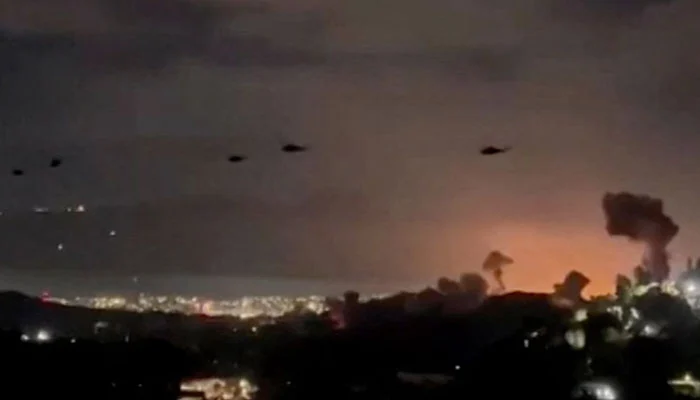
US Special Forces, armed heavily and equipped with tools including a blowtorch, moved into Caracas. Although the exact entry method was not disclosed, social media videos displayed low-flying helicopters over the city. Upon reaching Maduro’s residence—described by Trump as a “fortress”—the troops, aided by FBI agents, stormed the safe house. Trump stated the residence was so well-guarded that it was difficult to breach, but the team was able to break in quickly through steel doors designed to withstand such assaults.
Once inside, it is unclear precisely how Maduro and his wife were captured, though Trump indicated Maduro attempted to reach a safe room but was caught before he could. Trump noted that some U.S. forces sustained injuries but none were fatalities.
As the operation unfolded, Rubio kept lawmakers informed, although notifications were made only after the mission’s initiation, deviating from usual protocols. Reports suggest Maduro was aboard a helicopter that was hit “pretty hard,” yet it managed to return. The Venezuelan leader was then transferred to the USS Iwo Jima, an amphibious assault ship, before being flown to New York for trial.
 ChatGPT
 Perplexity
 Gemini AI
 Grok AI