Select Language:
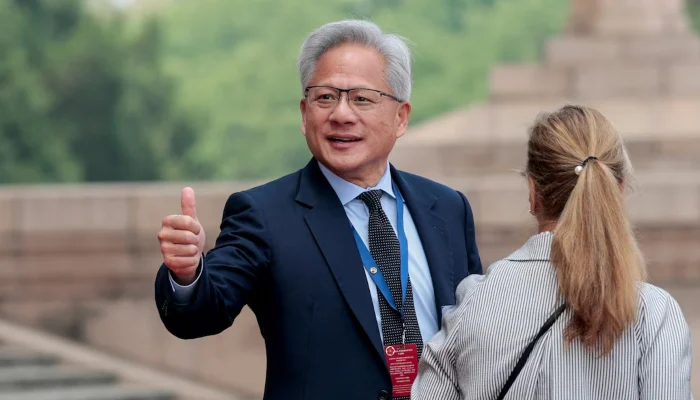
The U.S. has approved approximately 10 Chinese companies to purchase Nvidia’s advanced AI chip, the H200, although no shipments have been made yet. This situation leaves a major tech deal hanging in the balance as Nvidia CEO Jensen Huang seeks progress during his visit to China this week.
Initially, Huang was not part of the White House’s official delegation to Beijing, but he joined the trip following an invitation from President Donald Trump. Trump picked him up in Alaska before a summit with Chinese President Xi Jinping, fueling optimism that this visit might jumpstart efforts to sell the H200 chips in China.
This issue carries enormous significance, illustrating how the U.S.-China tech rivalry now hampers even approved trade agreements. Nvidia, the world’s most valuable company and a leading chip manufacturer, finds itself caught between competing national interests.
Before U.S. export restrictions tightened, Nvidia held around 95% of China’s high-end chip market. China once contributed about 13% of Nvidia’s revenue, and Huang has estimated that China’s AI industry alone could be worth $50 billion this year.
The U.S. Commerce Department has authorized roughly 10 Chinese firms—including Alibaba, Tencent, ByteDance, and JD.com—to buy the H200 chips under specific licensing conditions. Several distributors, like Lenovo and Foxconn, have also gained approval. Customers can purchase directly from Nvidia or through authorized intermediaries, with a cap of 75,000 chips per approved buyer.
The identities of these buyers and their relationships with Nvidia or the distributors have not been publicly disclosed before now. The U.S. Department of Commerce declined to comment, while China’s Ministry of Industry and Information Technology and National Development and Reform Commission did not respond to inquiries.
Lenovo confirmed in a statement that it is authorized to sell the H200 in China as part of Nvidia’s export license. Nvidia, Alibaba, Tencent, ByteDance, JD.com, and Foxconn did not comment.
Huang expressed hope that Biden and Xi Jinping would use this opportunity during their talks in Beijing to enhance bilateral relations and move forward.
Despite the U.S. approval, deals remain at a standstill, with some Chinese companies pulling back due to guidance from Beijing. The reasons behind the shift from China’s side are unclear, but internal pressures are mounting to restrict or carefully scrutinize such orders, according to sources.
Beijing’s cautious stance is partly strategic, as it aims to protect its ambitions to develop indigenous AI chips. While Chinese AI chips still lag behind Nvidia’s offerings, companies like Huawei are increasingly emphasizing domestic chip reliance.
Nvidia’s position in China remains vulnerable. Huang has warned that U.S. export controls are eroding Nvidia’s market share, which has effectively fallen to zero in China’s AI accelerator sector.
The path to completing the sales has been complicated by complex requirements. U.S. regulations, issued this January, demand that Chinese buyers demonstrate robust security measures and confirm the chips won’t be used for military purposes. Nvidia also has to certify sufficient inventory exists in the U.S.
An agreement negotiated during the Trump administration stipulated that 25% of revenue from the chips would flow back to the U.S., with the chips passing through U.S. territory first—since U.S. law prohibits direct export fees to China. However, this setup has raised concerns in Beijing about potential tampering or hidden vulnerabilities, even if it’s mainly seen as a workaround.
Further delays have stemmed from China’s recent implementation of supply chain security rules, prompting a nationwide effort to reduce foreign dependencies in critical tech sectors. Some hardliners in Washington believe such restrictions undermine the narrative that U.S. export controls slow China’s technological progress, with critics arguing that any Nvidia chip sales to China diminish U.S. leadership in AI.
 ChatGPT
 Perplexity
 Gemini AI
 Grok AI