Select Language:
A year ago, translator Jessica Spengler was asked by a client to create a glossary for training an AI system. That’s when she realized her job was at risk of being replaced.
“Hell, that’s when I started thinking… I’m done,” said the 52-year-old from Brighton, who translates for German educational and historical organizations into English.
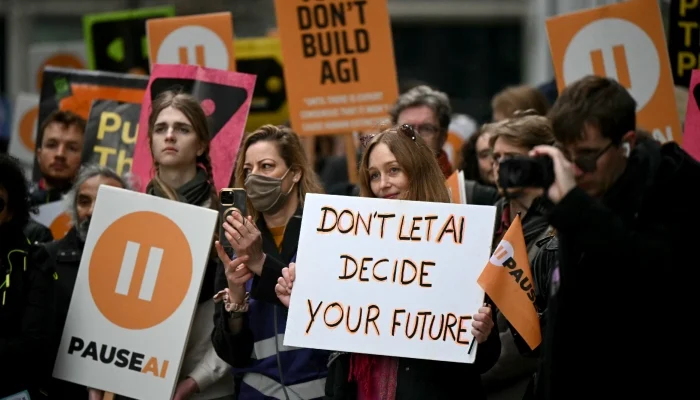
In the UK, where roughly 80% of the economy relies on services, AI has proven to be a fast, flexible, and affordable competitor for many white-collar workers, with the effects beginning to show.
The IMF estimated in 2024 that over two-thirds of British workers perform tasks that could potentially be automated by AI, leaving the country more vulnerable than many other developed nations.
“Some publishers now pay me less than I was earning a decade ago,” Spengler told AFP. She added that she no longer gets requests to translate corporate press releases or user manuals, which are often entry-level jobs in the profession. Instead, she’s increasingly offered proofreading work for machine-generated translations.
“Translators end up rewriting the entire translation and doing the work over, but they’re only paid the lower rate,” explained Holly Parsons, a budding Spanish-to-English translator.
“It’s tough to charge what my work is worth because people just aren’t willing to pay it,” added Parsons, 24, who still earns most of her income working as a children’s activity leader.
British companies that adopted AI cut their workforces by about 8% in the year leading up to October 2025—more than in Germany, Japan, or Australia—according to Morgan Stanley. Among those countries, only the U.S. saw employment levels increase due to AI integration.
“AI has definitely impacted film work… it’s really hit us hard,” said Laura, 35, a London-based director of photography who preferred not to share her last name. She’s retraining as an outdoor instructor in Dorset, earning minimum wage, to escape the ongoing crisis in her industry.
After participating in the short film “Mad Bills to Pay,” which won an award at Sundance, Rufai Ajala, 35, shifted focus and is now training as a plumber.
“I’m not planning to rely on film anymore… I don’t see it as a stable career anymore,” Ajala said, emphasizing the need for an “AI-proof” job.
Experts warn about a difficult transition ahead. Bouke Klein Teeselink, an economics professor at King’s College London, said society will need to go through a painful adjustment as new jobs slowly emerge, potentially causing significant unemployment.
Research shows that roles most vulnerable to AI, such as software developers and data analysts, saw a decline in job postings after ChatGPT’s release in November 2022, especially at entry levels.
The growth of AI coincides with high youth unemployment in Britain, which stands at its highest since 2014, with one in six young people aged 16-24 out of work, affected by ongoing conflicts in the Middle East and rising minimum wages.
Teeselink believes AI could also boost productivity, leading to lower prices, which might stimulate demand and create new jobs. The UK’s high-quality universities are well-positioned to help young people develop AI skills, easing the transition.
 ChatGPT
 Perplexity
 Gemini AI
 Grok AI