
Select Language:
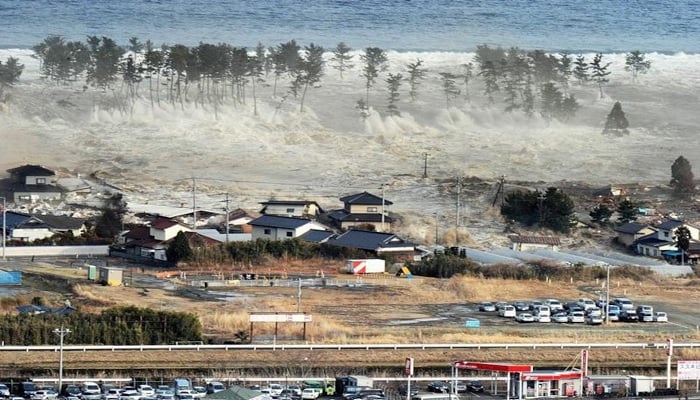
A huge tsunami rushes in to flood a residential neighborhood following a powerful earthquake in Natori, Miyagi Prefecture, northeastern Japan, on March 11, 2011. —Reuters
Tsunami warnings were issued throughout parts of the Pacific on Wednesday after an 8.7 magnitude quake struck off Russia’s Far East.
Here are some important facts about tsunamis and the destruction they can inflict:
Water Shock
A tsunami is a sudden surge of water that propagates through the ocean, usually caused by a strong earthquake beneath the seabed. The abrupt, forceful shift of the Earth’s crust can lift or drop sections of the ocean floor, displacing vast amounts of water that form waves. These waves radiate outward from their origin point and can travel great distances — sometimes at speeds comparable to a jet airplane. Though rare, tsunamis can generate extremely strong currents and deadly flooding along coastlines.
Other Causes
While major earthquakes are the primary trigger for tsunamis, other catastrophic natural events can also provoke them, including volcanic eruptions and landslides. For instance, in 1883, the eruption of Krakatoa shattered the Pacific island, producing an explosion loud enough to be heard 2,800 miles away and generating a tsunami that claimed roughly 30,000 lives. Additionally, powerful storms or space rocks plunging into the ocean can be sufficient to produce a tsunami, as noted by the U.S. National Oceanic and Atmospheric Administration.
“Harbor Wave”
The word “tsunami” originates from Japanese, meaning “harbor” + “wave.” It’s sometimes called a “tidal wave,” but experts emphasize this is inaccurate, as tsunamis are unrelated to ocean tides. They typically start with small wave heights and widely spaced peaks. As these waves get closer to shore, the seafloor’s slope compresses the waves, causing their peaks to bunch together and significantly increasing their height. When they arrive on land, they can strike multiple times over hours or even days.
Historical Perspective
Ancient Roman scholar Ammianus Marcellinus described the 365 AD tsunami that struck Alexandria: “The sea receded so much that the ocean floor was revealed, allowing many sea creatures to be seen. Suddenly, enormous waves returned unexpectedly, overwhelming and killing thousands. Ships were hurled onto rooftops by the waves’ fury.”
Potential for Destruction
Several factors influence how tall and destructive a tsunami can become, including earthquake magnitude, the volume of displaced water, the underwater topography, and natural barriers that absorb or dampen the waves. The Pacific Ocean is particularly vulnerable because of its earthquake activity, but tsunamis have appeared in many parts of the globe over the years. The 2004 Indian Ocean tsunami, triggered by a 9.1 magnitude earthquake off Sumatra, unleashed energy equivalent to 23,000 Hiroshima atomic bombs, according to the US Geological Survey, killing around 220,000 people across 11 nations, many thousands of miles from the quake’s epicenter.
 ChatGPT
 Perplexity
 Gemini AI
 Grok AI