Select Language:
A collaboration between a leading artificial intelligence laboratory and various research partners has successfully achieved the large-scale production of krypton fluoride (KrF) photoresist resin, a crucial material in chip manufacturing. This milestone has the potential to lessen China’s dependence on imported high-end photoresist products.
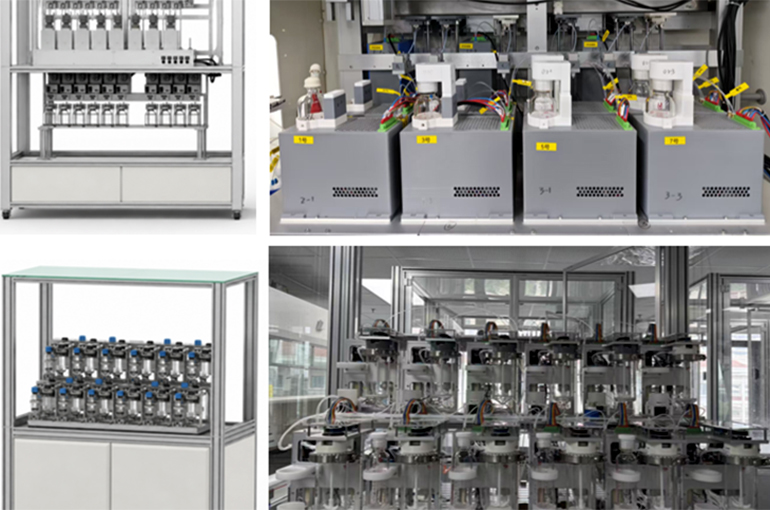
The joint team, which includes researchers from a prominent AI lab, Xiamen University, and Suzhou’s National Laboratory, has developed an AI-powered intelligent synthesis platform. This platform can produce high-purity, consistent, and efficient KrF photoresist resin, as announced yesterday. Such innovation could help alleviate supply shortages and reduce manufacturing costs within China’s semiconductor industry.
Photoresist plays an essential role during the etching process in chip production. It coats silicon wafers and blocks light to create precise circuit patterns. However, the high-end segment of this market has long been controlled by a few companies in Japan, Europe, and North America, making China heavily reliant on imports.
The development team explained that the platform is built on an advanced, multimodal scientific model capable of autonomously generating experimental plans, optimizing process parameters, and predicting results. This automation greatly enhances research and development productivity.
Traditionally, developing new resin materials involved manual trial-and-error, which resulted in lengthy development periods and operational inconsistency—factors that hinder meeting the strict stability standards required in semiconductor manufacturing.
Moreover, the platform possesses physical execution capabilities, enabling it to automatically manage multiple reaction chambers and workstations during experiments. This closed-loop system reduces the risk of contamination from oxygen, water vapor, and metal impurities, ensuring the resin’s quality remains stable.
To speed up commercial application, the researchers partnered with a domestic developer specializing in semiconductor materials to prepare the photoresist resin formulations. The key performance metrics of the product have already met targeted standards, and the material is now moving into the customer validation phase.
 ChatGPT
 Perplexity
 Gemini AI
 Grok AI