
Select Language:
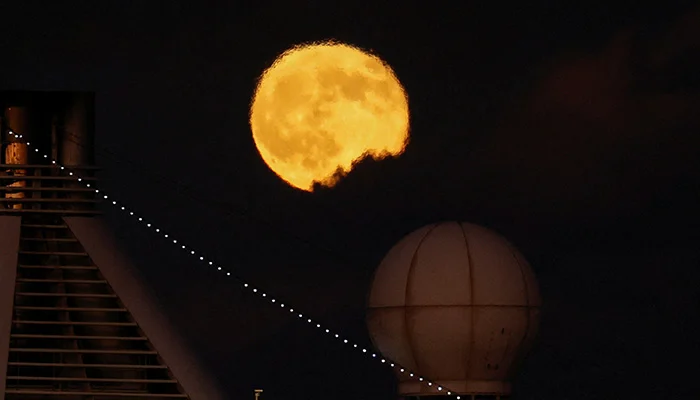
Pakistan experienced its first supermoon of 2025, dubbed the Beaver Moon, on Wednesday evening, casting a luminous glow across the skies nationwide and around the globe. This supermoon was the largest, brightest, and closest full moon of the year, hitting peak brightness at 6:19 PM local time, according to the Space and Upper Atmosphere Research Commission (Suparco).
The moon was approximately 356,980 kilometers (221,817 miles) away from Earth, making it about 7.9% larger and 16% more luminous than a typical full moon due to its proximity during perigee. A supermoon occurs when a full moon coincides with its closest approach to Earth in its elliptical orbit.
This particular event marks the second in a series of three consecutive supermoons—preceded by October’s and followed by December’s occurrences. Although the differences in size and brightness are subtle to the naked eye, the view remains extraordinary and rare for skywatchers.
Supermoons usually happen three to four times annually, depending on the alignment of the moon’s perigee and its full phase. The name “Beaver Moon” has roots in North American tradition and colonial folklore, historically signaling the optimal time to trap beavers before the swamps froze over. The term also references the large, semi-aquatic rodents known for gnawing trees to build dams.
Earlier, NASA highlighted the unique aspect of this supermoon, noting that while its physical size doesn’t change, its proximity can make it appear up to 14% larger and 30% brighter than when it is at its farthest point from Earth.
 ChatGPT
 Perplexity
 Gemini AI
 Grok AI