
Select Language:
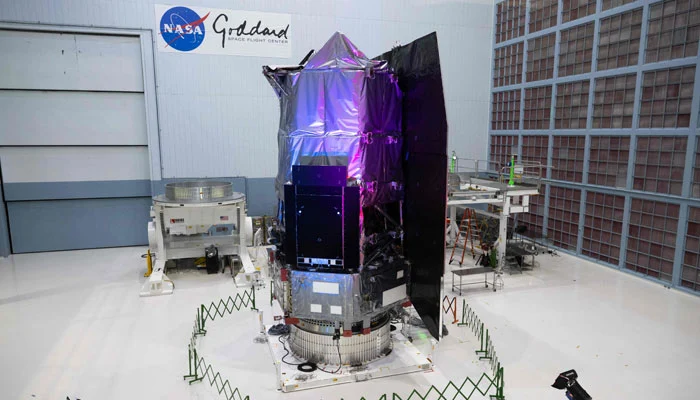
NASA revealed a new telescope on Tuesday designed to explore vast regions of the universe, searching for planets outside our solar system and investigating the mysteries surrounding dark matter and dark energy.
The Roman space telescope is projected to find tens of thousands of planets, potentially providing clearer insights into how many could be out there.
“Roman will create a new cosmic atlas for Earth,” NASA administrator Jared Isaacman announced during a press briefing at the Goddard Space Flight Center in Maryland, where the telescope was also displayed.
The telescope, a 12-meter (39-foot) shiny device equipped with large solar panels, will be transported to Florida before its scheduled launch into orbit on a SpaceX rocket, anticipated to happen as early as September.
Construction of Roman cost over $4 billion and spanned more than ten years. It bears the name of astronomer Nancy Grace Roman, often called the “Mother of Hubble” due to her instrumental role in developing the historic space telescope.
Thirty-six years after the Hubble’s launch revolutionized astronomy, NASA expects Roman to address some remaining questions.
With a field of view at least 100 times larger than Hubble’s, the telescope will survey expansive regions of space from its position 1.5 million kilometers (930,000 miles) from Earth.
Mark Melton, a systems engineer at NASA’s Goddard Center, said the telescope will transmit approximately 11 terabytes of data daily.
“In our first year alone, we’ll send down more data than Hubble has accumulated over its entire lifespan,” Melton explained to AFP.
Its wide field of view will enable NASA to catalog the universe’s components, as noted by Nicky Fox, the associate administrator for NASA’s Science Mission Directorate.
“Roman will identify tens of thousands of new exoplanets. It will also map billions of galaxies, detect thousands of supernovae, and observe tens of billions of stars,” Fox added.
This extensive data collection will allow scientists to pinpoint areas of interest for further study using complementary telescopes like the James Webb Space Telescope.
Unveiling the unseen
Roman will also focus on exploring invisible phenomena—dark matter and dark energy—whose origins are still a mystery but are believed to make up about 95% of the universe.
Dark matter is thought to serve as the cosmic glue holding galaxies together, while dark energy is believed to drive the accelerated expansion of the universe over time.
Thanks to its infrared capabilities, the telescope will observe ancient light emitted billions of years ago, effectively allowing us to peer back in time and hopefully better understand these phenomena.
Complementing Europe’s Euclid mission and the Vera Rubin Observatory in Chile, Roman will investigate how dark matter structures evolve through cosmic history and measure how rapidly galaxies are receding from us, according to Darryl Seligman, a physics and astronomy professor at Michigan State University.
Such discoveries could fundamentally alter our understanding of the universe’s structure, according to astrophysicist Julie McEnery, who led the Roman project.
Mark Melton remarked, “If Roman earns a Nobel Prize someday, it will probably be for something we haven’t even envisioned or questioned yet.”
 ChatGPT
 Perplexity
 Gemini AI
 Grok AI