Select Language:
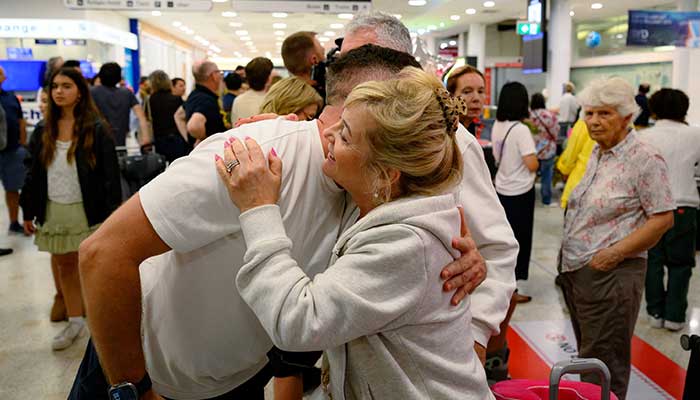
A passenger reacts after arriving from Dubai on a flight amid the US-Israeli conflict with Iran at Sydney International Airport in Mascot, Australia, on March 4, 2026. — Reuters
– Airline stocks stabilize after sharp declines.
– Most of the Middle East remains airspace-free.
– This marks the worst crisis for the global travel industry since COVID-19.
Dozens of repatriation flights are scheduled to leave the Middle East on Wednesday as governments rush to bring home thousands of stranded citizens amid escalating tensions between the US, Israel, and Iran.
Most Middle Eastern skies are still devoid of commercial aircraft, with key Gulf hubs, including Dubai — the world’s busiest international airport — largely closed for the fifth consecutive day, representing the most significant travel disruption since the COVID-19 pandemic.
The first repatriation flights are set to depart for the UK and France on Wednesday, while the United Arab Emirates has opened special corridors to facilitate the return of some citizens. Typically, this region sees thousands of daily commercial flights.
Meanwhile, stranded tourists and expatriates are attempting alternative routes to exit.
“We’re proceeding cautiously,” stated French Finance Minister Roland Lescure. The French government announced plans for several repatriation flights on Wednesday, serving an estimated 400,000 French nationals in the region.
A British charter flight will depart Oman later Wednesday evening, prioritizing vulnerable UK citizens, according to the British Foreign Office.
Emirates, the world’s largest international airline, announced all routes to and from Dubai remain suspended until March 7, operating only a limited schedule from Dubai International and Maktoum International airports.
New Zealand officials anticipate a total of 121 repatriation flights from Dubai International Airport on Wednesday.
Qantas is operating additional flights to bring stranded British travelers back from Australia, though these flights will need to reroute via a refueling stop in Singapore instead of the usual Middle Eastern hubs.
Airlines are adapting to severely restricted airspace by carrying extra fuel or making additional refueling stops to avoid sudden reroutes or longer flights through safer corridors.
Shares of airlines experienced less volatility on Wednesday following flash crashes earlier this week that erased tens of billions of dollars from their market values. Lufthansa saw a 3% increase at 1306 GMT, while Qantas dropped 2.7%, declining more than 10% earlier this week. British Airways owner IAG rose 2%, despite a more than 13% drop over the past three days.
Airline executives note that flight crews are now scattered globally, making it difficult to resume operations once airspace reopens. Rising oil prices will also increase operating costs.
Analysts warn that flight prices could surge if longer alternative routes become the norm for international carriers.
The Gulf region remains a crucial hub for air freight, adding further pressure to international trade routes amid disruptions to Red Sea shipping lanes.
Asian airline stocks saw mixed movements: United Airlines, American Airlines, and Delta Air Lines rose approximately 1% in pre-market trading, while Southwest Airlines declined slightly. Most Asian airlines reduced earlier losses from this week, although Korean Air Lines fell 7.9% after losing 10.3% on Tuesday. South Korea’s stock market was closed Monday, with many airlines and travel firms hit hard.
Oil prices have climbed sharply this week — Brent crude up about 14% since the US-Israeli strikes on Iran — likely increasing fuel costs for airlines. Many carriers are using hedging strategies to mitigate some of these expenses.
Lorraine Tan, director of equity research for Asia at Morningstar, commented, “Most airlines have hedged roughly 50% of their jet fuel needs. They should be able to pass on the remaining costs to passengers.”
 ChatGPT
 Perplexity
 Gemini AI
 Grok AI