
Select Language:
Iran is currently in Geneva for a new round of nuclear negotiations with the United States, with missile capabilities remaining a key sticking point.
Here’s an overview of Iran’s missile program:
What are ballistic missiles?
Ballistic missiles are rocket-propelled weapons guided during the ascent phase but then follow a free-fall path for most of their flight. They carry warheads that can contain conventional explosives or potentially biological, chemical, or nuclear agents, and are capable of striking targets over various distances.
Western nations see Iran’s missile stockpile both as a conventional threat to stability in the Middle East and as a possible delivery route for nuclear weapons if Tehran advances that program. Iran insists it has no intention of developing atomic bombs.
Types and Ranges of Iranian Missiles
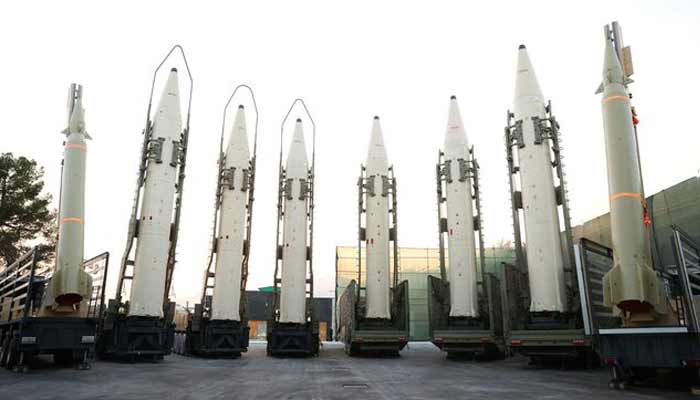
Iran’s ballistic missile stockpile is the largest in the Middle East, according to U.S. intelligence estimates. Its declared maximum range is roughly 2,000 km (1,240 miles), which Iranian officials claim is sufficient to defend the country, particularly with the ability to reach Israel.
Most missile sites are located around Tehran, with at least five underground “missile cities” across provinces like Kermanshah and Semnan, as well as near the Gulf.
The missile arsenal includes several that can reach Israel, such as the Sejil, with a 2,000 km range; Emad, capable of 1,700 km; Ghadr, also about 2,000 km; Shahab-3, with a range of around 1,300 km; Khorramshahr, reaching 2,000 km; and Hoveyzeh, with approximately 1,350 km.
In April 2025, Iranian state media displayed a graphic claiming nine missiles can reach Israel, including the Sejil, which reportedly travels over 17,000 km/h with a maximum range of 2,500 km; the Kheibar with a 2,000 km range; and the Haj Qasem at 1,400 km.
The Arms Control Association estimates Iran’s missile capabilities include the Shahab-1 (300 km range), Zolfaghar (700 km), Shahab-3 (800–1,000 km), and developmental models like Emad-1 (2,000 km) and Sejil variants (1,500–2,500 km).
Recent and Past Uses
In June 2025, during a 12-day conflict with Israel, Iran launched ballistic missiles into Israeli territory, resulting in casualties and structural damage. Analysts suggest Iran managed to disable roughly one-third of its missile launchers during the conflict but claims to have recovered.
Iran also responded militarily to U.S. involvement in the conflict, including missile fire at al-Udeid Air Base in Qatar, after issuing advance warnings. Additionally, Iranian forces targeted Israeli spy facilities in Iraqi Kurdistan in January 2024 and launched missiles at U.S. forces in Iraq in 2020 following the killing of Major General Qassem Soleimani by a U.S. drone strike.
Development and Modernization Strategies
Iran claims its missile program acts as a deterrent and serves as a retaliatory force against the U.S., Israel, and other regional threats.
Recent reports indicate Iran continues underground missile depot construction, complete with transportation, firing, production, and storage facilities. In 2020, Iran successfully launched a missile from underground, marking a new capability.
Iran has been developing lighter, composite materials for missile airframes to extend range through reverse-engineering efforts influenced by North Korean and Russian designs, with Chinese assistance also playing a role.
In June 2023, Iran unveiled its first domestically produced hypersonic missile, capable of speeds exceeding five times the speed of sound—complex to intercept.
The broader missile program includes cruise missiles like the Kh-55, which can be launched from aircraft and has a range of up to 3,000 km.
 ChatGPT
 Perplexity
 Gemini AI
 Grok AI