Select Language:
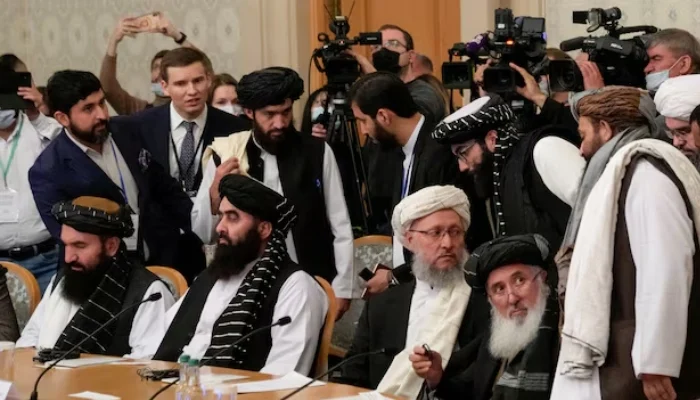
Four years into their rule in Afghanistan, the Taliban government is reportedly experiencing internal divisions, with top leaders at odds with one another.
The Taliban announced that their war in Afghanistan had ended after seizing control of Kabul’s presidential palace on August 15, 2021, coinciding with the U.S. military’s withdrawal from the war-torn nation.
However, strains have surfaced within the Taliban ranks, with Supreme Leader Hibatullah Akhundzada warning that internal conflicts could spell their downfall.
The BBC leaked an audio recording claiming that Akhundzada expressed concerns over the divisions within the organization. The snippet, believed to be from a speech delivered at a Kandahar religious school in January 2025, features him cautioning that “the emirate will collapse and end” if the factions do not reconcile.
Sources suggest that the Taliban is split into two main factions: one based in Kandahar, loyal to Akhundzada, and another based in Kabul, which generally favors engagement with the outside world and supports girls and women’s education.
The Kandahar faction includes Afghanistan’s Prime Minister Mohammad Hassan Akhund, Chief Justice Abdul Hakim Haqqani, and Higher Education Minister Neda Mohammad Nadim. They advocate for a strict Emirate, aligned with Akhundzada’s vision of an isolated, traditional Islamic state.
The Kabul faction is comprised of influential Taliban officials such as Deputy Prime Minister Abdul Ghani Baradar, Interior Minister Sirajuddin Haqqani, and Defense Minister Mohammad Yaqood Mujahid. They tend to favor opening up to international connections and enabling women and girls to pursue education.
The BBC describes the situation as “Kandahar house versus Kabul.” Tensions reportedly escalated in September last year when the Taliban leader ordered the suspension of internet and mobile services. The services were quickly restored three days later without any official explanation. Insider reports indicate that the Kabul group defied Akhundzada’s directive, restoring communication services—a move deemed “rebellious” because it threatened the officials’ privileges and funding.
Moreover, key operations like weapon distribution have been shifted to Kandahar, away from Kabul-control figures like Haqqani and Yaqoob. Recent reports also suggest that Kabul’s ministers face restrictions, with travel to Kandahar only permitted with official invitations.
While the situation seems to be under control as of early 2026, underlying tensions remain. Taliban spokespersons have dismissed the discord as mere disagreements; nonetheless, the ideological divide persists and continues to influence public statements.
 ChatGPT
 Perplexity
 Gemini AI
 Grok AI