Select Language:
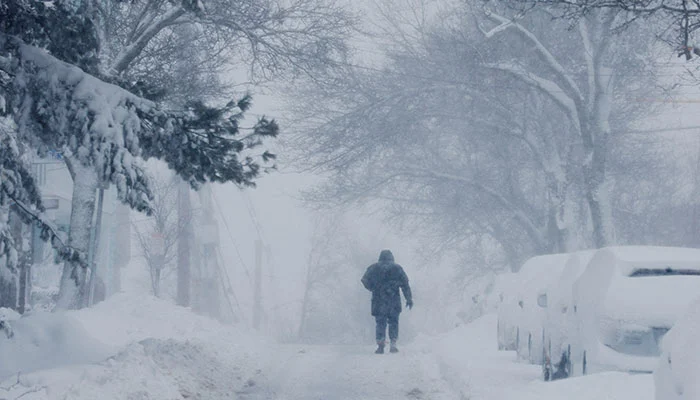
A person walks through a winter blizzard in Somerville, Massachusetts, on February 23, 2026. — Reuters
– Over two and a half feet of snow cripples the US Northeast.
– At least 7,400 flights canceled, with thousands more delayed.
– Millions are stranded as over 600,000 homes and businesses lose power.
A powerful snowstorm blanketed parts of the U.S. Northeast with more than 30 inches (76.2 cm) of snow on Monday, bringing travel to a near halt for millions. Roads were impassable, train services shut down, and approximately 7,400 flights were called off.
Numerous residents experienced power outages affecting homes and businesses. Officials, including New York City Mayor Zohran Mamdani, advised residents to stay off the streets to allow emergency crews to clear the snow. Schools in New York and surrounding areas were closed, and Broadway theaters suspended performances.
“New York is still under a state of emergency,” Mamdani announced. “The travel ban lifted at noon today, but a hazardous travel advisory remains in effect until midnight.”
By 1 p.m. ET, over 19 inches (48 cm) of snow had accumulated in Central Park, NYC, and Boston reported more than 14 inches, according to Bob Oravec, a meteorologist at the National Weather Service. Winds gusting between 40 to 60 mph (64–100 kph) whipped up snowdrifts several feet high.
“It might take a week to dig out,” Oravec estimated.
Philadelphia received 14 inches of snow, while Providence, Rhode Island, was buried under a record-breaking 32 inches.
Over 608,711 homes and businesses nationwide were without power as of Monday afternoon, per PowerOutage.us. This included about 10% of Massachusetts’ nearly 3 million electric customers.
Long Island resident Sandra Wu, with 20 years living in the area, said she’d never witnessed a storm this intense. Her family couldn’t open their front door due to towering snowdrifts, and she described her efforts to clear the driveway as futile.
“I tried to start digging us out early, but it was pointless,” said Wu, a veterinarian in her early 50s. She remembered similar storms from the 1990s during her time in Buffalo, where annual snowfall averages 92 inches.
Her children, aged 13 and 5, enjoyed an unexpected snow day and slept in. “We thought we might lose power, but luckily, we didn’t. Today, we’re baking and waiting for the storm to pass.”
Regional authorities across at least seven states declared states of emergency. Airlines canceled more than 7,400 flights and delayed around 2,300 others, primarily in major hubs like New York’s JFK and LaGuardia airports, Boston Logan, and Newark Liberty.
Governor Kathy Hochul activated 100 National Guard members to assist with rescue operations in Long Island, New York City, and the lower Hudson Valley, which bore the brunt of the storm and heavy coastal winds. The storm caused the United Nations headquarters in Manhattan to close for the day.
Despite a federal emergency funding lapse, the Department of Homeland Security assured that FEMA’s disaster response efforts would continue without interruption, including staff movement, emergency operations, and aid distribution.
Massachusetts Governor Maura Healey declared a state of emergency and directed state workers to stay home. Connecticut limited commercial vehicle travel on highways, allowing only emergency and essential deliveries.
Public transit was disrupted across New Jersey and Rhode Island, with bus and train lines halted until conditions improve. Some ships couldn’t leave port, including Wu’s in-laws, stranded aboard a cruise ship docked in New York Harbor en route to the Bahamas—though they’re making the best of the delay, enjoying their time with friends, food, and entertainment until the storm subsides.
 ChatGPT
 Perplexity
 Gemini AI
 Grok AI