Select Language:
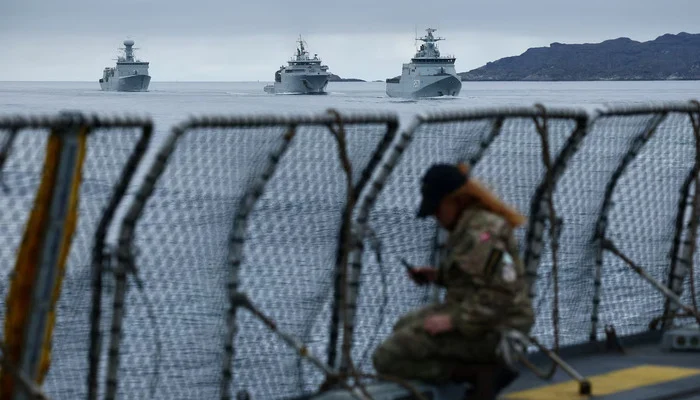
Danish Navy ships maneuver near the frigate Niels Juel as Danish and French military forces carry out drills off the coast of Nuuk, Greenland, on September 15, 2025. — Reuters
– Europeans are pushing for enhanced defense capabilities amid deteriorating US relations.
– Rubio’s address provides only marginal reassurance to European nations.
– Zelensky underscores the brutal reality of warfare to delegates.
European Commission President Ursula von der Leyen expressed a sense of significant shift among European leaders at this weekend’s Munich Security Conference, stating, “Some lines have been crossed that can never be uncrossed.” Over the past year, transatlantic relations have already been strained, particularly after Donald Trump’s re-election. However, the US president’s attempt to annex Greenland has significantly heightened European concerns about Washington’s commitment to safeguarding the continent through NATO.
In his speech at the conference, US Secretary of State Marco Rubio offered only limited reassurance. Rubio emphasized a desire for cooperation with Europe and spoke in a warmer tone than Vice President JD Vance did last year. Yet, he criticized Europe’s political direction recently and notably avoided mention of NATO, Russia, or Moscow’s invasion of Ukraine—key issues that have widened the US-Europe divide within the alliance.
As the war nears its fifth year, with Moscow seen increasingly as a threat by neighboring European nations, leaders from the continent announced plans to accelerate their efforts to bolster defenses and reduce reliance on the US. This aligns with the expectations set during the Trump administration, which anticipated Europe assuming primary responsibility for its conventional defense. In exchange, Washington remains committed to its nuclear umbrella and the NATO mutual defense agreement.
German Chancellor Friedrich Merz, French President Emmanuel Macron, and British Prime Minister Keir Starmer committed in Munich to developing a stronger “European pillar” within NATO. Strengthening indigenous defense capabilities also serves as a safeguard against potential future US leaders or Trump himself choosing not to defend Europe. Merz mentioned ongoing discussions with Macron regarding a European nuclear deterrent, reflecting concerns over US security assurances. France maintains the only truly independent nuclear capability in Europe, as Britain’s Trident system is American-built and maintained.
The pressing question remains whether European leaders can translate their commitments into concrete actions—such as acquiring new weapon systems, addressing gaps like long-range missiles, and increasing coordination to secure their own defenses. Initial indications are mixed. Fears of Russia and encouragement from Trump have prompted European countries to increase defense spending substantially. NATO nations agreed last year to raise their defense budgets from 2% to 3.5% of GDP, with an additional 1.5% allocated for other security investments.
Since the Ukraine conflict began, European defense expenditures have grown by approximately 80%, according to von der Leyen. Countries are forming joint ventures to develop advanced weaponry. French, German, Italian, Polish, and Swedish defense ministers signed a letter of intent to advance the European Long-range Strike Approach (ELSA), a project aimed at building “deep strike” missile capabilities. Additionally, during a NATO defense ministers’ meeting, several European countries agreed to collaborate on four major projects, including ballistic missile defense and air-launched munitions.
However, some ambitious European projects face hurdles. The future of the FCAS fighter jet initiative—launched by France, Germany, and Spain—has been uncertain due to disagreements over workload distribution. Debates also revolve around whether to restrict defense procurement to EU-based companies or to include external suppliers. France advocates for a “buy European” approach, while Germany and the Netherlands prefer a more open framework.
At the Munich conference, Ukrainian President Volodymyr Zelensky highlighted the brutal realities of modern warfare, surrounded by screens displaying statistics of Russian attacks—over 6,000 drones and 150 missiles in just the past month. Zelensky remarked, “Weapons evolve faster than political decisions to stop them,” underscoring the urgent need for continuous military support for Ukraine.
 ChatGPT
 Perplexity
 Gemini AI
 Grok AI