

Select Language:
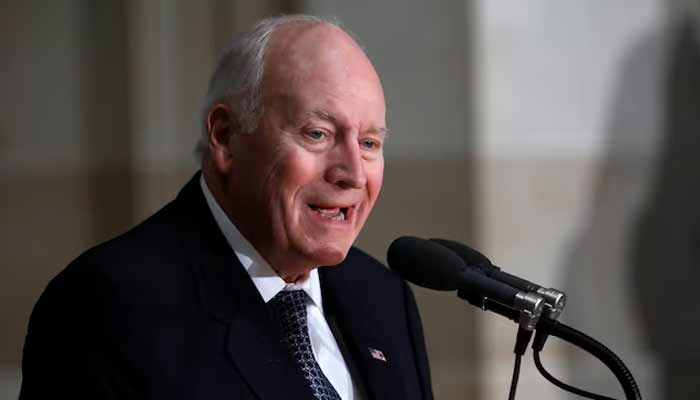
Dick Cheney, who was a major architect of the 2003 U.S. invasion of Iraq and widely regarded by presidential historians as one of the most influential vice presidents in American history, has died at age 84, his family announced on Tuesday. They stated that Cheney passed away Monday due to complications from pneumonia as well as heart and vascular conditions.
A former congressman from Wyoming and Secretary of Defense, Cheney already had a significant influence in Washington when Texas Governor George W. Bush selected him as his running mate in the 2000 presidential election, which Bush ultimately won. Serving as vice president from 2001 to 2009, Cheney was a staunch advocate for strengthening presidential power, feeling it had been diminishing since the Watergate scandal that led to Richard Nixon’s resignation. He also expanded the vice president’s office by establishing a prominent national security team that often operated as an independent power center within the administration.
Cheney was a leading supporter of the Iraq invasion in 2003 and was among the most vocal officials warning of Iraq’s supposed weapons of mass destruction—none of which were ever discovered. He frequently clashed with top advisors, including Secretaries of State Colin Powell and Condoleezza Rice. Cheney also defended the use of controversial interrogation techniques such as waterboarding and sleep deprivation, practices critics, including several U.S. and international human rights bodies, labeled as torture.
His daughter, Liz Cheney, served in the House of Representatives but lost her seat after opposing Donald Trump and voting to impeach him following the January 6, 2021 attack on the Capitol. Cheney expressed agreement with her stance, stating he would support Democratic candidate Kamala Harris in the 2024 election. He was outspoken about his opposition to Trump, declaring that “there has never been an individual who is a greater threat to our republic than Donald Trump” in his long-standing fight against the left.
Throughout his life, Cheney struggled with heart issues, suffering his first heart attack at age 37. He received a heart transplant in 2012.
On Iraq and Beyond
Cheney and Defense Secretary Donald Rumsfeld, longtime colleagues from the Nixon White House era, played pivotal roles in forging the push for the Iraq invasion. Leading up to the war, Cheney suggested links between Iraq and Al-Qaeda, as well as connections to the 9/11 attacks—a theory later discredited by a congressional commission. He predicted that U.S. forces would be welcomed as liberators and that the troop deployment would be brief, lasting weeks rather than years. Although no weapons of mass destruction were found, Cheney maintained later that the invasion was justified based on the intelligence available at the time and the goal of removing Saddam Hussein from power.
Prior to his vice presidency, Cheney had played a crucial role as Secretary of Defense during the 1990-91 Gulf War under President George H. W. Bush, urging a tough stand against Iraq after Saddam Hussein’s invasion of Kuwait. Interestingly, while he originally believed the U.S. should act alone and avoid an Iraq invasion at that time, his close ties to the Bush family eventually contributed to his selection as vice-presidential candidate in 2000.
His career in government and his ties to the oil industry—especially his tenure leading Halliburton from 1995 to 2000—generated significant criticism, especially regarding the firm’s lucrative role in Iraq war contracts. Upon returning to politics, Cheney’s influence was profound, shaping policy for nearly a decade.
Early Life
Born in Lincoln, Nebraska, on January 30, 1941, Cheney was the son of Marjorie Lorraine (née Dickey), a waitress turned softball player, and Richard Herbert Cheney, a federal employee. Both sides of his family were New Deal Democrats, and Cheney later noted this in his 2011 memoir, “In My Time: A Personal and Political Memoir.” He was the first Republican in his extended family since his Civil War-era great-grandfather who served on the Union side. Moving to Wyoming as a boy, Cheney attended Yale University but dropped out, describing himself as an average student.
 ChatGPT
 Perplexity
 Gemini AI
 Grok AI

